
Biography
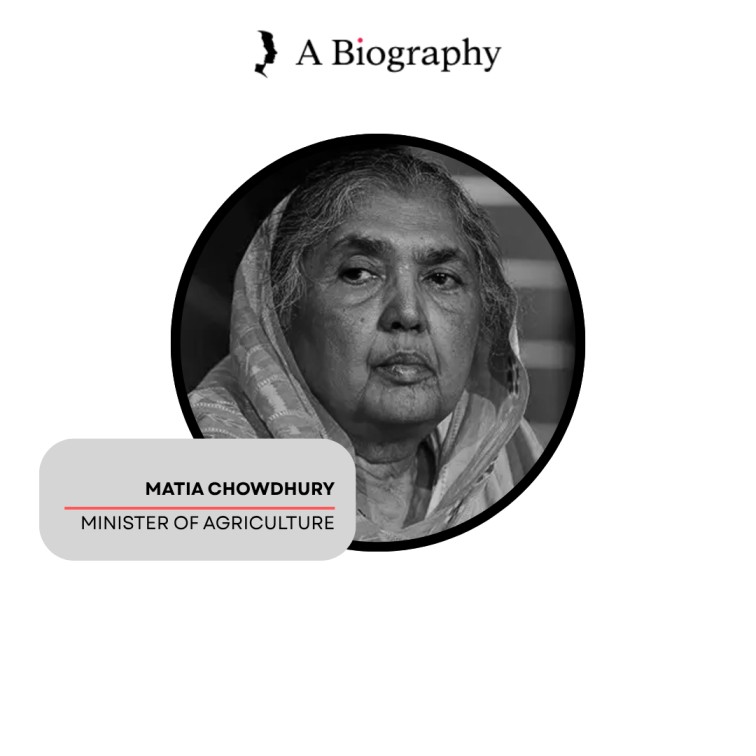
A Biography of Matia Chowdhury

Introduction
Scene 1: 1964, University of Dhaka Campus — Around 10 PM, a woman’s fiery speech before thousands of students
Thousands of students had gathered in front of Dhaka University’s Aparajita Bangla. It was a massive rally in support of the Six Points. On the stage, a young woman was speaking — fire in her eyes, thunder in her voice. When that woman in a sari finished her speech, the students erupted in chants — “Joy Bangla! Joy Matia Chowdhury!”
That very night, someone called out — “This girl is like a daughter of fire. Ogni Konna.”
The title stuck. For life, she became known as ‘Agnikonna’ — the Daughter of Fire.
From the remote village of Pirojpur to the high seat of the National Parliament — Matia Chowdhury’s life is a story of extraordinary ascent. The girl who once said, “Time has pulled me into the path of politics” — that girl became the beacon of hope for millions of farmers in Bengal. In the 1960s, when women were confined to the four walls of their homes, she sat in the seat of DUCS General Secretary. When she was called ‘Ogni Konna’ or ‘Daughter of Fire’, she used that fire to burn the foundations of Pakistani autocracy.
Matia Chowdhury (born June 30, 1942) was an experienced politician of Bangladesh, former Deputy Leader of Parliament, Presidium member of the Bangladesh Awami League, and former Agriculture Minister. She was at once a student leader, organizer of freedom fighters, democracy activist, and architect of development. Her political career spanning over six decades witnessed countless ups and downs. She was arrested countless times, sent to jail, threatened. But she never stopped. With each passing year, she became more fiery. She passed away on October 15, 2024 — but her fire still burns in the heart of every progressive woman.
In Bangladeshi politics, there is no second figure like Matia Chowdhury. She was simultaneously a leftist student leader, an organizer of the Liberation War, a pioneer of the movement for restoring democracy, a farmer-friendly minister, and a dedicated guardian of parliamentary democracy. In 2021, Bangla Academy awarded her an honorary fellowship for her role in Bangladesh’s Liberation War. It was a state recognition of her long struggle-filled life.
Now, in 28 steps, we will tell the story of Matia Chowdhury’s blazing life — where there is trial by fire, there is struggle, there is victory, and there is the immortal story of an extraordinary woman.
At a Glance — Life of Matia Chowdhury
| Information | Details |
| Full Name | Matia Chowdhury |
| Known As | Former Deputy Leader of Parliament, former Agriculture Minister, Awami League Presidium Member, former MP (Sherpur-2) |
| Political Codename | ‘Agnikonna’ (Ogni Konna / Daughter of Fire) |
| Birth | June 30, 1942 — Nazirpur village, Pirojpur district, Bengal Presidency, British India (present-day Bangladesh) |
| Death | October 15, 2024 — Evercare Hospital, Dhaka, Bangladesh |
| Age at Death | 82 years |
| Father | Mohiuddin Ahmed Chowdhury (police officer) |
| Spouse | Bazlur Rahman (died 2008) — editor of ‘Sangbad’ newspaper, journalist, freedom fighter |
| Education | Bachelor’s — University of Dhaka |
| Profession | Politician |
| Religion | Islam |
| Mother Tongue | Bengali |
| Student Politics Positions | Vice President & President of Eden Girls’ College Student Union; General Secretary of Dhaka University Central Students’ Union (DUCS) — first woman; President of East Pakistan Student Union |
| Political Party | National Awami Party (NAP) (1967-1979); Bangladesh Awami League (1979-2024) |
| Member of Parliament | Elected from Sherpur-2 constituency in 1991, 1996, 2008, 2014, 2018 — total 5 terms |
| Ministerial Tenure | 1996-2001 (Ministry of Agriculture & Food); 2009-2019 (again Ministry of Agriculture) |
| Deputy Leader of Parliament | From January 10, 2023 until death |
| Total Arrests | Countless — especially nearly two years in jail during anti-Ayub movement; arrested eight times during anti-Ershad movement |
| Notable Work | ‘Deaal Diye Ghera’ (book) |
| Awards & Honors | Bangla Academy Honorary Fellowship (2021); title ‘Agnikonna’ |
Early Life (1942–1960)
Flashback: 1942–1960, Pirojpur and Dhaka — First Light Against Darkness
June 30, 1942. The whole world was still trembling under the impact of World War II. A daughter was born in Nazirpur village of Pirojpur district, Bengal Presidency, British India. Her father was Mohiuddin Ahmed Chowdhury — a police officer who was transferred frequently due to his job. Despite his service, he was angry at the discrimination of Pakistani rulers against Bengalis. Her mother was a homemaker, gentle and calm.
Little Matia’s childhood was spent moving from place to place. Due to her father’s transferable job, she moved from Pirojpur to Barisal, to Khulna, and then in 1954 to a two-story house on North Road in Dhaka. In front of that house was a canal, and beyond the canal were footpaths and slums. She saw how the people of the slums suffered, how they spent their days in deprivation.
Matia remembered that time of her childhood in detail. She once said, “I grew up in a two-story house on North Road in Dhaka.”
At the time of the 1947 partition, Matia was only five years old. As a small girl, she witnessed Hindu-Muslim riots, blood on the streets, and thousands of people fleeing their homes. She didn’t understand then that the country was being divided, that people’s blood was being shed. But later in life, she grew up under an unstable Pakistani rule. Bengalis were then deprived of their rights. Oppression of minority activists, attempts to snatch away language rights — everything influenced her. Despite her father’s police service, she understood that the Pakistani state was the enemy of Bengalis.
From childhood, she was energetic and outspoken. As the eldest child in the family, she learned to take responsibility from a young age. Her father wanted his daughter to study and grow up. He never considered his daughter inferior to a son. This environment shaped Matia into a strong woman.
After completing primary school in Pirojpur, she enrolled at Shahid Suhrawardy College in Dhaka. From there, her journey in politics began. She saw how her father, an anti-British activist, was also a government employee. That duality made her think.
Incident — 1954: After the United Front’s landslide victory, a case was filed in the High Court. Matia would chant ‘Joy Bangla’ slogans with school children. One day, police came to question her school’s headmaster. Matia was not afraid — she ran and hugged the teacher.
From this time, she began to realize — politics was in her blood. And she would speak the language of the streets, never the politics of opportunism.
Education (1960–1965)
Scene 3: Eden Women’s College, 1963 — A Woman’s First Victory
Matia Chowdhury’s education began at primary school in Pirojpur. Later, she enrolled at Eden Women’s College in Dhaka, passing her HSC from there. The classrooms of Eden College were not just places of study; they were arenas for awakening political consciousness among women. During this time, she became involved in Student Union politics.
While at Eden College, she was elected Vice President of the Student Union. It was her first elected position. Later, she was elected President. This was the first recognition of her leadership among female students. From this time, she became associated with leftist student politics.
1964-65 — First Woman General Secretary of DUCS: Writing Her Name in History
While studying at Dhaka University, Matia made her commanding presence felt. She regularly studied political science and economics in the university classrooms, but outside the campus, she was a pioneer of student movements.
In the 1964-65 term, she was elected General Secretary of the Dhaka University Central Students’ Union (DUCS). It was a groundbreaking event — she was the first woman General Secretary in DUCS history. In that male-dominated society, on that male-dominated university campus, a woman student leader being elected to such an important position was an extraordinary achievement.
Her fiery speeches, extraordinary organizational skills, and dedicated work made her immensely popular among students. In 1965-66, she was elected President of the then East Pakistan Student Union. It was a bold step in a male-dominated society, which earned her the title ‘Agnikonna’ (Daughter of Fire).
From this time, she became known as ‘Agnikonna’ or ‘Ogni Konna’. Some say Bangabandhu Sheikh Mujibur Rahman himself called her ‘Agnikonna’. Others believe her fiery speeches and immense audacity earned her this title.
Whatever the case, the title stuck. Matia Chowdhury became ‘Agnikonna’ — the Daughter of Fire, who erupts against injustice, burns herself, but burns injustice to ashes.
Struggles & Adversities (1962–1990)
Scene 4: 1967, Dhaka Central Jail — Bangabandhu’s Blessing, the Turning Point of a Woman’s Life
The most important memory of Matia Chowdhury’s life — June 7, 1967.
A hartal was underway across Bengal in support of the Six Points. Matia Chowdhury took to the streets. Suddenly, a police baton charge. Then arrest. The Pakistani police took her to Dhaka Central Jail.
While crossing the jail gate, she saw that Bangabandhu Sheikh Mujibur Rahman was also being brought in under arrest. The two leaders — one woman, one man — together. Matia touched Bangabandhu’s hand and greeted him. Bangabandhu looked at her, placed his hand on her head, and blessed her. Then he said:
“Don’t be afraid, Matia.”
Matia later said, “Those words became the anthem of my entire life. Whenever I see darkness, whenever I see danger, I remember those words. And I stand back up.”
That blessing gave her strength in every crisis.
She Was in Jail for Nearly Two Years
Between 1967 and 1969, Matia repeatedly organized anti-Ayub movements. For this, she had to remain in jail for nearly two years. The dark cells of the prison never frightened her. Rather, from inside the jail, she continued to call for the movement. She was released from jail during the 1969 Mass Uprising.
Joining NAP (1967) and Rising to the Peak of Leftist Politics
After her release, she joined the National Awami Party (NAP) led by Maulana Abdul Hamid Khan Bhashani and Professor Mozaffar Ahmed. It was a strong platform for leftist politics. There, she served as a party organizer. NAP was then one of the strongest political forces in East Pakistan — Bhashani’s peasant movement, Mozaffar Ahmed’s communist ideals — everything sharpened Matia further.
1969 Mass Uprising and Fall of Ayub Khan
Matia actively participated in the 1969 Mass Uprising. After being released from jail, she intensified the movement further. On March 25, 1969, Ayub Khan was forced to resign. It was Matia’s first major victory.
Organizer of the Liberation War (1971) — The Unknown Commander of Guerrilla Warfare
During the Liberation War, Matia’s role was immense. She served as an organizer of the joint guerrilla force formed by NAP, the Communist Party, and the Student Union. She organized freedom fighters, collected funds and supplies, and tended to wounded freedom fighters. Throughout the war, she continued her political activities, evading the eyes of Pakistani occupiers and their collaborators, the Al-Badr forces. After the war ended, she got an independent Bangladesh.
In 1971, she was elected Organizing Secretary of the Awami League. This was a significant milestone in her political life.
Joining Awami League (1979) — From Leftism to the Mainstream
In 1979, Matia Chowdhury left NAP and joined the Awami League. This was an important turning point in her political life. The Awami League was the largest platform for Bengali nationalism, from where she could do even more for the country. By 1986, she had become the party’s Agriculture Secretary and a member of its policy-making council.
Anti-Ziaur Rahman and Anti-Ershad Movements (1976–1990) — One Imprisonment After Another
After independence, the Awami League lost power in 1975. When Bangabandhu and his family were assassinated, Matia erupted in protest. From 1976 to 1981, she protested against Ziaur Rahman’s military rule and was arrested multiple times.
Her biggest struggle was during the anti-Ershad movement from 1983 to 1990. Matia was the leading woman leader of the anti-Ershad movement. During this time, she was arrested eight times.
Matia later said, “At that time, I thought that every time they put me in jail, I would return. Because I have the right to stand up against injustice.”
Even inside jail, she kept leaders and workers inspired. She would write guidelines for the struggle and smuggle them out. Those papers said — “We will return. Ershad will go. Democracy will come.”
1990 Mass Uprising — The Final Fall of Autocracy
The 1990 Mass Uprising brought down Ershad’s government. Matia Chowdhury played a pioneering role in this movement. On March 5, 1991, she was elected to parliament for the first time from the Sherpur-2 constituency. It was a new chapter in her journey of democratic politics.
Love
Scene 5: 1964, A Press Conference — When Two Revolutionaries First Met
The most important person in Matia Chowdhury’s personal life was her husband, Bazlur Rahman.
Bazlur Rahman was the editor of ‘Sangbad’, one of the oldest newspapers in Bengali and English. He was a renowned journalist, freedom fighter, and a senior leader of the Communist Party.
1964 Introduction — Camera Flash and First Sight
Matia and Bazlur Rahman first met in 1964. Matia was then the General Secretary of DUCS, a name talked about in the media. Bazlur Rahman was working as a representative of ‘Sangbad’ newspaper. They met at a press conference.
Bazlur Rahman was impressed by Matia’s fiery speech. Then, gradually, their meetings increased. They discussed politics, socialism, imperialism, and the liberation of Bengalis. Eventually, liking turned into love.
Marriage (1964) — Union of Two Revolutionaries
They married in 1964. The marriage of Matia and Bazlur Rahman was a political union. From the time of the liberation struggle, they fought together and went to jail together. Their married life was a blend of politics and journalism. Bazlur Rahman was Matia’s biggest supporter.
Once, when Matia was going to jail, Bazlur Rahman wrote to her, “Wherever you are, my support will be with you. Keep fighting.”
Matia later said, “Bazlur is not just my husband; he is my political companion, my friend, my greatest strength.”
February 26, 2008 — Death of Bazlur Rahman, the Biggest Personal Tragedy of Her Life
On February 26, 2008, the biggest personal tragedy of Matia’s life occurred. Bazlur Rahman passed away. Matia Chowdhury remained a widow from then on.
Despite immense personal grief, Matia did not stop. Within a few months of losing her husband, she contested the election and won. She never allowed herself to be alone — her ideals, her party, her goals filled this void.
Matia later said, “Without Bazlur, I am quite alone. But my ideals, my party, my goals — these have filled this emptiness.”
Personal Life
As tough a politician as Matia Chowdhury was perceived to be, she was equally simple, cheerful, and sincere in her personal life. Although her tough speeches in parliament earned her the title ‘Daughter of Fire’, she stood closely beside ordinary people. She was an accepted personality among the common farmers, women, and youth of rural Bengal.
She was vocal for women’s rights. She encouraged women to come forward in politics. She did not hesitate to say — “If women do not come forward, society will never change.” Through her own work, she showed women how to achieve success despite being obstructed.
Not only politics, she regularly wrote columns in the media. She wrote about agriculture, women’s empowerment, and political change. She had a book titled ‘Deaal Diye Ghera’, which reflects her thoughts and experiences.
She never smoked or drank in her life. Her eating habits were also very simple — rice, lentils, vegetables, and fish. She was simple in her attire and did not like luxury.
Her daily routine was highly disciplined — she would wake up at 5 AM, pray, read newspapers, have breakfast, and go to parliament or office. Light lunch in the afternoon, public relations in the evening, and parliamentary work again at night. She would sleep by 11 PM.
She never used the office car for personal work. Outside the office, she rode ordinary rickshaws or CNGs. This restraint made her even more popular among ordinary people.
Future Plans & Vision
Scene 6: 2023, Parliament Building — An Elderly Woman Whose Dreams Are Still Unfinished
When she assumed the responsibility of Deputy Leader of Parliament in 2023, she was 81 years old. She was not bowed by age. Rather, she wanted to work with even more vigor. She had several plans:
First, implementation of new projects of the Ministry of Agriculture. She wanted to further improve salt-tolerant and drought-tolerant rice varieties and deliver those varieties to farmers.
Second, publication of a second volume of ‘Deaal Diye Ghera’, where she wanted to write about her political experiences after 2019 and parliamentary events.
Third, strengthening women’s leadership in the Awami League Presidium. She wanted more women to get places in the party’s highest policy-making forum.
Fourth, publication of her autobiography. She wanted to record everything from Bangabandhu’s blessing at the jail gate to the Liberation War, the anti-autocracy movement, and her experience as Agriculture Minister.
But before she fell ill in October 2024, she could not implement these plans. When her health broke down, her first question to doctors was — “When can I return to work?”
The doctors could not answer. Because Matia Chowdhury was already a terminally ill patient.
On her hospital bed, she told a nurse, “I have unfinished work. I don’t want to leave the country.”
The nurse said tearfully, “Apa, you will get well.” Matia Chowdhury tried to smile and said, “No, I may be leaving. But my work will go on.”
Her last words were to her younger sister — “Take care of the party. And remember the farmers.”
That was the final instruction of the ‘Daughter of Fire’.
Career (1963–2024)
Scene 7: June 23, 1996 — A Woman’s Oath at Bangabhaban
Matia Chowdhury’s career spans from student politics in the 1960s to becoming Deputy Leader of Parliament in 2023. It is a unique document of six decades of experience and achievement.
9.1 The Fiery Trial of Student Politics (1963–1966) — Birth of the Title ‘Agnikonna’
Matia Chowdhury entered politics while studying at Eden Women’s College. First, she became involved with the Student Union. Step by step, she advanced:
- 1963 — Elected Vice President of Eden Girls’ College Student Union
- 1964-65 — Elected General Secretary of Dhaka University Central Students’ Union (DUCS) — the first woman in DUCS history
- 1965-66 — Elected President of the then East Pakistan Student Union
Her extraordinary leadership qualities in student politics, her fiery speeches, and her tough attitude earned her the title ‘Agnikonna’ in South Asia. This title remained attached to her identity for life.
9.2 Leftist Politics and NAP (National Awami Party) (1967–1979)
Initially, Matia Chowdhury joined the leftist National Awami Party (NAP), led by Maulana Abdul Hamid Khan Bhashani and Professor Mozaffar Ahmed. Matia served as a party organizer. When Bangladesh became independent in 1971, Matia continued as NAP’s Organizing Secretary.
9.3 Joining Awami League (1979) — From Leftism to the Mainstream
In 1979, Matia Chowdhury left NAP and joined the Awami League. This was an important turning point in her political life. In 1986, she became the party’s Agriculture Secretary and a member of its policy-making council. She had been serving as a Presidium member of the Awami League since the 1980s.
9.4 Role as Member of Parliament (1991–2024) — Five-Term Elected Representative
On March 5, 1991, Matia Chowdhury was elected to parliament for the first time from the Sherpur-2 (Nakla-Nalitabari) constituency. She was re-elected in 1996, 2008, 2014, and 2018 — serving as an MP for a total of five terms.
9.5 First Term as Agriculture Minister (1996–2001) — The Beginning of a Green Revolution in Agriculture
In 1996, she was re-elected as an MP for the second time. Just 11 days later, on June 23, 1996, she was included in the cabinet and given charge of the Ministries of Agriculture, Food, and Disaster Management & Relief.
Notable achievements during her first tenure included:
- Starting farmer incentives to achieve food self-sufficiency
- Playing a role in agricultural trade and diversification of agricultural products
9.6 Second Term as Agriculture Minister (2009–2019) — Groundbreaking Agricultural Research
In the December 29, 2008 election, Matia was elected MP for the third time. On January 6, 2009, she was again included in the cabinet and given charge of the Ministry of Agriculture. When the Awami League came to power in 2014 and 2018, she retained this responsibility. From 2009 to 2019, she was the head of the Ministry of Agriculture for nearly a decade.
Her major contributions during this time included:
Position on Biotechnology and GM Crops: Matia Chowdhury was in favor of Bangladesh’s liberal position on adopting genetically modified organism (GMO) technology. On January 8, 2010, she signed an agreement with Indian Agriculture Minister Sharad Pawar, under which both countries would exchange technology and scientists and enhance capacity for developing GM and hybrid crop varieties. She emphasized, “The Bangladesh government will not be conservative if GM crops prove beneficial for the country.”
Support for Golden Rice: On March 6, 2018, Matia Chowdhury attended a stakeholder workshop in Dhaka as chief guest and expressed her support for Golden Rice. She said, “Bangladesh will go forward with Golden Rice,” and acknowledged that the positive impact of biotech crops could help Bangladesh achieve the zero-hunger sustainable development goal by 2030.
Salt-tolerant and Flood-tolerant Rice Varieties: Under Matia’s leadership, the Bangladesh Rice Research Institute (BRRI) succeeded in developing salt-tolerant and flood-tolerant rice varieties. In a statement given in July 2010, she informed that BRRI had so far developed 51 new varieties and four hybrid varieties, which were being cultivated on 70 percent of the land and had played a role in achieving food self-sufficiency.
Emphasis on Conservation Agriculture: She advised farmers to use organic pesticides and sustainable farming practices to meet the challenges of climate change.
9.7 Deputy Leader of Parliament (2023–2024) — The Peak of Recognition
On September 11, 2022, former Deputy Leader of Parliament Syeda Sajeda Chowdhury passed away. On January 10, 2023, at a meeting of the Awami League Parliamentary Party, Matia Chowdhury’s name was proposed for the post of Deputy Leader of Parliament. With Prime Minister Sheikh Hasina’s consent, Matia Chowdhury was elected Deputy Leader of Parliament. At 81 years old, she became a unique example of staying active without retiring.
Travels & Diverse Experiences
As a minister, Matia Chowdhury traveled to many countries for agricultural research and development:
- India: On January 8, 2010, after signing a bilateral agreement with Indian Agriculture Minister Sharad Pawar in Dhaka, agricultural technology exchange programs began between the two countries.
- International Forums: She represented Bangladesh at SAARC and other international agricultural forums.
- Agricultural Research Centers: She participated in various workshops organized by the International Rice Research Institute (IRRI) in Dhaka.
- Japan and Philippines: She attended agricultural technology and research forums.
In March 2016, she visited the Rice Research Institute and the Department of Agricultural Extension. During her travels, she never stayed in extravagant arrangements; rather, she lived very simply. Once, when a five-star hotel stay was arranged for a conference in Delhi, she refused and said, “I will stay in a regular hotel. Government money should be saved.”
Failures & Teachable Moments
Despite failures in Matia Chowdhury’s long political career, they could not disturb her path.
Failure 1: Being in the Opposition During a Long Parliamentary Term (2001–2008)
From 2001 to 2008, she was in the opposition. During that time, she could not fully voice her opinions in law-making. But without compromising, she remained in a strong position in parliament. As leader of the opposition in parliament, she criticized the budget, saying, “This budget does not consider ordinary people. It is a budget for the rich.”
Failure 2: Slow Progress on Women’s Representation Within the Party
Even though she wanted it, changing the patriarchal mindset in party decision-making took time. Although she criticized repeatedly, real change came slowly. Once at a party meeting, she said directly, “The party cannot progress by ignoring women leaders.”
Failure 3: Facing Criticism over GMO Technology
Some environmental organizations criticized her support for GMOs. But she firmly took a position in favor of adopting GMOs in a science-based manner.
Teachable Moment: She realized that desired change does not come without long struggle. So the struggle must not stop.
Source of Inspiration
Matia Chowdhury always regarded Bangabandhu Sheikh Mujibur Rahman as her political mentor. That meeting at the jail gate in 1967 was the turning point of her life. Bangabandhu’s words “Don’t be afraid” inspired her in every time of danger. She would say, “I remember those words in every dark night. And I am not afraid.”
Sheikh Hasina was her second inspiration. She stood by Hasina during the party’s difficult times, and Hasina also trusted her. The blend of Hasina’s leadership and Matia’s courage made the Awami League combative. Once Hasina told her, “Apa, you are my confidence.”
Other inspirations included her father Mohiuddin Ahmed Chowdhury, who, despite being a police officer, maintained sympathy for the anti-British movement; Maulana Bhashani, whose peasant movement led her toward leftist politics; and her husband Bazlur Rahman, who was her lifelong companion and critic.
Influences and Inspirations
Several people played special roles in shaping Matia Chowdhury’s thinking:
- Bangabandhu Sheikh Mujibur Rahman: Her political mentor and primary inspiration. That meeting at the jail gate and the blessing “Don’t be afraid” became her life’s companion.
- Sheikh Hasina: Party leader and close colleague. Matia herself repeatedly spoke of her loyalty and trust in Sheikh Hasina.
- Syeda Sajeda Chowdhury: As a senior woman leader, she guided Matia after joining the Awami League.
- Maulana Bhashani and Professor Mozaffar Ahmed: Showed her the path of early leftist politics.
- Bazlur Rahman: Husband and political companion, who always encouraged her to fight.
In an interview, she once said, “I am not a shadow of anyone, but I have taken light from everyone. Bangabandhu’s blessing, Sheikh Hasina’s leadership, Bhashani’s ideals — everything combined makes me Matia Chowdhury.”
Philosophical Views and Beliefs
Matia Chowdhury was a woman who believed in secular, democratic, and socialist ideals. She advocated for a non-communal mindset in politics. She was vocal against any form of religious extremism and communalism. She once said, “Religion is not politics. Religion is personal belief, politics is national development. These two should not be mixed.”
She believed politics is for economic liberation. Women’s empowerment was a major part of her belief. She thought that as long as half of society remains behind, true development is impossible. She often said, “When women are educated, the whole nation is educated. When women are developed, the whole nation is developed.”
On questions of technology and development, she was liberal. She opposed conservatism in adopting GMO technology and was vocal for science-based agriculture. She said, “One must not be afraid of science. Science must be utilized to advance the country.”
She valued honesty above all. She never allowed herself to compromise during her long political path. She said, “Staying on the honest path is difficult, but that difficult path is the only path.”
Unique Traits
- Fearless and Straightforward: She spoke tough words everywhere from parliament to the field without any filter. Even after crossing 80, she was not timid. Once, when an opposition leader made a sarcastic remark targeting her, she immediately stood up and said, “Before criticizing me, look at your own deeds.”
- Sincere and Simple: Outside parliament, she was extremely simple. She could easily mingle with ordinary people. She always had a smile on her face. She never treated anyone rudely.
- Professional Honesty: In her long political career, she was never accused of corruption. This achievement is truly remarkable. Once, when a businessman tried to bribe her, she threw him out and said, “Come to me after cleaning up your character.”
- Command over Language: She was comfortable in both Bengali and English. Even when giving English speeches in parliament, she was fluent. Many foreign diplomats were impressed by her speeches.
- Fighting Mentality: From her student life until her last days, she stood up against injustice. Jail, torture, threats — nothing could stop her. Once a journalist asked her, “You have been to jail so many times; were you never afraid?” She laughed and said, “I did feel fear, but I have conquered that fear.”
- Selfless and Dedicated: She never wanted anything for herself. She always prioritized the country and the party. After her ministership ended in 2019, she did not demand any high position until she became Deputy Leader of Parliament. An example of patience and dedication.
Contributions, Awards & Achievements
Major Contributions:
- Pioneering role in anti-autocracy movements (Ayub, Zia, Ershad)
- One of the key organizers of the great Liberation War of 1971 — played a role in forming the joint guerrilla force
- Incomparable role in modernizing the Ministry of Agriculture and making it research-based
- Opening the path for adoption of GMO technology and biotechnology
- Incomparable role in women’s empowerment; role model for young women
- Architect of Bangladesh’s food self-sufficiency
Awards and Recognition:
- Title ‘Agnikonna’ (Daughter of Fire)
- Honor of being Bangladesh’s first woman DUCS General Secretary
- Elected MP for a total of 5 terms
- Over two decades as Agriculture Minister — a rare occurrence in Bangladeshi politics
- Bangla Academy Honorary Fellowship (2021) — in recognition of her role in the Liberation War
- Elected Deputy Leader of Parliament (2023) — at age 81
- Although she did not receive a posthumous state medal, the people’s love gave her the highest award. Her popularity was immense — from the farmers of Sherpur to the intellectuals of Dhaka, everyone called her ‘Matia Apa’.
Controversies
Matia Chowdhury was not a very controversial figure. Her long political career was almost controversy-free. While opponents criticized her political stance, they could not comment on her personal honesty or character. This is a rare example in Bangladeshi politics.
Question of Party Change (from NAP to Awami League, 1979): Some questioned why she left a leftist party to join the Awami League. Matia’s answer: “The Awami League was then the largest platform for Bengali nationalism. From there, I could do more for the country. By changing parties, I did not become a turncoat; rather, I came to work for the larger national interest.”
Position on GMO Technology (2010-2018): There is debate among some agricultural experts and environmental organizations in the country about Matia Chowdhury’s support for GMO technology. They feared GM crops could be harmful to the environment. But she always took a position in favor of adopting GM crops in a scientific and safe manner. She said, “We are not adopting any technology blindly. We are researching, testing, then deciding. One must not be afraid of science.”
Criticism over the 2016 Budget (Speaking Out Against the Finance Minister): In the 2016 budget, Matia Chowdhury strongly criticized the proposal to reduce savings certificate interest rates. Some said that as a cabinet member, she publicly criticized the finance minister, hurting party unity. But Matia later explained, “I spoke for the ordinary people of the country, not for the party. I do not hesitate to speak the right words. The budget should not be imposed on ordinary people.”
These controversies never took an extreme form. Matia Chowdhury always gave restrained and logical answers, never personally attacking anyone.
Contemporary Opinions and Interviews
President Abdul Hamid (Condolence message, 2024): “Matia Chowdhury was a bright star in Bangladesh’s politics. Her leadership and sacrifice will never be forgotten. She was a pioneer of the anti-autocracy movement. The nation has lost a mother in her death.”
Prime Minister Sheikh Hasina (Condolence message, 2024): “Matia Chowdhury was my closest comrade. During the Awami League’s difficult times, she was the backbone of the party. As Bangabandhu called her ‘Agnikonna’, truly she was the daughter of fire. Her void will never be filled.”
Obaidul Quader (Awami League General Secretary, 2023): “Matia Chowdhury is one of the most vibrant forces in the Awami League Presidium. Her speeches in parliament are exemplary to all. She is an inspiration for women.”
Opinion of a farmer from Sherpur (2018): “Matia Apa is like a mother to us. She understands the farmers. During her time, we can run our households by cultivating rice. When she comes, everyone rushes in droves. She is truly a farmer-friendly minister.”
Myths and Misconceptions
| Myth | Reality |
| She got the title ‘Agnikonna’ only for her fiery speeches | She earned this title after being elected DUCS General Secretary and serving as President of East Pakistan Student Union. Bangabandhu himself called her by this name. |
| She was in the Awami League her entire life | She first joined the National Awami Party (NAP). She joined the Awami League in 1979. |
| Matia Chowdhury was only Agriculture Minister | She was in charge of Agriculture, Food, and Disaster Management & Relief — multiple responsibilities. |
| She never went to jail | She was in jail for nearly two years during the anti-Ayub movement and was arrested eight times during the anti-Ershad movement. Total imprisonment time was about three years. |
| She was a blind supporter of GMO technology | She supported GMO adoption in a scientific and safe manner and, on the Prime Minister’s instruction, urged caution. She said, “We will decide after research.” |
| She only did politics, not family life | She was married and had a happy family life with her husband Bazlur Rahman. Though they had no children, she loved her siblings’ children. |
Quotes and Thoughts
A few incomparable quotes from Matia Chowdhury’s life:
- “Time has pulled me into the path of politics” — when asked why she entered politics.
- “The Bangladesh government will not be conservative if GM crops prove beneficial for the country” — during the signing of the agriculture agreement with India in 2010.
- “Bangladesh will go forward with Golden Rice” — stating her position in favor of Golden Rice in 2018.
- “Due to the adoption of GMO technology, the country’s agriculture sector has improved in recent years” — at a science and technology seminar in 2026.
- “I always believe in speaking the truth. I have never pleased anyone by lying” — a reflection of her philosophy of life.
- “Don’t be afraid — these two words from Bangabandhu have been my life’s companion” — in a reminiscence in 2015.
- “I have spoken for the ordinary people of the country. I do not hesitate to speak the right words” — in response to criticism over the budget in 2016.
- “If women do not come forward, society will never change” — speech at a women’s rally, 2010.
- “One must not be afraid of science. Science must be utilized to advance the country” — in response to debate over GMOs, 2018.
- “I have unfinished work. I don’t want to leave the country” — among her last words on the hospital bed, 2024.
Message for the Present Generation
The core lesson of Matia Chowdhury’s life is to remain steadfast in one’s values and dedicated service. She left messages for the youth until her last days. In February 2024 (eight months before her death), she gave a speech to the younger generation at a student rally at the University of Dhaka. Excerpts:
“Today’s younger generation, I want to tell you — there is nothing to fear. As Bangabandhu told me ‘Don’t be afraid’, I also tell you, do not be afraid. When you see injustice, protest. Stand up against injustice. You may go to jail, you may die, but you cannot accept injustice.
Women, you come forward. Fight shoulder to shoulder with men. Do politics, work for the country. Changing society is not easy, but it’s not impossible. When I was elected DUCS General Secretary, no one thought a woman could come to such a high position. But I did. I proved it. You can too.
Remember the farmers. Agriculture is important for the country’s food security. Use science and technology to make agriculture more modern. But at the same time, protect the smiles of the farmers.
I will tell you one more thing — be honest. I have done politics for over fifty years; no one has been able to accuse me of corruption. That is my greatest victory. You try for that too.
I may not have many days left. But remember my words. ‘Agnikonna’ will burn forever — within you, in your deeds.”
This message remains a guide for the younger generation today.
Death and Legacy (October 15, 2024)
Scene 8: October 15, 2024, Evercare Hospital, Dhaka — The Final Breath
October 15, 2024. Afternoon. Matia Chowdhury lies on a bed at Evercare Hospital in Dhaka. Age 82. The fire is still in her eyes, but her body no longer responds. While serving as Deputy Leader of Parliament, she was active. But old age and illness finally subdued her. For several months, she had been suffering from various age-related complications.
At 4:25 PM (according to news reports), she closed her eyes. Hospital General Manager Arif Mahmud confirmed her death to the media.
She left behind her countless admirers, political colleagues, and a vast political legacy.
As the news of her death spread, a pall of mourning fell over the political arena. The President, Prime Minister, ministers, and opposition leaders expressed their condolences. The Awami League announced three days of mourning.
Burial (October 16, 2024) — Questions about state honors, but no doubt about people’s love
The next day, on October 16, 2024, she was buried at the Martyred Intellectuals Graveyard in Mirpur, Dhaka. Awami League leaders and workers, friends, family, and countless admirers attended her funeral.
It is worth noting that there was some negligence in providing a state guard of honor at her funeral. The Officer-in-Charge of Darus Salam police station, Rakib-ul-Hossain, said, “We gave a guard of honor to an individual. But since no one contacted us, no special arrangement could be made.”
However, there was no shortage of people’s love. Thousands of people flocked to see the ‘Agnikonna’ for the last time. Tears in their eyes, flowers in their hands — the melody of bidding farewell to Matia Chowdhury.
Successors and Lasting Impact
Matia Chowdhury’s legacy is immense. She has been identified as a unique woman in Bangladeshi politics.
Legacy in Student Politics: As the first woman to hold the position of DUCS General Secretary, she made history. The title ‘Agnikonna’ will forever remain with her. Following the path she showed, many other women student leaders have since held important positions like DUCS.
Legacy in the Liberation War: Her role in 1971 as an organizer of the joint guerrilla force will remain forever undimmed in the pages of history. This initiative of hers is an important chapter in the history of the Liberation War.
Anti-autocracy Legacy: The way she led the movements against Zia and Ershad — repeatedly arrested, imprisoned — will remain an example for future generations. Her tough stance played an important role in restoring democracy in Bangladesh.
Legacy in Agriculture: Her contribution to modernizing and making the Ministry of Agriculture research-based is undeniable. Her leadership is evident in everything — GMO technology, Golden Rice, salt-tolerant and flood-tolerant rice varieties. Agricultural scientists believe that under Matia Chowdhury’s leadership, Bangladesh brought a revolutionary change in agricultural research.
Legacy in Women’s Empowerment: She herself is an example. She created her place in male-dominated politics. Following her path, many more women have entered politics. Her role in increasing women’s seats in Bangladesh’s parliament and enhancing the importance of women leaders is memorable.
Writings: Her book ‘Deaal Diye Ghera’ reflects her thoughts and experiences. It will be a companion for the younger generation.
Unknown Facts
- She joined the Student Union at only 14 years old. That is, in her adolescence, she sowed the seeds of democracy and secularism.
- When elected General Secretary of DUCS in 1964-65, she was only 22-23 years old. It was an extraordinary achievement in the male-dominated Pakistani society.
- She repeatedly recounted the memory of seeing Bangabandhu at the jail gate: “That day, he blessed me by placing his hand on my head. That blessing was my life’s companion.”
- In 1971, she played a role in forming a joint guerrilla force combining NAP, the Communist Party, and the Student Union — this was a historic convergence of leftist politics.
- During the 2009 BDR mutiny, she was with Sheikh Hasina when nearly 50 army officers were being killed. Even in that turbulent environment, she was fearless. Later she said, “That night we saw death. But seeing Sheikh Hasina’s courage, I also gained courage.”
- When she was given the Deputy Leader position in 2023, she was 81 years old. Being active without retiring at 80 is a sign of her strength.
- She never smoked or drank in her life. Her eating habits were also very simple — rice, lentils, vegetables, and fish. She ate little meat. She was simple in attire.
- In 2021, Bangla Academy awarded her an honorary fellowship — a state recognition of her long struggle-filled life. She became emotional receiving this honor. She said, “By giving me this honor, Bangla Academy has valued my journey with the Bengali language and culture.”
- She was so vocal about GMO technology that in 2010 she directly signed an agricultural technology exchange agreement with India. It was a groundbreaking step for Bangladesh’s agricultural research.
- She worked directly for the commercial launch of Golden Rice in Bangladesh and in 2018 attended a workshop as chief guest to state her position in its favor. She said, “This vitamin-A enriched rice can save millions of children from malnutrition.”
Timeline (1942–2024)
| Year | Date | Event |
| 1942 | June 30 | Born in Nazirpur village, Pirojpur |
| 1962 | — | Became involved in student politics; participated in Education Commission movement |
| 1963 | — | Elected Vice President of Eden Girls’ College Student Union |
| 1964 | — | Married Bazlur Rahman |
| 1964-65 | — | Elected DUCS General Secretary (first woman) |
| 1965-66 | — | Elected President of East Pakistan Student Union |
| 1966 | — | Active participation in Six-Point movement |
| 1967 | June 7 | Met Bangabandhu at jail gate; “Don’t be afraid” blessing |
| 1967 | — | Joined NAP |
| 1967-69 | — | Organized anti-Ayub movement; nearly two years in jail |
| 1971 | — | Organizer of joint guerrilla force; elected Awami League Organizing Secretary |
| 1979 | — | Left NAP and joined Awami League |
| 1983-90 | — | Pioneering role in anti-Ershad movement; arrested eight times |
| 1986 | — | Became Awami League’s Agriculture Secretary and member of policy-making council |
| 1991 | March 5 | First elected MP (Sherpur-2) |
| 1996 | — | Second term MP |
| 1996 | June 23 | Sworn in as Agriculture Minister (first term) |
| 2008 | — | Third term MP |
| 2009 | January 6 | Again sworn in as Agriculture Minister (second term) |
| 2010 | January 8 | Signed agricultural-biotechnology exchange agreement with India |
| 2014 | — | Fourth term MP; retained as Agriculture Minister |
| 2018 | March 6 | Chief guest at Dhaka workshop in favor of Golden Rice |
| 2018 | — | Fifth term MP; retained as Agriculture Minister |
| 2019 | January 7 | End of ministerial term; served as Presidium member |
| 2021 | — | Received Bangla Academy Honorary Fellowship |
| 2023 | January 10 | Elected Deputy Leader of Parliament |
| 2024 | October 15 | Died at Evercare Hospital (age 82) |
| 2024 | October 16 | Buried at Martyred Intellectuals Graveyard |
Conclusion
From the very beginning, Matia Chowdhury was a fiery woman. After being elected General Secretary of DUCS in student politics in the 1960s, she earned the title ‘Agnikonna’. Since then, the fire never died. Against Ershad, Zia, Ayub — all autocrats — she protested, went to jail, never stopped.
In charge of the Ministry of Agriculture, she modernized Bangladesh’s agriculture and moved it toward food security. Organic pesticides, conservation farming, GMO technology, Golden Rice, salt-tolerant and flood-tolerant rice varieties — all these initiatives were implemented by her hand.
For over 50 years, she was a symbol of Awami League’s development. She took Bangabandhu’s words “Don’t be afraid” as her companion and never looked back. From being an organizer of the joint guerrilla force in 1971 to Deputy Leader of Parliament in 2023 — she fought continuously in various fields.
She was like fire — which burns and destroys, but spreads light. Matia Chowdhury is that daughter of fire who never extinguished, who spread light — and still spreads light, through her deeds and ideals.
Matia Chowdhury will forever be recognized in Bangladesh’s history as ‘Agnikonna’ in politics, ‘honest leader’, ‘farmer-friendly minister’, and ‘role model for women leaders’. Her passing truly marked the end of an era. But the path she showed will remain a guide for Bangladesh’s women and politics forever.
The thriller ends. The Daughter of Fire is eternally immortal.
References
- ISAAA.org — “Bangladesh-India Agreement on Agri-biotech Exchange” (January 15, 2010)
- bdnews24.com — “Awami League stalwart Matia Chowdhury dies at 82” (October 16, 2024)
- New Age BD — “Government liberal about GMO technology, says Matia” (April 4, 2026)
- International Rice Research Institute (IRRI) — “Agriculture Minister, key stakeholders praise progress of Golden Rice in Bangladesh” (March 13, 2018)
- bdnews24.com — “Awami League veteran Matia Chowdhury laid to rest at Martyred Intellectuals Graveyard” (October 17, 2024)
- The Business Standard — “No benefit of keeping faith in foreign mentors: AL tells BNP” (February 13, 2026)
- The Daily Star — “BRRI has so far developed 51 new varieties of rice” (July 11, 2010)
- The Business Standard — “Matia Chowdhury dies” (October 16, 2024)
- The Asian Age — “Lackluster farewell to a Fiery Lady” (October 2024)
- The Business Standard — “Matia elected deputy leader of the parliament” (January 10, 2023)
- Wikipedia (Bengali & English) — Matia Chowdhury
- Banglapedia — Matia Chowdhury article
Disclaimer
This long biography has been prepared for purely research and informational purposes. Various English and Bengali media outlets, reports of international organizations, Banglapedia, and Wikipedia have been used as sources.
There is no intention to disrespect Matia Chowdhury, her family, the Bangladesh Awami League, or any other political entity. All information is presented based on media and official sources. For the sake of a thriller presentation, some dramatic interpretations and fictionalized dialogues have been added, but core facts remain unchanged.
Information about Matia Chowdhury’s death is based on news reports from October 2024. Information about her work at the Ministry of Agriculture has been gathered from reports by ISAAA, IRRI, New Age BD, The Daily Star, and The Business Standard. The title ‘Agnikonna’ and information about her election as DUCS General Secretary have been gathered from various sources. The incident of Bangabandhu’s “Don’t be afraid” blessing is based on Matia Chowdhury’s own reminiscences. Any factual errors are open to correction by the research community.
Matia Chowdhury was a unique example of women’s politics in Bangladesh. She truly was ‘Agnikonna’ — the daughter of fire, who never extinguished, who spread light — and still spreads light through her deeds and ideals. Her death is an irreparable loss to Bangladesh’s politics. But the path she showed, the fire she ignited, her words “Don’t be afraid” — still burn, and will burn forever.

