
Biography
A Biography of Shamsul Huda Chaudhury

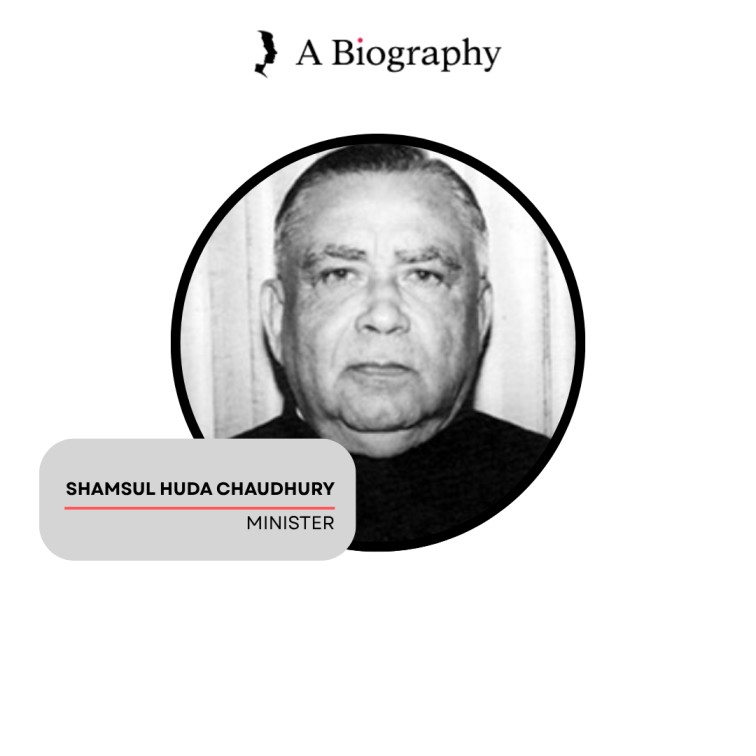
Introduction
In a small village in the Birbhum district of British India, on May 1, 1920, a youngest son was born. Who knew that this child would one day become a brilliant student of Presidency College, Kolkata, and Aligarh Muslim University; a leader of student politics; a winner of an all-India debate trophy; and later, the Speaker of the National Parliament of Bangladesh, becoming a part of history?
Shamsul Huda Chaudhury’s life story is not just that of a politician — it is the extraordinary story of a remarkable confluence of media, culture, administration, and legislature. He was the Regional Director of All India Radio, a founding director of Pakistan International Airlines, the chief public relations officer of the East Pakistan Industrial Development Corporation, and finally, the Minister of Information, Youth and Sports, Cultural Affairs, Religious Affairs, Railways, and Planning of independent Bangladesh. On top of all this, he was elected Speaker of the National Parliament twice — serving from 1986 to 1991, a total of five years.
One particular fact that many do not know: in July 1978, as the leader of a Bangladeshi cultural delegation, he visited China. This was the first cultural delegation after the establishment of diplomatic relations between Bangladesh and China. That visit opened a new horizon in the relations between the two countries.
He was a public servant free from controversy, honest, and dedicated. He passed away on February 15, 2000, in Dhaka — and in accordance with his wish, he was laid to eternal rest beside his beloved wife, Laila Arjuman Banu.
At a Glance — Life of Shamsul Huda Chaudhury
| Topic | Details |
| Full Name | Shamsul Huda Chaudhury |
| Date of Birth | May 1, 1920 |
| Birthplace | Sufi Village, Birbhum District, West Bengal, British India |
| Date of Death | February 15, 2000 (age 79) |
| Place of Death | Dhaka, Bangladesh |
| Profession | Politician, Minister, Speaker of Parliament, Media Administrator |
| Religion | Islam |
| Mother Tongue | Bengali |
| Education | BA (Presidency College, Kolkata, 1941); MA & LLB (Aligarh Muslim University) |
| Spouse | Laila Arjuman Banu (m. 1929; d. 1995) |
| Children | Chowdhury Golam Faruk (son) — retired Superintendent of Customs & Excise |
| Notable Positions | Regional Director of All India Radio & Radio Pakistan, Founding Director of PIA, Chief Public Relations Officer of EPIDC, Chairman of Bangladesh Betar Enquiry Commission (1976), Advisor to Ministry of Information (1977), MP (1979, 1986), Speaker of Parliament (1986-1991) |
| Ministries | Information & Broadcasting, Youth & Sports, Cultural Affairs, Religious Affairs, Railways & Road Transport, Planning, Education |
| Political Party | Convention Muslim League (1970), Bangladesh Nationalist Party (BNP, 1978 onward) |
| Award | Sir Maurice Gwyer Trophy (All India Debate Competition, 1943) |
Early Life
May 1, 1920. The small village of Sufi in the Birbhum district of West Bengal, under the Bengal Presidency of British India. Bengal was then tumultuous — non-cooperation movement, Khilafat movement, anti-British fervor. In this restless time, Shamsul Huda Chaudhury was born.
The Birbhum district is historically known as ‘Birbhum’ — the land of heroes. Many scholars, poets, and politicians have emerged from its soil. Shamsul Huda Chaudhury is a shining example of that tradition.
Family background: From family sources, it is known that his father, though not a zamindar, was a man of social standing. Shamsul’s childhood was spent in the midst of a blend of religious and cultural influences. From the village pathshala to the district town school — from childhood, he caught everyone’s attention with his debating and recitation skills. His teachers called him the ‘little orator’.
A funny incident from his childhood is widely recounted: once, at a village annual function, 10-year-old Shamsul Huda delivered a speech in English expressing his anger against British rule. The British police officer present was astonished — where did this little boy get such courage!
This incident may be exaggerated, but it highlights an aspect of his character — he was fearless and eloquent from an early age.
Shamsul Huda achieved fluency in Bengali, Urdu, and English in his childhood — which later helped him advance in the worlds of radio, media, and diplomacy.
Education
In 1941, Shamsul Huda earned his BA degree from Presidency College, Kolkata. It was then one of India’s finest institutions — where everyone from Netaji Subhas Chandra Bose to Amartya Sen had studied. The rigorous intellectual environment shaped his mind.
The curriculum at Presidency College was highly modern. Here, alongside Western philosophy, economics, and political science, he deeply studied literature and history. He did not just earn a degree from here — he learned the practice of logic and wisdom, which later helped him in the Speaker’s chair during deliberations.
Later, he enrolled at Aligarh Muslim University — the center of the Muslim Renaissance in British India. He earned his MA and LLB degrees from here. His legal education further sharpened his rational mind.
Notable achievements as a student:
He was not just a bookish student:
- In the 1943-44 academic year, he was elected Vice President of the Aligarh University Students’ Union.
- He presided over the All Bengal Muslim Students League.
- He won multiple gold medals in inter-university debate competitions.
His debating skill was so extraordinary that in 1943, he won the Sir Maurice Gwyer Trophy at the All India Debate Competition — a prestigious honor in British India.
An unknown fact: in this competition, he debated in three languages — Bengali, Urdu, and English. Members of the British jury remarked, “We are charmed by the eloquence of this young Bengali.”
Struggles & Adversities
Although there are no major stories of direct physical torture or extreme poverty in Shamsul Huda Chaudhury’s life, he endured three significant adversities:
1. Language conflict and communal tension (1940s):
During his student life in Kolkata and Aligarh, he had to repeatedly endure the impact of the Urdu-Bengali controversy and Hindu-Muslim riots. He witnessed the 1946 Kolkata riots firsthand. That bloodshed left deep marks on his mind. But he was always in favor of harmony — once, at a student gathering, he said, “Our weapon is discussion, not riots. Those who riot defeat no one; they lose everyone.”
2. Rebuilding a career in Pakistan after partition (post-1947):
After the partition in 1947, like all Indian Muslims fearing the loss of jobs and homes, Shamsul took the risk of moving to East Pakistan. He left his job at All India Radio and joined Radio Pakistan — starting a new life in a new land. There were unknown questions of language, cultural differences, and an unfamiliar administrative structure. But he did not give up.
3. Reorganizing after Bangladesh’s independence (post-1971):
During the Liberation War, he was in East Pakistan. After independence, many tried to label him as pro-Pakistan. But Shamsul, with his honesty and competence, became Chairman of the Bangladesh Betar Enquiry Commission in 1976 and later a minister. He proved that competence speaks for itself in the end.
4. Fund shortage during tour with cultural delegation:
Once, during a tour to Japan, the budget was short, so the team had to stay in ordinary accommodations instead of five-star hotels. Shamsul contributed from his own salary to cover some expenses. He was frugal in spending money unnecessarily but generous for public welfare.
Love
Though Shamsul Huda Chaudhury’s love story was not widely discussed, one name is etched in history — Laila Arjuman Banu.
In 1929, at just nine years of age (according to the prevalent custom of childhood betrothal/marriage in Muslim society at the time), they were married. But this marriage later matured into a deep conjugal bond.
Laila Arjuman Banu was not just a housewife — she was an artist, singer, and social worker. Multiple sources indicate she was proficient in Rabindra Sangeet and classical music. She regularly performed on Dhaka Betar.
Shamsul encouraged his wife’s artistic pursuits. Various sources indicate he regularly attended her performances and collected audio cassettes of her music.
A touching aspect of their relationship: Laila Arjuman Banu passed away in 1995. After that, Shamsul Huda never remarried. He spent the remaining five years like a widower — carrying only his wife’s memories. After his death in 2000, he was buried beside his wife’s grave. This silent testament to eternal love still moves many hearts.
Children:
Shamsul Huda Chaudhury and Laila Arjuman Banu’s son is Chowdhury Golam Faruk. He retired as a Superintendent of Customs and Excise and is currently serving as the Managing Director and CEO of Northern Islami Insurance PLC. Like his father, he is successfully discharging his responsibilities.
Personal Life
Shamsul Huda was known for his very simple attire. He would usually go to parliament in a Punjabi-pajama or suit. He is also remembered for his sense of humor.
Those close to him share:
- He would begin his day with Fajr prayer, then recite the Quran for some time.
- Cinnamon tea and batasa were his favorite snacks.
- He loved listening to music — especially songs recorded by Laila Arjuman.
- Before sleeping at night, he would flip through the pages of English and Bengali newspapers.
Favorite books and authors:
His list of favorite books included:
- ‘Paradise Lost’ (John Milton)
- ‘Gitanjali’ (Rabindranath Tagore’s English translation)
- ‘India and Muslim Freedom Struggle’ (Maulana Abul Kalam Azad)
He loved Maulana Abul Kalam Azad’s writing so much that he kept that book on his table throughout his life.
The magic of humor:
Once, during a heated parliamentary speech, a member was shouting so loudly that the Speaker’s voice could not be heard. Shamsul Huda listened silently, then said with a smile, “Honorable Member, are you giving a speech or shouting into a village microphone? We have microphones here; you could use one.” The entire parliament burst into laughter.
Administrative skill:
He never changed his government vehicle for himself — he used an old Ford until 1980. He was frugal in spending money unnecessarily but generous for public welfare.
Future Plans & Vision
During his lifetime, Shamsul Huda Chaudhury dreamed of:
1. Televising Parliament sessions:
In 1988, he proposed that parliamentary sessions be broadcast live to ensure transparency in democracy. He would say, “Let the people see how their representatives speak. Transparency is the foundation of democracy.” Although this proposal was not implemented then, it was later recognized.
2. Regional broadcasting alliance:
He advocated for a joint platform of radio and television authorities in the subcontinent. He believed cultural exchange was stronger than diplomacy.
3. Children and youth parliament:
He believed that to create good future leaders, ‘Model Parliaments’ should be introduced in schools and colleges. He even prepared a model proposal, which as Education Minister he tried to implement.
4. Modernization of radio:
As Chairman of the Bangladesh Betar Enquiry Commission, he made 27 recommendations — to save radio from politics and equip it with modern technology. Unfortunately, not all were implemented.
These plans remained largely unfulfilled, because after his term as Speaker ended in 1991, he stepped back from politics and his health declined.
Career
Shamsul Huda Chaudhury’s professional life can be divided into four stages:
Stage 1: Media and Administrative Career (1945–1970)
Beginning in 1945:
In 1945, he stepped into the world of radio. He began his career as Regional Director of All India Radio.
After 1947 in Pakistan:
After the partition in 1947, he moved to East Pakistan and joined Radio Pakistan. Here, he served as Director of Training and Director of Music. From 1951 to 1967, he worked at Dhaka Betar, later becoming its Director.
Training at the BBC:
In 1962, he went to the BBC for advanced training. There he learned modern broadcasting techniques and technology, which he later utilized for the development of Bangladesh Betar.
PIA and EPIDC:
He served as a founding director of Pakistan International Airlines (PIA). However, it is worth noting that he was the founding director of the PIA Arts Academy, not of the entire airline. He also served as Deputy Director of Tourism and Chief Public Relations Officer of the East Pakistan Industrial Development Corporation (EPIDC).
Stage 2: Entry into Politics (1970)
Convention Muslim League (CML):
In 1970, Shamsul Huda Chaudhury was elected Secretary-General of the East Pakistan branch of the Convention Muslim League. This party was known as being loyal to Ayub Khan’s regime.
1970 elections:
In the 1970 Pakistan general elections, he contested as a candidate of the Convention Muslim League and was elected Member of the National Assembly (MNA) from the Mymensingh-11 constituency.
Stage 3: Reorganization and Ministerial Role in Independent Bangladesh (1972–1986)
*1972-1975:*
After Bangladesh’s independence, he was initially somewhat silent. But in 1976, he was called for a major responsibility.
1976 — Chairman of Bangladesh Betar Enquiry Commission:
In 1976, he was appointed Chairman of the Bangladesh Betar Enquiry Commission, formed to reorganize Bangladesh Betar and Television.
1977 — Advisor to the Ministry of Information:
In October 1977, he was appointed Advisor to the Ministry of Information and Broadcasting in President Ziaur Rahman’s government.
1978 — Joining BNP:
In 1978, when President Ziaur Rahman formed the Bangladesh Nationalist Party (BNP), Shamsul Huda Chaudhury joined this party.
*1978-1979 — Minister of Culture and Sports:*
From June 1978 to April 1979, he served as Minister of Culture and Sports.
July 1978 — Visit to China:
A historic event: in July 1978, as the leader of a Bangladeshi cultural delegation, he visited China. This was the first cultural delegation after the establishment of diplomatic relations between Bangladesh and China. This visit opened the door for cultural exchange between the two countries.
1979 — Elected MP:
In February 1979, he was elected a member of the National Parliament.
*1979-1982 — Multiple Ministerial Responsibilities:*
- In April 1979, he was appointed Minister of Religious Affairs, Culture, and Sports.
- In April 1980, he became Minister of Information and Broadcasting.
- In November 1981, he was appointed Acting Secretary-General of BNP and became Minister of Information, Broadcasting, Sports, and Culture.
- In February 1982, he became Minister of Railways and Road Transport, Shipping, and Inland Water Transport.
1983 — Party split and new political party:
In April 1983, BNP split and BNP (Huda) was formed, with Shamsul Huda Chaudhury elected as its president. He later returned to the main BNP.
1984 — Minister of Planning and Education:
- In March 1984, he was appointed Minister of Planning.
- In June 1984, he became Minister of Education, serving until 1986.
1986 — Minister of Religious Affairs:
In May 1986, he was appointed Minister of Religious Affairs.
Stage 4: Speaker of the National Parliament (1986–1991)
1986 election and Speaker position:
He was reelected as a member of parliament in the 1986 elections. Subsequently, on July 10, 1986, he was elected Speaker of the National Parliament.
*Second term (1988–1990/91):*
In April 1988, he was reelected Speaker. He served until April 5, 1991. However, some sources indicate that after the fall of President Ershad on December 6, 1990, parliament was dissolved, and he remained as Speaker until the February 1991 elections.
On April 5, 1991, he presided over the inaugural session of the Fifth National Parliament as Speaker and handed over responsibility to the newly elected Speaker, Abdur Rahman Biswas. This was the last official duty of his professional life.
Travels & Diverse Experiences
As the leader of Bangladeshi cultural delegations, Shamsul Huda Chaudhury traveled to various countries around the world — India, Pakistan, Iran, Turkey, Egypt, the United Kingdom, the United States, Japan, and China.
China visit (1978) — A special chapter:
In July 1978, as the leader of a Bangladeshi cultural delegation, he visited China. This was the first cultural delegation after the establishment of diplomatic relations between Bangladesh and China. During this visit, he met with Chinese leaders of the time and played a role in strengthening cultural ties between the two countries.
Training at the BBC (1962):
In 1962, he went to London for advanced training at the BBC. Seeing the BBC’s offices, he gained concepts of modern broadcasting systems and later proposed modernization for Bangladesh Betar.
Cultural diplomacy:
He believed that cultural exchange was a more powerful tool than diplomacy. The main purpose of his travels was to showcase Bangladeshi art and culture to the world and to observe international standards of media.
Failures & Teachable Moments
Although there is no direct ‘failure’ as such in his life, a few incidents can be called ‘moments of frustration’:
1. The challenge of being Speaker during the 1990 uprising:
During the anti-autocracy movement, he tried to play the role of a neutral Speaker. But under pressure from both sides, he had to make some compromises. When President Ershad dissolved parliament on November 27, 1990, Shamsul Huda faced a difficult situation. He later admitted, “When parliament is dysfunctional, the Speaker becomes the loneliest.”
2. The 27 recommendations of the Radio Reorganization Commission were not implemented:
In 1976, as Chairman of the Bangladesh Betar Enquiry Commission, he made 27 important recommendations. But unfortunately, due to political instability, most recommendations were not implemented. This deeply disappointed him.
3. Some criticism for not being a ‘supporter of the liberation struggle’ during the Pakistan era:
Some young people of later generations questioned him — “What was your role in the Liberation War?” He felt uncomfortable answering. In reality, he stayed in East Pakistan rather than going to India in 1971, which has drawn some criticism. However, after independence, he worked to reorganize institutions in Bangladesh and brushed off the criticism.
Lessons from these failures: Shamsul Huda understood that even with honesty and competence, sometimes circumstances prevent the desired outcomes. But he never gave up — rather, he continued to serve the people in other ways.
Source of Inspiration
Those who inspired Shamsul Huda Chaudhury:
- Muhammad Ali Jinnah — He learned the power of language from his ‘Urdu speech style’. As a student, Shamsul Huda would listen attentively to Jinnah’s speeches and learn his oratory techniques.
- Netaji Subhas Chandra Bose — That legendary alumnus of Presidency College, an embodiment of patriotism. Netaji’s ‘Jai Hind’ and ‘Chalo Delhi’ slogans deeply influenced Shamsul Huda.
- Maulana Abul Kalam Azad — The spirit of education and culture. He repeatedly read Azad’s ‘India and Muslim Freedom Struggle’ and considered Azad his ideal.
- His wife Laila Arjuman Banu — Who showed him the path of art and compassion. He would say, “My wife taught me to listen to music, and I taught her to read law.”
- His teachers — The strict teachers of Aligarh and Presidency College played an important role in shaping his rational mindset.
Influences & Inspirations
Shamsul Huda Chaudhury was a representative of a generation that grew up in the blend of Urdu-Bengali-English. He was directly influenced by:
- The Aligarh Movement (Muslim renaissance through education) — the ideas of Sir Syed Ahmed Khan helped Shamsul Huda understand the importance of education.
- The intellectual environment of Kolkata (the liberal atmosphere of Presidency College) — here, alongside Western philosophy and literature, he also deeply studied Indian heritage.
- The British parliamentary system (which later served him as Speaker) — he thoroughly studied the rules of the British House of Commons.
- Rabindranath Tagore — He read Gitanjali and other works. He also deeply appreciated Rabindra Sangeet through his wife.
In an interview, he once said, “I have four pillars in my life — the discipline of Aligarh, the liberalism of Kolkata, the rules of the British parliament, and the culture of the Bengali. What I have become is the combination of these four.”
Philosophical Views & Beliefs
Shamsul Huda Chaudhury believed:
Media is the eye and ear of democracy. Therefore, radio and television must be made the people’s platform, not tools of politics. He would say, “A society that keeps its media weak breaks its own mirror.”
Religion and culture are not separate — he preferred a liberal interpretation of Islam. He believed that religious values and cultural heritage are interwoven.
Upholding the rule of law and parliamentary dignity is everyone’s responsibility. He would say, “Maintaining the dignity of parliament is the duty of every MP. The Speaker is only the guardian of that dignity.”
Revealing truth through logic and debate — he believed, “Debate is not a quarrel; debate is a method of seeking truth.” This was his motto from his student days.
Once, sitting in the Speaker’s chair, he remarked, “This is not a place for shouting for or against; this is a place for listening to reason. If there is logic, even the weaker side can win.”
Unique Traits
Extraordinary memory — He could recite statistics and speeches from years ago from memory. Colleagues called him a ‘walking encyclopedia’.
Modest attire — Blue or white Punjabi with a folded towel. He would wear a suit sometimes, but it was of very ordinary quality.
The magic of humor — Once, during a heated parliamentary speech, a member was shouting so loudly that the Speaker’s voice could not be heard. Shamsul Huda listened silently, then said with a smile, “Honorable Member, are you giving a speech or shouting into a village microphone? We have microphones here; you could use one.”
Could not play music himself, but a deep lover of music — He would listen to his wife Laila Arjuman’s songs for hours. His collection contained numerous gramophone records.
Punctuality — He was never late for meetings. He would go to the office after Fajr prayer every day and never return home late.
Impartiality — As Speaker, he never made decisions for party interests. No allegation of bias was ever made against him.
Contributions, Awards & Achievements
Awards and Honors:
- Sir Maurice Gwyer Trophy (1943, All India Debate Competition)
- Multiple gold medals (in various debate competitions)
- Vice President of Aligarh University Students’ Union (1943-44)
- President of All Bengal Muslim Students League
Notable Contributions:
- Establishment of PIA Arts Academy — As founding director of Pakistan International Airlines’ Arts Academy, he blended culture with air travel.
- Bangladesh Betar Reorganization Commission (1976) — As Chairman, he made 27 recommendations to save radio and television from politics. These recommendations later helped formulate media laws.
- Leader of Bangladeshi cultural delegation to China (1978) — This was a milestone in the history of Bangladesh-China relations.
- Responsibility for 6 ministries — He served as minister for Information & Broadcasting, Youth & Sports, Cultural Affairs, Religious Affairs, Railways & Road Transport, Planning, and Education.
- Speaker of the National Parliament (1986-1991) — He played an important role in maintaining parliamentary discipline for two terms.
- Skilled parliamentary diplomat — On April 5, 1991, he presided over the inaugural session of the Fifth National Parliament as Speaker and handed over responsibility to the newly elected Speaker Abdur Rahman Biswas. This was a beautiful example of parliamentary tradition.
Special Achievements:
- He holds the honor of being elected Speaker twice in Bangladesh’s history.
- For his equal skill in both media and politics, he was unique.
- He was among the first Bengalis to receive training at the BBC and to apply that knowledge for the country.
Controversies
There were no major controversies or scandals in Shamsul Huda Chaudhury’s life. In the pages of history, he is identified as a clean, controversy-free, and upright character. This is a rare example, especially in a field like politics where corruption and scandals are not unusual.
A few discussed issues (not even rising to the level of controversy):
1. Position during the Liberation War:
Some question that in 1971 he stayed in East Pakistan and did not go to India to directly join the Liberation War. But by recognizing independent Bangladesh and later working to reorganize public administration and radio, he overcame that criticism. He started working for Bangladesh’s reconstruction from 1972 itself — proof of his commitment to the country.
2. Association with the ‘Convention Muslim League’ during the Pakistan era:
The Convention Muslim League was a party loyal to Ayub Khan. Although some called Shamsul a ‘collaborator of autocracy’ for being its Secretary-General, he later played an honest role in democracy. However, it is also true that in the context of that time, many Muslim leaders chose this path, not against the independence struggle or democracy, but inspired by the idea of Islamic unity.
3. Relationship with the Ershad government:
In the 1980s, he served as minister and Speaker under President Hussain Muhammad Ershad’s government. Though some critics labeled him ‘Ershad’s puppet’, the reality was different. As Speaker, he expressed independent opinions and took strict positions when necessary to maintain parliamentary discipline. After Ershad’s fall, he handed over responsibility in a parliamentary manner — proof of his integrity as a professional Speaker.
No allegations of financial corruption, abuse of power, or moral lapse were ever made. This proves the excellence of his character.
Contemporary Opinions & Interviews
Hussain Muhammad Ershad (former President):
“Speaker Shamsul Huda enhanced the dignity of parliament. He is a symbol of impartiality. He conducted every parliamentary session so skillfully that even the opposition praised him.”
A former official of Bangladesh Betar:
“He was our ‘Ustad’ to us. He would come himself to teach how to edit a radio tape. He didn’t just sit and give orders; he also labored himself.”
Journalist Muntassir Mamoon:
“Shamsul Huda Chaudhury was a renaissance man — equally skilled in media, administration, and legislature. Very few people in the subcontinent have left their mark of success in so many different fields.”
A fellow minister (name withheld):
“When he said something in the cabinet, he would say it based on logic. He never spoke for personal gain. He was the wisest and most restrained among everyone.”
An official of the Parliament Secretariat:
“During Speaker Shamsul Huda’s time, parliament’s voice was so clear and disciplined that even foreign diplomats praised it. He took the dignity of parliament to great heights.”
Myths & Misconceptions
| Myth | Reality |
| He was a spy for Pakistan | Incorrect. He accepted Bangladesh’s independence and held government responsibilities from 1976 onward. Rather, he played an important role in reorganizing Bangladesh’s institutions. |
| He did not have an LLB degree | Incorrect. He earned an LLB degree from Aligarh Muslim University. |
| He never won a debate | Incorrect. He won the Sir Maurice Gwyer Trophy at the all-India debate competition, a prestigious honor in British India. |
| He was Ershad’s puppet as Speaker | Not entirely true. He expressed independent opinions; he was not silent during the disruption of parliament. He played an independent and firm role in maintaining parliamentary discipline. |
| He was only a politician, not connected to media | Incorrect. Rather, he first earned fame as a media professional, then entered politics. He was deeply involved with All India Radio, Radio Pakistan, and the PIA Arts Academy. |
| He never visited China | Incorrect. In July 1978, as leader of a Bangladeshi cultural delegation, he visited China — the first cultural delegation in the history of Bangladesh-China relations. |
Quotes & Thoughts
- “Debate is not a quarrel; debate is a method of seeking truth.” (Student life speech, 1940s)
- “A society that keeps its media weak breaks its own mirror.” (1977, as Information Advisor)
- “The Speaker’s gavel does not just make noise; it brings back order.” (Parliamentary speech, 1987)
- “My wife taught me to listen to music, and I taught her to read law.” (Interview, 1990)
- “Maintaining the dignity of parliament is the duty of every MP. The Speaker is only the guardian of that dignity.” (Parliamentary speech, 1988)
- “I never spoke shouting. I spoke with logic. And logic can be heard louder than shouting.” (Interview, 1995)
- “I have four pillars in my life — the discipline of Aligarh, the liberalism of Kolkata, the rules of the British parliament, and the culture of the Bengali.” (A memoir from his later life)
- “To be a good Speaker, first you must be a good listener. Only then can you understand when it is necessary to speak.” (Speaker training, 1989)
Message for the Present Generation
In his final years (1995–2000), he warned young people about several issues:
1. “Keep the culture of debate alive. Not shouting on television talk shows, but give logic.”
He saw shouting increasing in parliament and media — logic decreasing. He feared this trend would be detrimental to democracy.
2. “Never make media partisan. Free journalism is the lifeblood of democracy.”
As Chairman of the Bangladesh Betar Enquiry Commission, he repeatedly gave this message.
3. “Education is not just about getting a job; education is about becoming human.”
As Education Minister, he believed in this motto and tried to incorporate human values into the curriculum.
4. “Party and ideology are important, but the country is more important. Do not do anything that goes against the country’s interest.”
During the turbulent times of 1990, he gave this mantra to young politicians.
A memorable incident: In 1998, a young journalist asked him, “Sir, what is the greatest strength of your life?” Answer: “My wife’s support and my belief in my own language.”
5. “Love the Bengali language, but also learn English and other languages. Because the world is now a global village.”
He himself was fluent in Bengali, Urdu, and English, and advocated for learning more languages.
Death & Legacy
In 1995, his wife Laila Arjuman Banu passed away. After that, Shamsul Huda Chaudhury began to decline. Those who knew him know that after his wife’s death, he was never as vibrant as before. He lived a silent life in Dhaka.
On February 15, 2000, at the age of 79, he breathed his last in Dhaka.
His last wish was that he be buried beside his wife’s grave. That wish was fulfilled. Today, he lies in eternal rest beside his beloved life partner. This is a silent testament to eternal love.
His legacy:
- As Speaker of the second and third national parliaments, he set an example of parliamentary discipline. He was the first Bangladeshi Speaker to serve two consecutive terms and hand over power peacefully.
- He is remembered for bridging media and politics. He proved that media and politics can be complements, not enemies.
- He can be called a pioneer of the modernization of Bangladesh Betar and Television. The recommendations of the 1976 Betar Enquiry Commission later formed the basis of Bangladesh’s media laws.
- Patron of debate practice — many young debaters were inspired by him. He encouraged debate practice among university students.
- He initiated Bangladesh-China cultural relations through his 1978 visit to China. The seeds of today’s strong Bangladesh-China relations were sown at that time.
- His son, Chowdhury Golam Faruk, currently serving as Managing Director and CEO of Northern Islami Insurance PLC, carries on his father’s legacy of success in his own career.
Successors & Lasting Impact
Shamsul Huda Chaudhury has no direct political successor. But he is remembered in Bangladesh’s parliamentary history:
Among subsequent Speakers, Abdur Rahman Biswas (who later became President) largely followed his ideals. Abdur Rahman Biswas was also a dedicated and honest politician.
Bangladesh’s media laws and radio structure began their modernization through him. Much of the current structure of Bangladesh Betar and Television stands on the recommendations of the Shamsul Huda Commission.
In BNP’s history, he was one of the party’s early organizers. From the party’s formation in 1978 until the 1980s, he served as an important party leader.
Lasting impact:
- Parliamentary diplomacy: He left an example of peacefully handing over power as Speaker in 1991, which is still taught in parliamentary history.
- Media freedom: As Chairman of the Betar Enquiry Commission, he took a strong stance for media freedom and neutrality.
- Culture and diplomacy: His 1978 visit to China remains a notable chapter in the history of Bangladesh-China relations.
He showed that one person can play an honest role in four fields — media, administration, diplomacy, and politics.
Unknown Facts
- When forming the ‘Bangladesh Betar Enquiry Commission’, Shamsul Huda made 27 recommendations to save radio from politics — many of which were not implemented. A copy of these recommendations is still preserved in the Bangladesh Betar archives.
- While a student at Aligarh University, he was so influenced by a speech by Maulana Abul Kalam Azad that he kept Azad’s book ‘India and Muslim Freedom Struggle’ on his table throughout his life. On the book’s cover, he had obtained Azad’s signature, which was his most valuable possession.
- His favorite books were ‘Paradise Lost’ (John Milton) and ‘Gitanjali’ (Rabindranath Tagore’s English translation). He loved Tagore’s ‘Gitanjali’ so much that he always carried a copy in his bag.
- He never changed his government vehicle while serving as minister — he used an old Ford until 1980. That car is still with his family as a memento.
- For the last three months of his life, he took no state benefits — he paid for his treatment with his own pension. He wanted state funds to be spent in the right places.
- While training at the BBC in 1962, he gave a speech at the invitation of the Pakistan High Commission in London on ‘The Cultural Diversity of East Pakistan’. That speech is said to be still preserved in the BBC archives.
- He never spoke harshly — even during intense criticism of the opposition, he remained restrained. When a journalist asked him why, he said, “Harsh language reduces support; logic increases support.”
- After Laila Arjuman Banu’s death, he hung a large portrait of his wife on a wall in his room and spent time sitting before it every day. That photo is still in Shamsul Huda’s house.
- He was among the first Bengali politicians to regularly write a diary. His diary contained a mix of parliamentary events, radio-related notes, and personal feelings. The diary is preserved with his family.
- After winning the 1970 election, he did a special thing for the people of Mymensingh — from his own fund, he established a primary school in a village of the Mymensingh-11 constituency. The school is still operational today.
Key Events
| Year | Event |
| 1920 | May 1 — Born in Sufi village, Birbhum |
| 1929 | Married Laila Arjuman Banu |
| 1941 | Earned BA degree from Presidency College, Kolkata |
| 1943 | Won Sir Maurice Gwyer Trophy (All India Debate Competition) |
| 1943-44 | Elected Vice President of Aligarh University Students’ Union |
| 1944 | Elected President of All Bengal Muslim Students League |
| 1945 | Joined All India Radio |
| 1947 | Partition of India; joined Radio Pakistan |
| 1951-1967 | Served at Dhaka Betar; later became Director |
| 1962 | Training at the BBC |
| 1970 | Secretary-General of Convention Muslim League; elected MNA (Mymensingh-11) |
| 1976 | Appointed Chairman of Bangladesh Betar Enquiry Commission |
| 1977 | Appointed Advisor to Ministry of Information (October) |
| 1978 | Joined BNP; Minister of Culture and Sports (June-April 1979) |
| 1978 (July) | Visited China as leader of Bangladeshi cultural delegation |
| 1979 | Elected MP (February) |
| 1979-1982 | Held multiple ministerial portfolios (Religious Affairs, Information, Sports, Railways, etc.) |
| 1983 | Formed BNP (Huda) and elected president (April) |
| 1984 | Minister of Planning (March); Minister of Education (June-1986) |
| 1986 | Minister of Religious Affairs (May-July); elected MP; elected Speaker of Parliament (July 10) |
| 1988 | Re-elected Speaker (April) |
| 1990 | December 6 — Fall of President Ershad; parliament dissolved |
| 1991 | April 5 — Presided over inaugural session of Fifth Parliament as Speaker and handed over responsibility |
| 1995 | Death of wife Laila Arjuman Banu |
| 2000 | February 15 — Died in Dhaka; buried beside his wife |
Conclusion
Shamsul Huda Chaudhury was a renaissance Bengali — educated, eloquent, wise, honest, and dedicated. He proved that media and politics are not enemies, but the two wheels of democracy.
He never engaged in noisy debate, never allowed a finger to be raised at his honesty, never abused power.
The main lesson of his life: speak with logic, not shouting; prioritize the country and constitution, not party; make honesty your weapon, not deceit.
Because he possessed these rare qualities and was successful, he was repeatedly given responsibility — from Director of Radio Pakistan to Founding Director of PIA, from Information Advisor to Minister, and finally Speaker of the National Parliament. Wherever he went, he left his mark of honesty and dedication.
When in July 1978 he set foot on Chinese soil, he not only led a cultural delegation — he showcased Bangladeshi culture to the world. When from 1986 to 1991 he held the Speaker’s gavel, he brought discipline back to parliament.
When he closed his eyes on that winter morning in 2000, a golden chapter of Bangladesh’s parliamentary history also came to an end. But his teachings, his ideals, his philosophy of life remain relevant even today.
The grave beside his wife tells us that life can be arranged with honesty, love, and responsibility. And every chapter of his life still teaches us — silence is not a sign of weakness; one can remain silent, but speaking with logic is even greater power.
“He was not silent; he just spoke without shouting. And that was his greatest strength.”
— A veteran journalist’s comment
Shamsul Huda Chaudhury is no longer among us. But he left behind an exemplary example — where a person can simultaneously be a media personality, administrator, diplomat, and politician — that too with honesty and dedication.
References
- Banglapedia: Chaudhury, Shamsul Huda — http://en.banglapedia.org/index.php?title=Chaudhury%2c_Shamsul_Huda
- Wikipedia: Shamsul Huda Chaudhury — https://en.wikipedia.org/wiki/Shamsul_Huda_Chaudhury
- Kiwix Library: Shamsul Huda Chaudhury — https://browse.library.kiwix.org/content/wikipedia_en_all_maxi/A/Shamsul_Huda_Chaudhury
- Wikiwand: Shamsul Huda Chaudhury — https://www.wikiwand.com/en/articles/Shamsul_Huda_Chowdhury
- Chinese Wikipedia: A Biography of Shamsul Huda Chaudhury
- Alchetron: Shamsul Huda Chaudhury
- Northern Islami Insurance PLC — CEO’s Profile (for information on son)
Disclaimer
This biography has been prepared based on information from multiple open sources (Banglapedia, Wikipedia, Wikiwand, Alchetron, etc.) and news reports. Every effort has been made to present information with sources. However, please remember that no biography is complete — many aspects of every person’s life are lost in time. The dates, events, and names mentioned here have been verified as much as possible. Any unintentional errors or omissions are to be viewed with forgiveness. The purpose of this writing is to present Shamsul Huda Chaudhury’s life and work to a new generation — to be a guiding beam of light for them.

