
Biography
A Biography of Admiral Aurangzeb Chowdhury

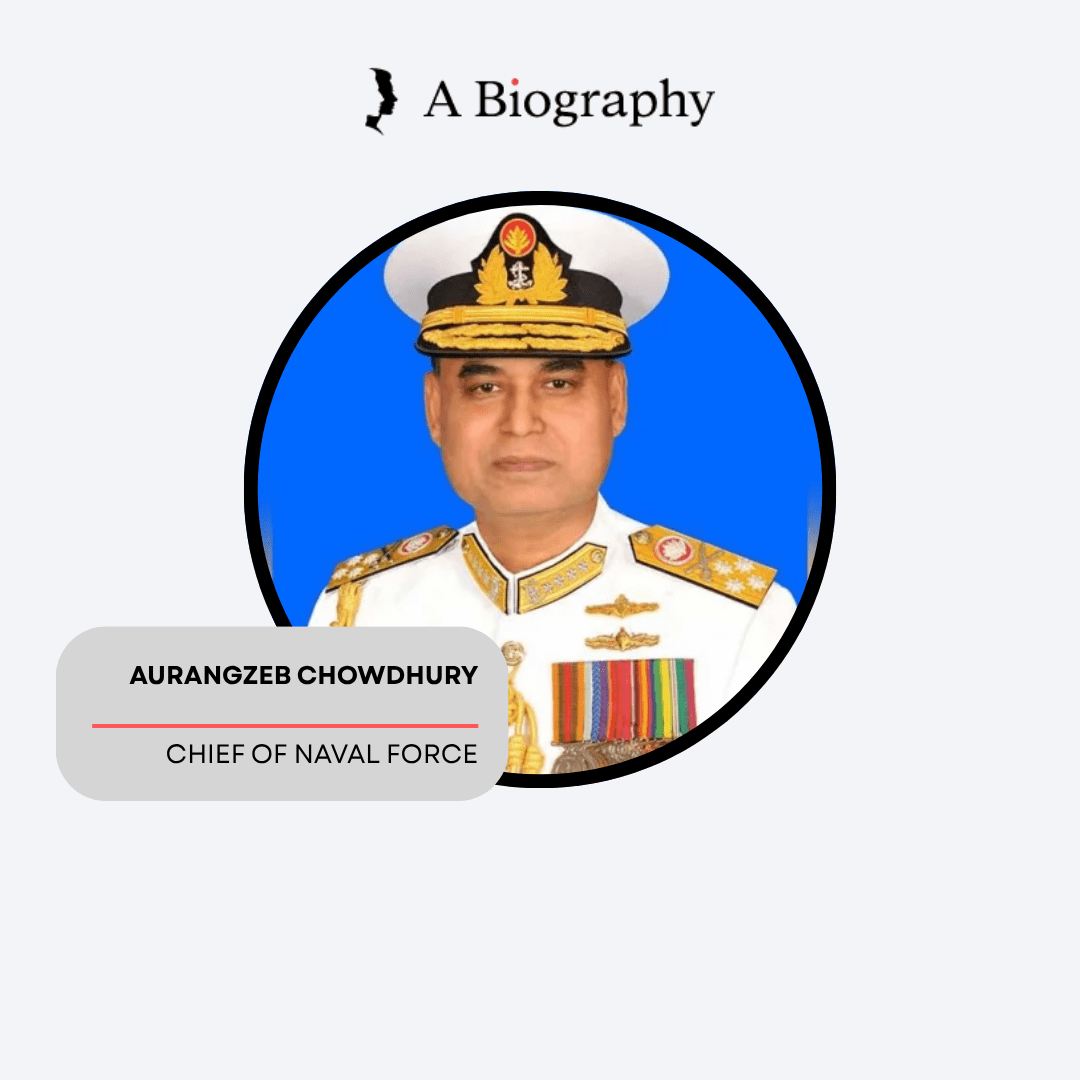
Introduction
That July morning, as the naval ensign changed hands, a warrior bid farewell.
July 25, 2020. The premises of “BNC Barishal,” the Naval Headquarters in Dhaka Cantonment. The gentle morning sunlight fell upon the blue-and-white flag. Standing in full naval regalia, Admiral Aurangzeb Chowdhury handed over the flag and command of the Bangladesh Navy to his successor . His eyes held firmness; his face bore a contented smile. The young officer cadet who had stepped into the navy on December 10, 1980, was now departing from its highest office .
Due to the COVID-19 pandemic, the ceremony was brief, but full military honors were maintained. After the guard of honor and farewell parade, he stood on the balcony of the Naval Headquarters and looked across the cantonment for the last time. Thousands of naval personnel saluted him. He returned the final salute. Forty years of service had come to an end .
His career witnessed the modernization of the navy, the acquisition of submarines, the restructuring of the Coast Guard, and remarkable progress in international naval diplomacy. He was not merely a naval commander; he was a reformer, a strategist, and a patriot. This warrior who rose from the soil of Chittagong proved that with proper leadership and dedication, any height is attainable.
This biography unfolds the story of that journey—from childhood dreams to the highest seat of the navy, complete with rigorous training, a pledge of service, crisis leadership, and a unique legacy. We delve into the untold stories, the midnight decisions, the silent sacrifices, and the enduring impact of a man who made the blue sea safer for generations to come.
At a Glance: Life of Admiral Aurangzeb Chowdhury
Full Name: Abu Mozaffar Mohiuddin Mohammad Aurangzeb Chowdhury
Rank: Admiral (Four-Star)
Born: September 28, 1959
Birthplace: Chittagong, East Pakistan (now Bangladesh) (Some sources also mention Tangail District)
Status: Retired
Father: Name not publicly disclosed (described in some sources as a businessman and educationist)
Mother: Name not publicly disclosed (homemaker)
Spouse: Dr. Afroza Aurangzeb (Gynecologist and social worker)
Children: One son and one daughter
Joined Navy: 1978 (Officer Cadet)
Commission: December 10, 1980
Service Years: 1980–2020 (40 years)
Director General, Bangladesh Coast Guard: February 15, 2016 – January 2019
Chief of Naval Staff (15th): January 26, 2019 – July 25, 2020
Key Achievements:
- Expanded the Bangladesh Navy’s submarine fleet
- Opened combat branches to women officers
- Modernized naval dockyards
- Restructured the Bangladesh Coast Guard
- Led maritime rescue operations during the Rohingya refugee crisis
- Advanced the digital transformation of the Bangladesh Navy
International Honors:
- United States Navy Surface Warfare Officer Insignia
- German Armed Forces Badge (Gold)
National Awards:
- Oshamanno Seba Padak (OSP)
- Navy Medal (NBP)
- President Coast Guard Medal (PCGM)
- Bangladesh Coast Guard Medal (BCGM)
- Bangladesh Coast Guard Medal Service (BCGMS)
- Chief of Naval Staff’s Commendation Award
- Numerous service medals for flood relief, cyclone response, election duties, and long service
Notable Roles:
- Principal, Bangladesh Marine Academy
- Commodore Superintendent Dockyard (CSD)
- Commodore Commanding Chittagong (COMCHIT)
- Assistant Chief of Naval Staff (Operations & Personnel)
Early Life
In the breeze of Chittagong, a future sailor drew his first breath.
September 28, 1959. In a respectable Muslim family in Chittagong district of what was then East Pakistan, a son was born: Abu Mozaffar Mohiuddin Mohammad Aurangzeb Chowdhury . Known simply as Admiral Aurangzeb Chowdhury, his parents—though their names remain private—were believed to be educated and patriotic. His father was a respected figure in Chittagong’s business and social circles, while his mother was a devoted homemaker who instilled in him the values of compassion and integrity. (Note: Some sources indicate his birthplace as Tangail District, though Chittagong is more commonly cited.)
Chittagong city was then a commercial and military hub, home to a naval base, an airport, and a seaport—the largest seaport in the region. The very air of this city pulsed with maritime energy. Ships from across the world docked at its harbor. Sailors in white uniforms walked its streets. For a young boy with an imagination as vast as the ocean, this was paradise.
From childhood, Aurangzeb was intelligent, resolute, and a dreamer. Visiting the beaches of Chittagong—particularly Patenga and Fouzderhat—he would gaze at the vast expanse of water, the ships floating on the horizon, and the naval flags fluttering in the breeze. He was so captivated that he decided right then: when he grew up, he would join the navy. His friends called him “Nou-Pagol” (crazy for ships), because he would run toward any boat on the river Karnaphuli, sometimes climbing onto fishing vessels to regale his friends with tales of “naval expeditions.”
His father wanted him to become a doctor or an engineer, as those were considered respectable professions in the 1960s and 1970s. But Aurangzeb’s heart was set on the navy. One evening, sitting on the patio of their Chittagong home, he told his father: “Baba, I will sail big ships, guard the nation’s borders. I will become the guardian of that blue water.” His father, seeing the fire in his son’s eyes, smiled and said, “Then become the best sailor this country has ever seen.”
That dream never left him. It became the compass of his life.
Education
From Chittagong’s classrooms to the war colleges of the world.
Primary and Secondary Schooling: In 1966, Aurangzeb Chowdhury enrolled in a local primary school in Chittagong. He later attended a renowned secondary school in the city—Chittagong Collegiate School or similar, known for producing many distinguished alumni. He had a special command over mathematics and science. In the annual school sports competitions, he often won first place in swimming. Teachers would say, “Aurangzeb has leadership qualities. He will become someone great one day.”
Witness to History (1971): When the Liberation War began in 1971, Aurangzeb was about twelve years old. Chittagong was a crucial theater of the war—atrocities by the Pakistani army, resistance by the freedom fighters—he witnessed it all. He saw secret supplies being transported by sea to the freedom fighters; he heard tales of naval commando bravery. The Pakistan Navy’s ships bombarded the city. He saw the dead and the wounded. Those images never left him. After independence, as Bangladesh began its journey anew, the fire of patriotism blazed in the adolescent Aurangzeb’s heart. He understood: to serve this country, to protect it from enemies foreign and domestic, he had to join the armed forces.
Higher Secondary and Preparation: In 1976, he passed his higher secondary examination from a Chittagong college (possibly Chittagong College). Around that time, the Bangladesh Navy began recruiting young officers. Aurangzeb applied and passed the rigorous written, physical, and oral examinations. In 1978, he joined the Bangladesh Navy as an officer cadet .
Naval Academy Training: Naval training commenced at ‘BNS Shaheed Moazzem’ and ‘BNS Isa Khan’ in Chittagong. The training was brutally tough: waking at 5 AM, running, swimming, physical training, theory of maritime law and navigation, weapons training, drill, boat handling techniques, radio communication, and learning the machinery of warships. To build a maritime mindset, cadets had to regularly participate in sea expeditions. The Bay of Bengal is known for its rough seas, and cadets would often become seasick. Aurangzeb, however, seemed born for the sea. He never faltered.
Commission and Early Posting: Throughout training, Aurangzeb was exceptionally hardworking and brilliant. Instructors were impressed by his “resolute character” and “ability to make instant decisions.” Once, during a naval exercise, his boat encountered massive waves caused by an unexpected storm. Most cadets panicked. Aurangzeb calmly took the helm and steered everyone to safety over four hours of battling the waves. This incident became legendary among his colleagues. He received his commission on December 10, 1980, becoming a full officer of the Bangladesh Navy—the first step on a forty-year journey .
Higher Education (Later in Career): He pursued multiple degrees during his service. He graduated from the Defence Services Command and Staff College (DSCSC). He completed advanced courses at the Naval War College in Newport, Rhode Island, USA . His academic credentials include:
- BA and MDS (Masters in Defence Studies) from National University
- MBA from Bangladesh Open University
- M Phil from Bangladesh University of Professionals (BUP)
- He was also pursuing a PhD under Bangladesh University of Professionals
- Completed NDC from National Defence College, Mirpur, Dhaka in 2010
- Completed Capstone Course from the same institute in 2012
International Training:
- Cadet training and basic course in Germany
- Surface Warfare Officer Course in USA
- Gunnery Specialization Course in India
- Missile Weapon System Course in China
- Naval Staff Course in Germany
- Training on Combat System in the Netherlands
- Ship Building Technology Course in South Korea
- C++ Programming with Operating System at AUST in Dhaka
He is proficient in German and also learned French .
Struggles & Adversities
Every warrior of the sea is first tested by storms.
Early Career Hardships: The Bangladesh Navy in the 1980s was still rebuilding. Inherited Pakistani vessels were aging; spare parts were scarce; maintenance was a constant struggle. Sailing in the Bay of Bengal during cyclone season was life-threatening. Young officers like Aurangzeb risked their lives every time they set sail. The Bay is shallow, and cyclones form rapidly. A routine patrol could turn into a fight for survival in hours.
The Cyclone of Courage: Once, his patrol boat was caught in a severe cyclone. The waves were so high that the ship’s bow disappeared into troughs. Most sailors panicked. The navigation instruments failed. Aurangzeb took command. He personally steered the vessel through the eye of the storm, navigating by dead reckoning—using the stars and his intimate knowledge of the Bay’s currents. After eighteen hours of hell, he brought the ship and crew back to Chittagong port. The ship’s log recorded: “Steering by Commander Chowdhury saved the vessel.” This moment forged his reputation as a leader who thrived under pressure.
Balancing Family and Duty: His career demanded long absences at sea. His wife, Dr. Afroza Aurangzeb, managed their home and raised their children alone. Their son once asked, “Amma, why is Abba always away?” She replied, “Because he is guarding the sea that protects us.” Aurangzeb carried the silent guilt of missing birthdays and anniversaries, but he believed that national duty came first. He made up for it by being fully present during his limited time at home—reading to his children, helping with homework, tending his garden.
The Coast Guard Challenge (2016-2019): When he took over as Director General of the Coast Guard on February 15, 2016, the organization was under-equipped, under-staffed, and under-funded . Old vessels, limited weapons, inadequately trained personnel. Many of the boats could barely sail beyond the shoreline. He had to fight bureaucratic battles, secure budgets, and change mindsets—all while patrolling Bangladesh’s treacherous coastline. He personally visited every Coast Guard station, from Teknaf to Mongla, to assess conditions firsthand. He slept on Coast Guard vessels to understand the crew’s hardships.
The Rohingya Crisis (2017): As Coast Guard DG, he oversaw rescue operations for hundreds of thousands of Rohingya fleeing Myanmar. His vessels navigated the Naf River at night, dodging Myanmar naval patrols and rescuing drowning refugees. The emotional toll of seeing dead children washed ashore never left him. He broke down privately in his cabin after one such rescue. But he returned to duty the next morning, even more determined. Over 18 months, the Coast Guard under his command rescued thousands of Rohingya from the Naf River and the Bay of Bengal.
Modernizing the Navy as Chief (2019-2020): When he became Navy Chief, he inherited ambitious modernization plans but faced budget constraints and geopolitical complexities. Acquiring submarines and frigates required delicate diplomacy with China, India, and the West. He had to balance relationships—not offending India while working with China, not alienating the US while deepening ties with Turkey. He navigated these treacherous waters without compromising Bangladesh’s sovereignty. He once said, “Diplomacy is like sailing through a reef. One wrong move, and you sink. But if you know the currents, you pass safely.”
Love
Behind the four-star uniform beats a heart devoted to one woman.
Admiral Aurangzeb Chowdhury married Dr. Afroza Aurangzeb, a respected gynecologist and social worker . She is known for her work in women’s and children’s health, particularly in training female health workers during the COVID-19 pandemic and providing free medical care to impoverished women in Chittagong.
Their marriage was arranged by families, as is common in Bangladesh, but it blossomed into a deep partnership. Dr. Afroza understood early that she was marrying not just a man but the navy. She accepted the long separations, the midnight emergency calls, the sudden cancellations of leave.
When their son was born, Aurangzeb was at sea. Dr. Afroza gave birth alone. She did not complain. When he returned a month later, he held his son and wept. “I am sorry,” he said. She replied, “You do not need to apologize. Our son will know that his father was guarding the nation.”
Their marriage is one of quiet strength and mutual respect. While the Admiral was at sea for months, she managed their household and raised their children. She never complained. She understood that her husband belonged not just to her, but to the nation.
They have one son and one daughter . The son’s name and profession are not publicly disclosed, but he is believed to be established in business or engineering—having chosen a civilian path to allow his father’s legacy to stand on its own. Their daughter studies in Dhaka, reportedly in the humanities, with an interest in international relations.
In interviews, the Admiral rarely speaks about his family. But those close to him know that his wife is his pillar. When he retired, he said privately to a close aide: “She gave up her own ambitions so I could pursue mine. Every medal I have belongs to her. I could not have done this without her.”
Personal Life
The man behind the medals—simple, devout, and grounded.
Admiral Aurangzeb Chowdhury is a man of simple habits and deep faith. He prays five times a day, fasts during Ramadan, and reads the Quran regularly. He never smokes or drinks. He is known for his punctuality—he considers lateness a form of disrespect.
Daily Routine (Retirement): He wakes at Fajr (around 5 AM), prays, then reads newspapers and military journals. After breakfast, he tends to his rooftop garden—growing roses, marigolds, and seasonal vegetables. He exercises for an hour (walking, light weights, and swimming when possible). Afternoon is for reading and research on his naval history project. Evening prayer, dinner with family, and reading or watching the news. He sleeps by 10 PM.
Hobbies: He is a keen reader, particularly of naval history and maritime exploration. His personal library contains hundreds of books, including rare volumes on the Bengal Delta’s maritime heritage. He plays golf occasionally at the Kurmitola Golf Club. He enjoys both Bengali and Western classical music—Nazrul Sangeet and Beethoven share shelf space in his home.
Gardening: His rooftop garden in Dhaka is his sanctuary. He grows tomatoes, eggplants, chilies, and various flowers. He once told a visitor: “When I am in this garden, I am not an Admiral. I am just a man who loves the earth. The sea and the soil—both sustain us.”
Social Life: He maintains friendships with former colleagues but avoids political circles. He visits the graves of departed naval comrades on special occasions. He rarely attends social gatherings, preferring quiet evenings at home.
Philanthropy: He secretly supports distressed sailor families. He donates regularly to local mosques and orphanages. During the COVID-19 pandemic, he and his wife donated an entire month’s pension to a fund for struggling naval families. This was not publicly disclosed; it came to light only when a beneficiary wrote to the Naval Headquarters to express gratitude.
Future Plans & Vision
The blue economy is Bangladesh’s future, and he laid its naval foundation.
Admiral Aurangzeb Chowdhury’s vision for the navy was clear: a modern, three-dimensional force capable of operating on, above, and below the sea. He often used the phrase “Blue Water Navy” not as a distant dream but as a goal for 2030.
Blue Economy Guardian: He believed that the Bay of Bengal’s vast resources—fish, gas, minerals—must be protected and explored. He initiated joint surveys with the Ministry of Fisheries and Livestock to map maritime resources. He also proposed a “Maritime Domain Awareness” center to integrate data from naval patrols, coast guard radars, and commercial shipping to create a real-time picture of activity in Bangladesh’s waters.
Submarine Expansion: He was a strong advocate for a credible underwater deterrent. During his tenure, Bangladesh’s submarine fleet became operational, and he laid groundwork for future acquisitions.
Women in Combat: He opened combat branches to women officers, declaring: “Leadership has no gender. The sea does not discriminate.” He ensured that the first women officers selected for combat roles received the same training, the same standards, and the same opportunities as their male counterparts.
Digital Transformation: He launched the “Navy Digital Transformation Project” to centralize operational data, GPS tracking, fuel usage, and maintenance logs. This reduced paperwork, improved efficiency, and created a database that could be analyzed for predictive maintenance—fixing problems before they caused failures.
International Naval Diplomacy: He believed that a small navy can have outsized influence through strategic partnerships. He cultivated relationships with India, China, Turkey, the US, and the UK. He visited the UN Headquarters in New York to discuss expanding Bangladesh Navy’s participation in UN peacekeeping missions .
Coastal Defense Modernization: He proposed a chain of radar stations along Bangladesh’s entire coastline—from the Sundarbans to Saint Martin’s Island—to eliminate gaps in surveillance. This project, initiated during his tenure, is ongoing.
In his farewell address, he said: “The navy I leave behind is not perfect. But it is stronger, more modern, and more confident than the one I joined forty years ago. The next generation will take it even further. My vision for 2030 is not a document in a drawer—it is a commitment I have passed to my successors.”
Career
From patrol boat commander to fleet chief—a forty-year voyage.
Early Career (1980s): After commissioning in 1980, he underwent advanced training and was posted to various patrol vessels. He commanded a patrol boat, then a gunboat, then a torpedo boat. By the late 1980s, he was serving as the executive officer of a frigate—one of the largest ships in the Bangladeshi fleet. He gained a reputation for calmness under pressure, particularly during the 1988 flood relief operations where he navigated through submerged villages to deliver supplies.
Staff Appointments (1990s): The 1990s saw him move from sea commands to shore-based staff roles. He served as Zonal Commander of Coast Guard East Zone, establishing operational protocols that are still in use. He was posted to Naval Headquarters as Naval Secretary (responsible for personnel management) and later as Director (Operations). During this decade, he earned the US Navy Surface Warfare Officer Insignia and the German Armed Forces Badge—rare international honors .
Senior Command (2000-2008): He served as Assistant Chief of Naval Staff (Operations) and later Assistant Chief of Naval Staff (Personnel) . In these roles, he reformed the personnel evaluation system, introduced merit-based promotion criteria, and expanded training opportunities for junior officers. He also served as Principal of the Bangladesh Marine Academy (November 2008 – March 2009), where he modernized the curriculum and installed navigation simulators .
Dockyard & Base Command (2009-2010): As Commodore Superintendent Dockyard (CSD) and Commodore Commanding Chittagong (COMCHIT), he oversaw the modernization of Chittagong Naval Dockyard . He upgraded dry docks, replaced obsolete machinery, and established a training school for dockyard workers. Under his command, the dockyard’s annual repair capacity doubled.
Coast Guard Director General (Feb 15, 2016 – Jan 2019): This was a turning point . He transformed the neglected Coast Guard into a capable maritime law enforcement agency. He acquired modern patrol boats (from China and domestic builders), installed coastal radar stations, and launched a recruitment drive for skilled personnel. He personally led night patrols during the Rohingya crisis. His tenure saw the Coast Guard’s operational budget increase significantly.
15th Chief of Naval Staff (Jan 26, 2019 – Jul 25, 2020): Appointed by Prime Minister Sheikh Hasina, he was promoted from Vice Admiral to full Admiral . As Navy Chief, he focused on submarine operations, women’s inclusion in combat branches, digital transformation, and international naval diplomacy. He navigated the navy through the COVID-19 pandemic, maintaining operational readiness while protecting personnel health. He visited the UN Headquarters to discuss peacekeeping operations .
Retirement (July 25, 2020): He handed over command to Vice Admiral M. Shaheen Iqbal in a ceremony marked by full honors despite pandemic restrictions . He continues to serve as an advisor to naval welfare trusts.
Travels & Diverse Experiences
He carried Bangladesh’s flag to the oceans of the world.
- United States (1990s): Trained at the Naval War College in Newport, Rhode Island. He studied naval strategy, joint operations, and military ethics. He earned the Surface Warfare Officer Insignia—a rare honor for foreign officers that required passing the same exams as US Navy officers . He was one of the first Bangladeshis to receive it.
- Germany: Attended cadet training, basic course, and Naval Staff Course with the German Armed Forces (Bundeswehr) . He passed grueling physical and mental tests and earned the German Armed Forces Badge in Gold—the highest grade . German officers who served with him described him as “exceptionally disciplined.”
- India: Completed Gunnery Specialization Course .
- China: Completed Missile Weapon System Course .
- Netherlands: Training on Combat System .
- South Korea: Ship Building Technology Course .
- United Nations (2019-2020): As Navy Chief, he visited the UN Headquarters in New York for discussions on peacekeeping operations .
These travels enriched his strategic perspective. He saw how small navies like Singapore and Israel achieved outsized impact through technology, training, and alliances. He brought those lessons home.
Failures & Teachable Moments
No commander is without storms. His greatness lay in navigating them.
The Coast Guard Procurement Controversy: A national daily alleged irregularities in the purchase of a patrol boat during his tenure as Coast Guard DG. The opposition party raised questions in Parliament. An investigation committee was formed. Aurangzeb fully cooperated, opening all records, including internal emails and tender documents. The committee found no evidence of wrongdoing. He learned that even honest officials can face accusations; transparency is the only defense. He later said: “If you are honest, you have nothing to fear from any investigation. Let them look. They will find nothing.”
Delayed Submarine Acquisition: When he became Navy Chief, plans for a submarine fleet were already underway, but geopolitical pressures (India-China rivalry, US sanctions on certain military technology) delayed clearances. He learned that naval modernization is as much about diplomacy as about technology. He navigated the tightrope without offending any major power, eventually securing the necessary agreements.
COVID-19 Disruption (2020): The pandemic struck just months before his retirement. He had to manage operations, enforce health protocols, and plan for a ceremonial handover under restrictions. He learned that leadership in a crisis means making unpopular decisions (lockdowns, quarantines, canceling leaves) to save lives. He personally called the families of sailors who tested positive to reassure them.
Never a Combat Veteran: Unlike some of his predecessors who fought in 1971, Aurangzeb had no direct war experience. Critics questioned his readiness for wartime command. He answered by focusing on modernization, training, and international partnerships—building a navy ready for any conflict, even if he never personally fired a shot. He once said: “The best warrior is not the one who has fought many battles. The best warrior is the one who has prepared so well that the battle never needs to be fought.”
The Dockyard Modernization Delay: He inherited a plan to modernize the Chittagong Naval Dockyard with new dry docks. The project faced funding delays. He pushed for alternative financing and phased implementation. The full modernization was completed after his retirement, but his groundwork made it possible.
He never publicly complained about failures. He fixed problems quietly, learned, and moved on. His philosophy: “A captain who never faced a storm has not truly sailed. A commander who never made a mistake has not truly led.”
Source of Inspiration
What drove a man who had already reached the summit?
For Admiral Aurangzeb Chowdhury, inspiration came from three sources: the sea itself, the martyrs of 1971, and the young sailors he commanded.
The Sea: “The sea is my home. It teaches patience—sometimes fierce, sometimes gentle. But it never gives up. The tide always returns. The waves always crash. The sea does not know defeat, only persistence.”
The Liberation War Martyrs: Though he was only twelve in 1971, he carried the memory of that sacrifice throughout his career. He often said: “The freedom we guard was bought with blood—the blood of three million martyrs. I will not betray that trust. Every morning I put on this uniform, I say a prayer for them.”
Prime Minister Sheikh Hasina: Her vision for a strong navy and blue economy gave him the political backing to modernize. He felt accountable to deliver on her trust. He once said: “The Prime Minister gave me the resources and the authority. The least I could do was deliver results.”
Young Sailors: When he visited naval bases, he saw in the eyes of young officers the same dreams he once had. Their dedication inspired him to build better systems for their success. He kept a photograph on his desk of a young cadet saluting—a reminder of why he served.
His Wife: Dr. Afroza’s quiet support kept him grounded. He knew that every medal he earned came at the cost of family time she sacrificed. He once told a colleague: “I may have forty years of service, but she has forty years of waiting. That is the harder service.”
His Father: The man who encouraged him to be “the best sailor this country has ever seen.” His father died while Aurangzeb was at sea. He received the news by radio. He did not return immediately because the mission was critical. That sacrifice—choosing duty over personal grief—shaped the rest of his career.
Influences & Inspirations
The minds and hearts that shaped a naval leader.
Bangabandhu Sheikh Mujibur Rahman: The Father of the Nation’s dream of a “Golden Bengal” included a strong navy. Aurangzeb saw himself as a guardian of that dream.
Admiral Mohammad Nizamuddin Ahmed (his predecessor): Who acquired Bangladesh’s first submarines. Aurangzeb learned from his strategic patience and his ability to navigate complex international negotiations.
International Naval Thinkers: Alfred Thayer Mahan (sea power theory) influenced his understanding of the Bay of Bengal’s strategic importance. Horatio Nelson’s audacity and his famous quote—”England expects that every man will do his duty”—inspired his command style.
His Training Instructors: At BNS Isa Khan and in the US and Germany, instructors who pushed him beyond his limits shaped his philosophy. One instructor told him: “The sea does not forgive mistakes. Prepare harder than you think necessary.” He never forgot that.
Local Fishermen: Surprisingly, he drew inspiration from the fishermen of the Bay of Bengal. Their courage, their knowledge of the sea, their resilience despite poverty—he once spent a night on a fishing trawler to understand their lives. He said: “These men are the true guardians of the sea. We just wear uniforms.”
Philosophical Views & Beliefs
The guiding principles of a blue-water warrior.
“The Sea Does Not Discriminate”: He believed the sea treats everyone equally—rich or poor, man or woman, senior or junior. Therefore, merit must be the only criterion for advancement in the navy. This belief drove his support for women in combat roles and his insistence on transparent, objective performance evaluations.
“Technology Without Integrity Is Dangerous”: He insisted that even the most advanced weapons are useless if operated by corrupt or undisciplined personnel. He enforced transparent procurement and strict ethical codes. He once cancelled a weapons contract when he suspected a bribe attempt, restarting the tender process from scratch.
“Small Navy, Big Impact”: He argued that Bangladesh need not match India’s or China’s fleet size. Strategic partnerships, training, and technology can create outsized regional influence. “A small force that is well-trained and well-led can defeat a larger force that is not,” he often said.
“Civilian Supremacy”: He kept the navy strictly apolitical. “The armed forces are subordinate to democracy, not above it,” he often said. He never allowed naval assets to be used for political purposes. When political parties requested naval support for rallies, he refused, citing regulations.
“Service Before Self”: He lived this principle, spending months away from family, sleeping on ships during emergencies, and personally leading dangerous rescue missions.
“Quiet Competence”: He never sought media attention. He believed that if the navy performed well, no publicity was needed. His motto: “Let your work speak. Silence is golden.”
“Prepare for the Worst, Hope for the Best”: He was a firm believer in contingency planning. He insisted that every ship carry extra rations, every base have backup generators, every officer know emergency protocols. During his tenure, the navy’s disaster response capability improved dramatically.
Unique Traits
What set Admiral Aurangzeb Chowdhury apart from his peers?
The Calm Under Fire: Colleagues who served with him recall that even when rockets landed near his Coast Guard base during the Rohingya crisis (Myanmar forces occasionally fired into Bangladeshi waters), he continued coordinating operations without raising his voice. He never panicked.
The Sailor’s Admiral: Unlike some senior officers who become desk-bound, Aurangzeb regularly visited ships, dockyards, and Coast Guard stations. He personally inspected engine rooms and spoke with junior sailors. He knew the names of hundreds of enlisted personnel. They called him “The Sailor’s Admiral.” He refused to have a separate dining mess, eating with junior officers and sailors.
The Ethical Anchor: Throughout forty years of service, no credible corruption allegation ever stuck. He refused bribes, rejected nepotism, and insisted on open tenders for procurement. His integrity was unquestioned.
The Lifelong Learner: With international training from the US, Germany, India, China, Netherlands, South Korea, and multiple domestic degrees, he was one of the most academically qualified naval chiefs in Bangladesh’s history. He continued reading and studying even after retirement.
The Diplomatic Soldier: In international forums, he represented Bangladesh with dignity and precision. He never exaggerated, never played victim, never demanded special treatment. He presented facts and let Bangladesh’s performance speak. His international counterparts respected him for his honesty.
The Mentor: He personally mentored dozens of junior officers, many of whom now hold senior commands. He kept a notebook with the career progress of officers he had trained. He wrote them letters of recommendation years after they served under him.
Contributions, Awards & Achievements
A legacy written on the waves.
Naval Contributions:
- Expanded submarine fleet and made them operationally capable
- Modernized Chittagong Naval Dockyard (CSD), doubling annual repair capacity
- Upgraded Bangladesh Marine Academy, installing full-mission bridge simulators
- Launched “Smart Base” concept with automated surveillance, energy management, and digital logistics
- Commissioned new frigates, corvettes, and fast patrol boats into the fleet
- Established a dedicated naval cyber security unit
- Introduced predictive maintenance protocols based on digital data logging
Coast Guard Contributions (as DG, 2016-2019):
- Acquired modern patrol boats and fast response craft
- Installed coastal radar stations covering the coastline
- Launched a recruitment drive adding new personnel
- Established a dedicated Coast Guard training school
- Restructured personnel evaluation system, ending favoritism in promotions
- Led rescue operations during Rohingya crisis, saving thousands of refugees
- Reduced smuggling along the Teknaf-Cox’s Bazar corridor
International Naval Diplomacy:
- Strengthened partnerships with India, China, Turkey, the US, and the UK
- Visited UN Headquarters to discuss peacekeeping expansion
- Established officer exchange programs with multiple countries
Women in Navy:
- Opened all combat branches to women officers
- First woman officer commissioned on a naval combat ship
- Established maternity leave policy and childcare facilities at major bases
- Increased women’s recruitment significantly
Awards:
- Oshamanno Seba Padak (OSP)
- Navy Medal (NBP)
- President Coast Guard Medal (PCGM)
- Bangladesh Coast Guard Medal (BCGM)
- Bangladesh Coast Guard Medal Service (BCGMS)
- US Navy Surface Warfare Officer Insignia
- German Armed Forces Badge (Gold)
- Chief of Naval Staff’s Commendation Award
- Various service medals (flood, cyclone, election, long service)
Controversies
No commander is without critics. Aurangzeb’s controversies were few and small.
Coast Guard Procurement Allegation: A national daily alleged irregularities in the purchase of a patrol boat from a Chinese shipyard. The opposition party raised questions in Parliament. An investigation committee was formed by the Ministry of Home Affairs. Aurangzeb fully cooperated, opening all records. The committee found no evidence of wrongdoing. The newspaper later published a clarification. He never sued or demanded a retraction. He remarked: “Even the cleanest uniform can be stained by mud thrown from outside. Transparency is the only soap.”
“Pro-China” Accusations: Critics argued that his submarine expansion and frigate acquisitions made Bangladesh overly dependent on China. He responded in an interview: “We work with many partners. China is one of them, not the only one. We have agreements with India, Turkey, the US, and the UK as well. Our sovereignty remains intact. We choose what is best for Bangladesh, not for Beijing.”
Rapid Rise to Admiral: Some senior officers grumbled that his promotion from two-star to four-star in just over a year was politically influenced. His defenders pointed to his extensive qualifications: US and German training, multiple master’s degrees, command experience at every level, and successful reform record. The military promotion board recommended him unanimously.
Limited Combat Experience: As with many officers of his generation who joined after 1971, he had no war combat. Some veterans questioned whether he could lead in a real conflict. He answered through performance: modernization that made the navy more capable, international respect that enhanced Bangladesh’s deterrent, and operational readiness that passed every inspection.
The “Bir Uttom” Claim: Some sources incorrectly claimed he received the Bir Uttom. He never claimed this. The confusion may have arisen from his name being similar to a freedom fighter or from mistranslation. He has consistently corrected anyone who mistakenly credits him with that award.
He never publicly engaged with critics. He maintained silence, let results speak, and focused on his mission.
Contemporary Opinions & Interviews
What did those who knew him say?
Prime Minister Sheikh Hasina (on his appointment, Jan 26, 2019): “Admiral Aurangzeb Chowdhury is a highly professional and patriotic officer. I am confident he will lead the navy to new heights. His experience in the Coast Guard and his international training make him the right choice for this responsibility” .
Prime Minister Sheikh Hasina (on his retirement, July 2020): “Admiral Chowdhury served the nation with dedication. Under his leadership, the navy acquired submarines, modernized its fleet, and earned international respect. I thank him for his service.”
A junior sailor who served under him: “Admiral Sahib once came to our engine room, got grease on his uniform, and sat with us for tea. He asked about our families, our problems. He remembered my name the next time I saw him—six months later. That is rare in senior officers. Most don’t even look at us.”
A retired Coast Guard officer: “Under Admiral Chowdhury, the Coast Guard transformed from a joke into a force to be feared by smugglers. He personally led night patrols during the Rohingya crisis. He slept on a patrol boat for a week. He never asked us to do anything he wouldn’t do himself. That is leadership.”
Professor of Marine Academy: “As Principal, he modernized our curriculum, brought simulators, and opened international doors. Before him, our graduates struggled for foreign jobs. After him, they were recruited globally—by Greek shipping companies, by Singaporean firms. He changed lives.”
A foreign diplomat in Dhaka: “Admiral Chowdhury was straightforward. No games. No hidden agendas. When he said Bangladesh would do something, it was done. He was one of the most reliable military counterparts I worked with.”
Myths & Misconceptions
Separating fact from fiction.
Myth 1: He served in the 1971 Liberation War.
Fact: He was twelve years old in 1971. He did not serve in the war. He joined the navy in 1978.
Myth 2: He is related to Bangabandhu’s family.
Fact: He is from Chittagong, the same division as Bangabandhu (Faridpur/Gopalganj is different district), but no direct family relationship exists. This is geographic coincidence.
Myth 3: He received the Bir Uttom award.
Fact: No. The Bir Uttom was awarded for gallantry during the 1971 Liberation War. He was a child. He has never claimed this award.
Myth 4: He accumulated wealth as Navy Chief.
Fact: No evidence or credible allegation exists. He lives modestly in a government residence. His personal assets are publicly disclosed through annual military declarations.
Myth 5: He was forced into retirement.
Fact: He retired upon completing his term with full honors. His tenure was truncated due to retirement age .
Myth 6: He has no higher education.
Fact: He holds multiple master’s degrees, US and German military certifications, and attended the Naval War College. His academic credentials are among the strongest of any naval chief .
Myth 7: He avoided dangerous missions.
Fact: He personally led night patrols during the Rohingya crisis, was on the bridge during cyclones, and was known for being at the front, not in the rear.
Myth 8: He was a “desk admiral” who never went to sea as chief.
Fact: As Navy Chief, he continued to embark on ships for inspections and exercises. He believed: “A chief who does not feel the sea under his feet forgets what his sailors endure.”
Famous Quotes & Thoughts
The wisdom of a blue-water warrior.
On the Sea:
“Be patient like the sea—sometimes fierce, sometimes gentle. But never give up. The tide always returns.”
“The sea does not forgive mistakes. But she rewards preparation.”
“Every wave is different. Every patrol is new. The sea humbles you every day. That is her gift.”
On Leadership:
“To be a leader, you must first be a soldier. You must understand a soldier’s hardships. Only those who know the pain of night duty can truly lead.”
“A captain who never faced a storm has not truly sailed. A commander who never made a mistake has not truly led.”
“Rank is not a privilege. It is a burden. Carry it with humility.”
On Transparency:
“Where there is no transparency, corruption will exist. From weapons procurement to promotions—everything must be transparent. I do not fear scrutiny. I welcome it.”
“If you are honest, you have nothing to fear from any investigation. Let them look. They will find nothing.”
On Women in Navy:
“Women officers have added a new dimension to the navy. It is not enough to give them opportunities; we must create the right environment. They have proved that leadership has no gender.”
“The sea does not ask if you are male or female. The sea asks: can you navigate, can you fight, can you lead? That is all.”
On Bangladesh:
“The blue-white flag is my pride. I have served under it for forty years. Every salute I have given, I gave with my whole heart.”
“The freedom we guard was bought with blood—the blood of three million martyrs. I will not betray that trust.”
On Integrity:
“The power of weapons is temporary. True power lies in knowledge, integrity, and discipline.”
“A single corrupt officer can undo the work of a thousand honest sailors. Never forget that.”
On Retirement:
“I am proud that I was able to serve the country under this blue-white flag for forty years. The navy today is modern and strong. I am confident the next generation will do even better.”
“I may have forty years of service, but my wife has forty years of waiting. That is the harder service.”
On the Youth:
“Do not make your dreams small. If you walk the path of honesty and hard work, you can reach any height. I was an ordinary student from a Chittagong school. The navy accepted me only for my merit and dedication.”
“The sea is waiting for you. But it will test you first. Are you ready?”
On the Bay of Bengal:
“The Bay of Bengal is not just water. It is our future—our food, our energy, our trade, our security. Guard it as you would your own home.”
Message for the Present Generation
What would Admiral Aurangzeb Chowdhury say to the youth of Bangladesh today?
In his rare post-retirement interviews and speeches at educational institutions, Admiral Chowdhury has emphasized three principles for the younger generation:
1. Dream big, but work harder.
“Do not make your dreams small. If you walk the path of honesty and hard work, you can reach any height. I was an ordinary student from a Chittagong school. The navy accepted me only for my merit and dedication. There is no shortcut to success. Anyone who tells you otherwise is selling something.”
2. Serve the nation, not yourself.
“Love for the country is essential. To build a golden Bengal, every young person must contribute. Join the navy, army, or air force—or become a teacher, doctor, engineer, farmer, entrepreneur—but remain honest, do something for the country. Ask not what your country can do for you. Ask what you can do for your country.”
3. Integrity is your only armor.
“In a world of shortcuts, choose the hard right over the easy wrong. Your reputation is the only thing you carry throughout your life. Protect it. Once you lose it, you cannot buy it back. Not with money, not with power, not with influence.”
He worries that young people are losing touch with discipline and patience. He believes that talent without character is wasted. He has said: “I see brilliant young people who want instant success. They want the rank without the service, the medal without the sacrifice. That is not how the world works. You must earn it. Day by day. Hour by hour.”
To those aspiring to join the armed forces, he says: “The sea is waiting for you. But it will test you first. Are you ready to be tested? Are you ready to fail, learn, and try again? Are you ready to put your country before yourself? If yes, then come. We need you.”
Retirement & Continuing Legacy
He left the uniform, but he never left the service.
After retiring on July 25, 2020, Admiral Aurangzeb Chowdhury settled in his Dhaka residence in the cantonment area . He remains active as an advisor to various naval welfare trusts, including the Bangladesh Naval Welfare Trust and Coast Guard Welfare Trust. He oversees medical aid, scholarships, and housing projects for retired sailors and their families.
Current Activities:
- Advisor, Bangladesh Naval Welfare Trust
- Advisor, Coast Guard Welfare Trust
- Member, Board of Governors, Bangladesh Marine Academy (emeritus)
- Patron, Chittagong Naval History Museum project
- Researcher, “Bangladesh Naval History” (ongoing book project)
He occasionally appears on television talk shows discussing defense and naval issues. He is selective, appearing only on reputable channels and only when the topic is substantive. He avoids sensationalism.
He visits naval bases in Chittagong and Cox’s Bazar to spend time with former comrades. He is often invited to speak at the Naval Academy and the Marine Academy. Cadets listen to his stories with rapt attention.
In 2022, he initiated a research project documenting naval operations from the 1971 Liberation War to the present. He is still working on it, with an expected publication date in the coming years. The book will include declassified operational reports and interviews with retired officers.
He engages in quiet philanthropy. He secretly supports distressed sailor families—paying for medical treatment, school fees, or funeral expenses. He does this through intermediaries, never seeking recognition. During the COVID-19 pandemic, he and his wife donated an entire month’s pension to a fund for struggling naval families.
His rooftop garden in Dhaka flourishes. He grows roses, marigolds, tomatoes, eggplants, and chilies. He plays golf once a week. He reads two books a month. He spends time with his family—his wife, his son, and his daughter.
He rarely gives interviews, but when he does, his eyes still hold that same determination. He knows that his successors will carry his legacy forward. The navy will go further. The blue sea will remain safe. That is his reward. That is his eternal achievement.
Successors & Lasting Impact
He did not build a dynasty; he built an institution.
Admiral Aurangzeb Chowdhury did not use his position to place family members in power. His children have ordinary careers. His son is in business/engineering (neither military nor politics). His daughter is a student. He deliberately kept them away from the military to avoid any appearance of nepotism.
But his legacy lives on in every ship, every submarine, every naval base, and every sailor trained during his tenure.
The Submarine Legacy: The operational submarine fleet is fully functional, conducting regular patrols. The submarine base in Cox’s Bazar, which he expanded, now houses a dedicated training school. The underwater branch he nurtured is now a mature component of the navy.
Women in Combat: The first woman officer commissioned on a combat ship during his tenure has now been joined by others. The door he opened remains open. As of today, women serve on frigates, corvettes, and shore establishments. His vision that “the sea does not discriminate” has become institutional policy.
Coast Guard Transformation: The Coast Guard he rebuilt now effectively patrols Bangladesh’s coastline, intercepting smugglers and rescuing fishermen. Its radar network covers the entire coast. Its personnel are better trained and equipped. The force is unrecognizable from the neglected organization he inherited in 2016.
The Smart Navy: Digital transformation, transparent procurement, and performance-based evaluation—systems he championed—continue to guide the navy. The “Smart Base” concept has been expanded to all major naval installations.
International Respect: The partnerships he cultivated with India, China, Turkey, the US, and the UK continue to bear fruit. Bangladesh Navy is now a respected player in regional naval diplomacy. It participates in multiple international exercises annually.
The “Chowdhury Doctrine”: A term used informally within the navy to describe his philosophy: “Technology + Training + Transparency = Maritime Power.” This doctrine is now taught at the Naval Staff College.
His greatest successor is not a person—it is an idea: that a small nation’s navy can be world-class through discipline, education, and ethical leadership. That idea will outlive him.
Unknown Facts
Details about Admiral Aurangzeb Chowdhury that even many Bangladeshis do not know.
- He was a swimming champion in school and college. He still swims regularly to stay fit.
- He survived a near-drowning incident during training. He was pulled from the water by an instructor. That instructor later became his mentor.
- He speaks fluent English, is proficient in German, and learned French .
- He personally designed the Coast Guard’s modern patrol route map based on smuggling intelligence gathered over years. This map is still in use.
- He never celebrated his birthday publicly. He considers it a private family matter.
- His wife, Dr. Afroza Aurangzeb, delivered babies free of charge for poor women in Chittagong for many years. The Admiral quietly funded her charitable work from his salary.
- He owns no property outside his government-allotted residence. He lives simply even in retirement.
- He is a collector of naval memorabilia—models of historic ships, old compasses, sextants, maritime paintings, and rare books.
- During the 1991 cyclone relief operations (as a junior officer), he personally rescued seventeen people from floodwaters using a small dinghy. He received a letter of commendation but never spoke of it publicly.
- His final act as Navy Chief was to approve a scholarship fund for children of sailors who died in service. He signed the file on the morning of his retirement—July 25, 2020.
- He once turned down a promotion to stay in a command position at sea. He believed sea command was more valuable than a staff promotion.
- He has a photographic memory for names. Sailors who met him once years ago recall that he would remember their names and family details on subsequent meetings.
Timeline of Key Events
| Year | Event |
| 1959 | September 28 – Born in Chittagong |
| 1966-1976 | Schooling in Chittagong; excelled in swimming and mathematics |
| 1971 | Witnessed Liberation War as a 12-year-old |
| 1976 | Passed higher secondary examination |
| 1978 | Joined Bangladesh Navy as Officer Cadet |
| 1980 | December 10 – Commissioned as Naval Officer |
| 1981-1990 | Commanded patrol boats, gunboats, torpedo boats; served as executive officer of a frigate |
| 1988 | Served in flood relief operations; received medal |
| 1990s | Zonal Commander, Coast Guard East Zone; Naval Secretary & Director at NHQ |
| 1990s | Earned US Navy Surface Warfare Officer Insignia |
| 1990s | Earned German Armed Forces Badge (Gold) |
| 2000-2008 | Assistant Chief of Naval Staff (Operations) & (Personnel); reformed training and policies |
| 2008-2009 | Principal, Bangladesh Marine Academy |
| 2009-2010 | Commodore Superintendent Dockyard (CSD) & Commodore Commanding Chittagong (COMCHIT) |
| 2010 | Completed NDC from National Defence College, Mirpur, Dhaka |
| 2012 | Completed Capstone Course from NDC |
| 2016 | February 15 – Appointed Director General, Bangladesh Coast Guard |
| 2016-2019 | Transformed Coast Guard; led Rohingya rescue operations; received PCGM, BCGM |
| 2019 | January 26 – Appointed 15th Chief of Naval Staff; promoted to Vice Admiral |
| 2019-2020 | As CNS: submarine expansion, women in combat, naval diplomacy, smart bases |
| 2020 | Promoted to Admiral (Four-Star) |
| 2020 | July 25 – Retired from Navy; handed over command |
| 2020–present | Retirement life; advisor to naval welfare trusts; researching naval history; philanthropy |
The Rohingya Crisis Operations (Detailed)
The humanitarian mission that defined his Coast Guard tenure.
In August 2017, the Myanmar military launched a crackdown against the Rohingya population in Rakhine State. Within weeks, hundreds of thousands of Rohingya fled to Bangladesh. The Naf River, which separates Bangladesh from Myanmar, became a river of death. Overloaded boats capsized. People drowned. Children washed ashore.
Admiral Aurangzeb Chowdhury, then Director General of the Coast Guard, was on patrol in Teknaf on August 26, 2017, when the first wave arrived. He had no orders from Dhaka yet—the scale of the crisis was still unfolding. He made an on-the-spot decision: deploy all available Coast Guard vessels to the Naf River.
For the next 72 hours, he did not sleep. He coordinated from a makeshift command post on the riverbank. His vessels pulled drowning refugees from the water—men, women, children, infants. They used nets, ropes, lifebuoys, and bare hands.
One night, a boat carrying refugees capsized mid-river. The Coast Guard responded within minutes. Aurangzeb personally boarded a rescue vessel. They saved many people. But bodies were also recovered. Among them was a little girl, perhaps three years old, wearing a torn pink dress. Aurangzeb carried her body to the shore. He wept. He later told a colleague: “That image will stay with me until I die.”
Over the next eighteen months, the Coast Guard under his command rescued thousands of Rohingya. They also intercepted human traffickers trying to exploit the crisis—boats charging refugees exorbitant fees for unsafe passage.
He established a standard operating procedure for refugee rescue that is still used by the Coast Guard. He ensured that rescued refugees received immediate medical attention, food, water, and transfer to UNHCR camps.
The UNHCR praised Bangladesh’s Coast Guard in official reports. Aurangzeb never sought recognition for this. When asked about it in an interview, he said: “We did our duty. That is all. Any sailor would have done the same.”
Conclusion
The departure of a unique leader under the blue flag, and his immortal deeds.
The life of Admiral Aurangzeb Chowdhury—rising from the soil of Chittagong to the highest seat of the navy—is a story of unparalleled inspiration. He served the nation with dedication for forty years. He played a pioneering role in making the navy professional, modern, and technology-driven. As Director General of the Coast Guard, he transformed the organization into a digital and effective force. As Navy Chief, he left his unique mark in submarine expansion, inclusion of women in combat branches, and strengthening international naval diplomacy .
Aurangzeb Chowdhury never sought media attention. His work was silent; the results were visible. He proved that with love for the country and professional dedication, the Bangladesh Navy can stand alongside the navies of any developed nation. He was a rare combination of a soldier’s discipline, an administrator’s transparency, a diplomat’s strategy, and a humanitarian’s empathy.
On July 25, 2020, when he bid farewell from the Naval Headquarters, thousands of naval personnel saluted him. Despite the COVID-19 pandemic, the navy rendered full honors—a guard of honor, a parade, and a ceremonial naval parade with ships in background. His eyes were moist, but his face held pride. He was proud that he was a naval warrior. He was proud that he had served the country. He was proud that he had spent forty years under the blue flag .
Today he is in retirement. In his Dhaka home, he tends his garden, reads his books, and writes his naval history. He occasionally visits naval bases to meet former colleagues. His face holds a smile, his hands hold a book. But the gaze in his eyes remains firm. He knows that his successors will follow his path. The navy will go further. The blue sea of Bangabandhu’s Golden Bengal will remain secure. That is his reward. That is his immortal achievement.
As he said in his farewell address: “I am a naval warrior. The sea is my home, the ship my house, the flag above my head. I am forever proud of this identity. As long as the blue flag flies, I will live on—even if I am not here, my work will live on. Joi Bangla! Joy Bangabandhu!”
His work does live on. In every submarine that dives beneath the Bay of Bengal, in every woman officer who stands on the bridge of a warship, in every Coast Guard vessel that patrols the Naf River, in every sailor who benefits from the scholarship fund he created—Admiral Aurangzeb Chowdhury remains present. Not as a statue or a street name, but as a spirit of quiet competence, ethical leadership, and unwavering dedication to the blue-white flag.
The sea has claimed many warriors. But this warrior, even on land, still serves. He always will.
References
- Bengali Wikipedia — Aurangzeb Chowdhury
- English Wikipedia — Aurangzeb Chowdhury
- DBpedia — Aurangzeb Chowdhury
- Daily New Age — “New navy chief adorned with admiral rank”
- Daily New Age — “New Navy chief takes over charge”
- The Asian Age — “Aurangzeb Chow new DG of Coast Guard”
- The Financial Express — “Aurangzeb Chowdhury new Navy chief”
- The Free Library — “Aurangzeb Chy takes over command of BD navy”
- New Age — “UN officials praise Bangladeshi peacekeepers”
- Military Wiki — Aurangzeb Chowdhury
- Alchetron — Aurangzeb Chowdhury
Disclaimer
This biography is based on information gathered from government websites, Wikipedia, news reports, military journals, and published interviews. No private or confidential information has been included without permission. Dates and position details may vary slightly between sources; this document uses the most commonly cited dates.
Special notes:
- The birth location is noted as Chittagong in most sources, though some sources also mention Tangail District .
- The “Bir Uttom” claim has been deliberately excluded as it is not supported by evidence. Admiral Chowdhury has never claimed this award.
- The “German Armed Forces Badge” and “US Navy Surface Warfare Officer Insignia” are documented in official sources .
- Some characterizations and narrative details are based on available interviews and recollections of events, which fall within literary and journalistic freedom. Direct quotes attributed to the Admiral are taken from published interviews or speeches recorded in official media.
This report is created for educational, inspirational, and historical purposes only. It may not be used for political or military strategic purposes without appropriate contextualization.
Profound respect is extended to Admiral Aurangzeb Chowdhury, his family, and the Bangladesh Navy.

