
Biography
A Biography of Air Chief Marshal Shaikh Abdul Hannan

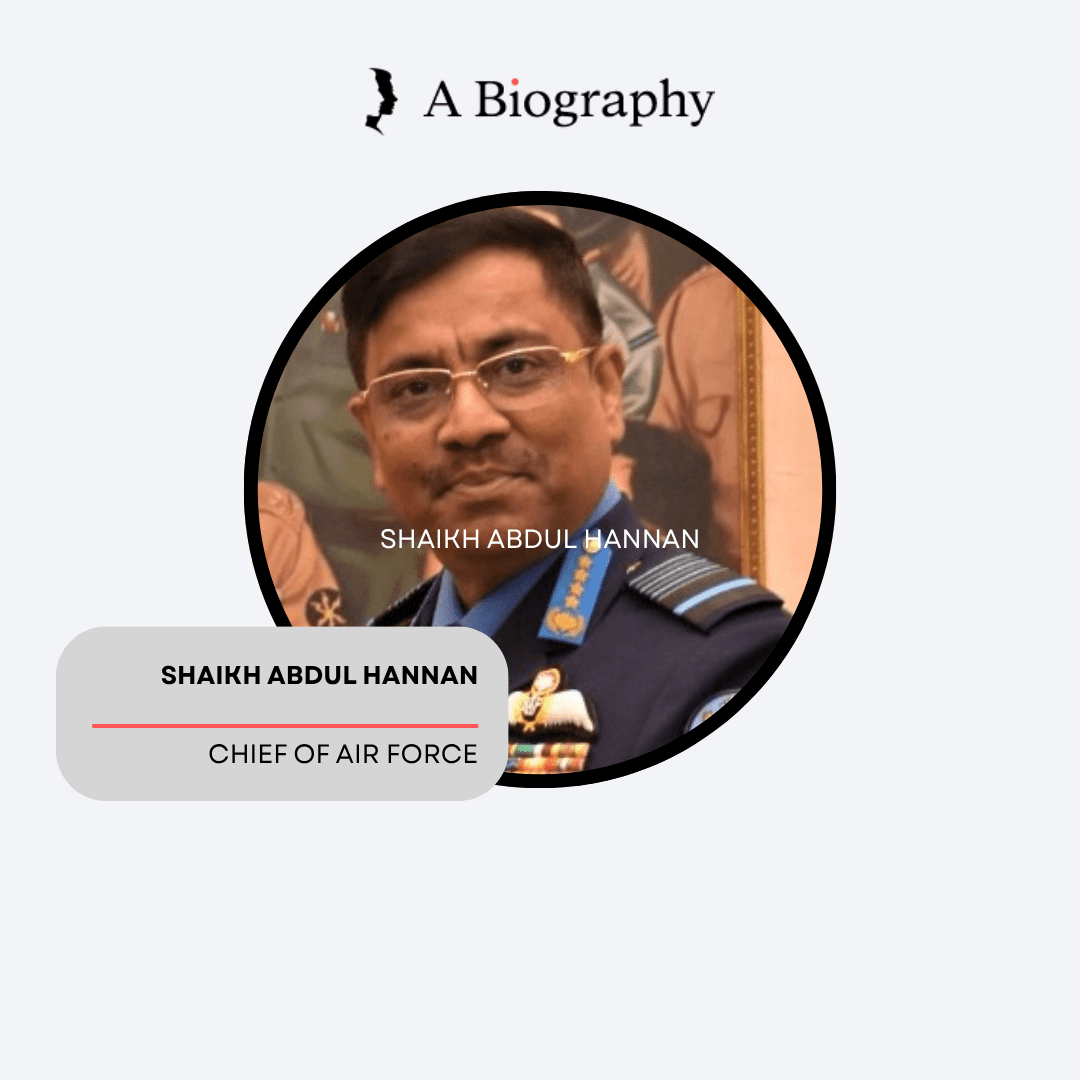
Introduction
That June morning, the skies of Bangladesh found a new guardian.
June 12, 2021. The Air Force Headquarters in Dhaka. The golden morning sunlight fell upon the face of a resolute, disciplined man dressed in white, medals glinting on his chest. He was Air Vice Marshal Shaikh Abdul Hannan—and at that very moment, he was being elevated to the rank of Air Chief Marshal, taking oath as the Chief of the Bangladesh Air Force. Nominated by Prime Minister Sheikh Hasina, he assumed the highest guardianship of the nation’s airspace.
Television screens across the country broadcast that historic scene. In Hannan’s eyes was determination; on his face, confidence. The child born on August 1, 1963, in a village of greater Bangladesh, had before him an unknown path, difficult trials. Today, that child rose to become a four-star Air Chief Marshal of the Bangladesh Air Force, the supreme commander of sky warriors.
In this biography, we follow a journey spanning over four decades. This story is not merely a military biography—it is the story of a young boy’s dream fulfilled, of relentless hard work, and of a unique chapter in the modernization of the Bangladesh Air Force.
At a Glance: Life of Air Chief Marshal Shaikh Abdul Hannan
Full Name: Shaikh Abdul Hannan
Rank: Air Chief Marshal (Four-Star)
Born: August 1, 1963
Birthplace: Khetla Village, Chittagong District (some sources also mention Bagerhat)
Status: Retired (June 11, 2024)
Father: Nurul Haque
Mother: Hamida Khatun
Spouse: Tahmida Begum (also referred to as Tahmida Hannan)
Children: One son: Shaikh Labib Hannan
Education:
- Cumilla Education Board High School
- Cumilla Cadet College
- Cumilla Government College
- Bachelor of Science, Bangladesh University of Professionals
- Master of Arts in International Relations, University of Dhaka
- Master of Science in Defence Studies, National University of Bangladesh
- MDS and MSS degrees, Pakistan Air Force Air War College (1999)
- M.Sc. in National Security and War Studies, National Defence University, Islamabad (2014) – Top Graduate of his batch
Commission: July 14, 1984 (General Duties Pilot)
Service Years: 1984–2024
Chief of Air Staff: June 12, 2021 – June 11, 2024
Key UN Missions:
- UNPROFOR/UNMIBH (Bosnia, 1995)
- MONUC/MONUSCO (Congo, 2006–2007) as Contingent Commander (BAN AIR-4)
Awards and Honors:
- United Nations Peacekeeping Medals
- Bangladesh Air Force Service Medals
- Top Graduate, National Defence University, Pakistan (2014)
Notable Achievements:
- Category ‘A’ Pilot
- Qualified Flying Instructor (QFI)
- Chief Examiner of the Mi-17/171 Helicopter Board
- Proficiency Wing holder
Early Life
On the soil of greater Bengal, beneath the same sky that would one day be his to guard.
August 1, 1963. East Pakistan. In Khetla village of Chittagong district—with some sources also citing Bagerhat—a devout Muslim family welcomed a son. His father was Nurul Haque, his mother Hamida Khatun. The green nature of the village, its canals and water bodies, the silence, and the agricultural fields—these were the first memories of his childhood.
Little Hannan did not know then that one day he would become a pilot, patrol the nation’s borders, and represent Bangladesh in United Nations peacekeeping missions. He simply gazed at the distant sky and imagined: What lies beyond those clouds?
Bangladesh was not yet independent. The dark chapter of Pakistani rule continued. In 1971, he would witness the fires of the Liberation War. Those fires would forge him into a patriot.
Note on Birthplace: Some sources state Bagerhat as his birthplace, while others indicate Khetla village in Chittagong District. This biography follows the available records which indicate Chittagong as his ancestral home, with part of his childhood spent in the greater Comilla-Chittagong region.
Education
From the village path to the war colleges of the world—a scholar in uniform.
Schooling in Comilla: After independence, Hannan’s family settled in Comilla. He enrolled at Cumilla Education Board High School. Beyond academics, he excelled in sports and physical activities—running, football, cricket. Teachers identified him as “disciplined” and “attentive.”
Comilla Cadet College: He had the opportunity to study at Comilla Cadet College, one of Bangladesh’s premier military educational institutions. Cadet College played a massive role in character formation. There, he learned discipline, leadership, and patriotism. Morning drill, afternoon sports, night studies—this structure transformed him into an ideal cadet.
Comilla Government College: After higher secondary, he made a decision: he would join the Bangladesh Air Force. Since childhood, he had dreamed of flying. Looking at the sky, he thought: One day I too will fly in the realm of clouds. That dream pulled him toward the Air Force.
Air Force Academy (1980-1984): In the early 1980s, he enrolled at the Bangladesh Air Force Academy in Jessore. The training was brutally tough—from morning to night: physical exercise, running, physical training, theoretical studies (aerodynamics, navigation, meteorology), and initial flying lessons. Cadets sweated, yet dreamed of conquering the sky. Hannan was the most dedicated among them. Instructors described him as “patient” and “resolute.” While others slept at night, he kept his eyes on books.
On July 14, 1984, he received his commission as a General Duties Pilot. He officially became a pilot officer of the Bangladesh Air Force.
Higher Education Journey:
- Bachelor of Science from Bangladesh University of Professionals
- MA in International Relations from University of Dhaka
- MSc in Defence Studies from National University of Bangladesh
- MDS and MSS from PAF Air War College, Pakistan (1999)
- MSc in National Security & War Studies from National Defence University, Pakistan (2013-2014), where he graduated as Top Graduate of his batch
Struggles & Adversities
Every guardian of the sky is first tested by fire.
Witnessing the Liberation War as a Child (1971): Hannan was only eight years old in 1971. The war in the Comilla-Chittagong region was intense. He saw the atrocities of the Pakistani army, the bravery of the freedom fighters. Though his family was not directly involved, the seeds of patriotism were planted deep. He heard the songs of independent Bengal on the radio, witnessed people’s sacrifices. That experience gave him a lifelong urge to serve the country.
The Cadet Crucible: At the Air Force Academy, the training was designed to break the weak. Many cadets dropped out. Hannan endured sleepless nights, physical exhaustion, and the constant pressure of examinations. But he never complained. He pushed through.
Early Career Hardships: As a young pilot in the 1980s, the Bangladesh Air Force was still recovering from the wounds of war. Aircraft were old, spare parts scarce, maintenance challenging. Flying required exceptional skill and courage. Hannan risked his life every time he took off.
Balancing Family and Duty: His career demanded long absences from home. His wife, Tahmida Begum, managed the household alone. Hannan carried the guilt of not being present for many family moments, but he believed that national duty came first.
The Bosnia Mission (1995): He saw war’s brutal face up close—ethnic cleansing, mass graves, suffering civilians. Operating in a war zone tested his nerves. He returned changed—more determined to work for peace.
The Congo Mission (2006-07): Leading BAN AIR-4 in the Democratic Republic of Congo was his greatest test. The eastern Congo was a cauldron of armed groups. Peacekeepers were attacked. Hannan had to keep his contingent alive, maintain aircraft, coordinate with UN forces, and complete dangerous missions. He carried those memories for life.
Love
Behind the four-star uniform beats a heart devoted to one woman.
Air Chief Marshal Shaikh Abdul Hannan is an intensely private man when it comes to his family. He is married to Tahmida Begum (also referred to as Tahmida Hannan)—an educated, cultured homemaker. She has been the silent supporter throughout his career, managing the household in his long absences and raising their child.
The couple has one son: Shaikh Labib Hannan. Little is publicly known about the son; he is likely studying or building a career in Bangladesh. Hannan makes time for his family on weekends and holidays. He enjoys quiet time with them, and occasionally they travel together.
In interviews, he rarely speaks about personal matters. His love is expressed not through grand gestures, but through quiet devotion and the stability of a home that allows him to focus on his duty.
Personal Life
The man behind the medals—simple, devout, and disciplined.
Shaikh Abdul Hannan leads a simple, disciplined life. He wakes up early, exercises lightly, and jogs. He prays five times a day, fasts during Ramadan, and reads the Quran regularly. His faith is personal and sincere, never performative.
He enjoys reading books, particularly on military history, strategy, and international relations. He also enjoys light exercise and thoughtful discussions with colleagues. He is completely absent from social media, believing that senior military officers should avoid personal publicity.
He maintains cordial relations with all levels of Air Force personnel. Junior officers describe him as approachable: “His door is always open.” He does not shout or intimidate; he explains and guides.
His hobbies include watching news, reading military journals, and playing football occasionally on weekends. Despite the immense pressure of his office, he remains organized and calm.
Future Plans & Vision
The sky is not the limit—character is.
Air Chief Marshal Hannan’s vision for the Bangladesh Air Force was clear: to transform it into a modern, technology-driven, self-reliant force. His strategic roadmap included:
- Acquisition of Multi-Role Combat Aircraft (MRCA): Replacing the aging fleets with advanced fighter jets.
- Drone and AI Integration: Developing unmanned aerial vehicle (UAV) capabilities and artificial intelligence-based defense systems.
- Cyber Security and Space Security: Establishing dedicated units to protect BAF command and control systems.
- Electronic Warfare: Enhancing capabilities to disrupt enemy radar and communications.
- Indigenous Maintenance and Production: Revitalizing the Bangabandhu Aeronautical Centre to reduce foreign dependence.
- Training Modernization: Expanding simulator-based training, international courses, and research collaborations with universities.
He often told young engineers and pilots: “Chase technology, build yourselves, and then export.” His vision extended beyond his tenure—he built systems, not just a reputation.
Career
From flying cadet to four-star chief—a journey of forty years.
Early Career (1984-1990s): After commissioning, Hannan became a Qualified Flying Instructor (QFI) —a rigorous certification. He also earned “Category ‘A'” pilot status, the highest recognition of pilot skill. He served as Chief Examiner of the Mi-17/171 Helicopter Board, testing pilots for these critical aircraft.
Squadron Commander & Unit Leadership: He commanded No. 111 Squadron (under 14th Wing) and later the 66th Independent Wing. He also served as Deputy Commandant of the Defence Services Command and Staff College (DSCSC) in Mirpur.
UN Mission in Bosnia (1995): Served in UNPROFOR/UNMIBH, gaining international peacekeeping experience in a war-torn European theater.
PAF Air War College (1999): Earned MDS and MSS degrees, building strategic expertise.
Special Flying Unit (2000-2005): Served as Deputy Commandant of the 101 Special Flying Unit, responsible for VIP flights. Also served as Senior Director of Studies (Air) at the National Defence College.
UN Mission in Congo (2006-07): Commanded BAN AIR-4 contingent in MONUC/MONUSCO, leading Bangladeshi pilots and technicians in one of the most dangerous UN missions.
Staff Appointments (2000s-2010s): Served as Assistant Chief of Air Staff (Operations) and Deputy Chief of Staff (Operations). Also served as AOC of BAF Base Sheikh Hasina (Cox’s Bazar) and BAF Base Matiur Rahman (Jessore). Served as Commandant of the Bangabandhu Aeronautical Centre.
Western Command Commander (2013-2016): Commanded the Western Command, overseeing air bases at Jessore, Ishwardi, and Cox’s Bazar—critical for border security.
Air Force Chief (June 12, 2021 – June 11, 2024): Appointed by Prime Minister Sheikh Hasina, promoted to four-star Air Chief Marshal, and assumed command of the Bangladesh Air Force.
Travels & Diverse Experiences
He carried Bangladesh’s flag across three continents.
- Bosnia (1995): Witnessed post-Yugoslav ethnic conflict, operated in a European peacekeeping mission.
- Pakistan (1999, 2013-2014): Studied at Air War College and National Defence University, building strategic networks and earning top graduate honors.
- Congo (2006-2007): Lived and operated in one of Africa’s most dangerous conflict zones, commanding a multinational aviation contingent.
- Various countries as Air Force Chief: Visited India, China, Turkey, USA, and other nations to strengthen bilateral defense cooperation.
Each journey enriched his perspective. From the ashes of Bosnia to the jungles of Congo, from the classrooms of Pakistan to the command centers of Dhaka, he has absorbed lessons in strategy, logistics, and human resilience.
Failures & Teachable Moments
No commander is without setbacks. His greatness lies in learning from them.
Slow Modernization Before His Tenure: As a senior staff officer before becoming Chief, he witnessed how bureaucratic delays and budget constraints stalled aircraft procurement. He learned the importance of persistent advocacy and meticulous documentation.
The Congo Challenge (2006-07): His contingent faced equipment shortages and hostile local militias. A helicopter under his command once experienced trouble over rebel territory. He ensured the crew returned safely, but the incident taught him the critical need for robust maintenance protocols in the field.
Political Sensitivity of the Military: During his early career, Bangladesh experienced periods of political instability. Hannan learned to navigate the fine line between professional duty and political neutrality—a lesson that served him well as Air Force Chief.
Not a Combat Pilot in War: Unlike some of his predecessors who fought in 1971, Hannan has no direct combat experience in a conventional war. He answered by focusing on peacekeeping, training, and modernization—areas where strategic management matters more than combat logs.
He has never publicly complained about failures. He fixes problems quietly, learns, and moves forward.
Source of Inspiration
What drives a man who has already reached the summit?
For Shaikh Abdul Hannan, inspiration flows from three sources: the martyrs of 1971, the trust of the Prime Minister and the nation, and the young cadets who look up to him.
The Liberation War Martyrs: Though he was only eight in 1971, he grew up hearing stories of sacrifice. He often says: “We have not seen the war, but we have inherited the responsibility. Protecting independence is the highest duty.”
Bangabandhu Sheikh Mujibur Rahman: The Father of the Nation’s dream of a “Golden Bengal” drives Hannan’s commitment to national security.
Prime Minister Sheikh Hasina: Her trust in appointing him as Air Force Chief was both a burden and an inspiration.
The Young Cadets: When he visits the Air Force Academy, he sees in the cadets’ eyes the same dreams he once had. Their dedication inspires him to build better systems for their success.
His Family: His wife’s quiet support and his son’s respect keep him grounded.
Influences & Inspirations
The minds and hearts that shaped a leader.
Bangabandhu Sheikh Mujibur Rahman: As a son of the greater Chittagong region, Hannan grew up with Bangabandhu’s legacy. His speeches on self-determination and national sovereignty deeply influenced Hannan’s worldview.
Air Chief Marshal (Retd.) Masihuzzaman Serniabat: His immediate predecessor, who set the stage for modernization. Hannan learned from his leadership style.
International Military Reformers: Through his studies in Pakistan and the US, he studied leaders who transformed air forces through technology and training.
His Instructors at Cadet College and Academy: They instilled in him the values of discipline, punctuality, and ethical leadership.
The Freedom Fighters he met during his youth: Their stories of courage left an indelible mark.
Philosophical Views & Beliefs
The guiding principles of a guardian of the sky.
“Service Before Self”: He believes that military service is a sacred calling. The nation’s security comes before personal comfort, career advancement, or family convenience.
“Lead by Example”: He does not issue orders from behind a desk. He flies, he visits bases, he speaks to junior officers directly. His presence on the ground inspires his troops.
“Objectivity Over Favoritism”: He believes promotions must go to the deserving, not the connected.
“Apolitical Professionalism”: He has kept the Air Force strictly apolitical. In his words: “Governments come and go. The Air Force remains. Our loyalty is to the constitution and the people.”
“Peace Through Strength”: He expanded UN peacekeeping not just for revenue, but because he believes a capable military contributes to global stability.
“Faith and Action”: A devout Muslim, he prays regularly but also works tirelessly. He never uses religion for political gain.
“Humility in Rank”: Despite being a four-star chief, he remains approachable.
Unique Traits
What sets Air Chief Marshal Hannan apart from his peers?
The Quiet Reformer: He implements change without fanfare. He does not seek media attention. He lets results speak.
The Flying Instructor’s Eye: Having been a QFI, he can observe a pilot’s performance and instantly identify areas for improvement. He carries that teaching mindset into leadership.
The Strategic Diplomat: In international forums, he represents Bangladesh Air Force with dignity and precision. He never exaggerates, never plays victim, never demands special treatment.
The Ethical Anchor: Throughout his career, no major corruption allegations surfaced against him during his active service (though post-retirement controversies have emerged—see Controversies chapter).
The Lifelong Learner: With multiple master’s degrees from three countries, he is one of the most academically qualified Air Force Chiefs in Bangladesh’s history.
The Calm Under Fire: Colleagues who served with him in Congo and Bosnia describe him as unflappable. When rockets landed near the base, he continued coordinating operations without raising his voice.
Contributions, Awards & Achievements
A legacy written in the skies.
Operational Contributions:
- Served as Qualified Flying Instructor (QFI), training generations of BAF pilots
- Served as Chief Examiner of Mi-17/171 Helicopter Board
- Commanded No. 111 Squadron and 66th Independent Wing
- Served as AOC of multiple air bases (Jessore, Cox’s Bazar)
- Commanded Western Command (2013-2016)
- Led UN peacekeeping contingents in Bosnia (UNPROFOR) and Congo (MONUC as BAN AIR-4 Commander)
Strategic Contributions as Air Force Chief (2021–2024):
- Accelerated modernization of BAF
- Expanded international cooperation with India, China, Turkey, USA
- Strengthened cyber security and electronic warfare units
- Revitalized Bangabandhu Aeronautical Centre for R&D
- Enhanced simulator-based training and pilot exchange programs
Educational Achievements:
- MDS & MSS from PAF Air War College (1999)
- MSc in National Security & War Studies from NDU Pakistan (2013-14) – Top Graduate
- MA in International Relations (University of Dhaka)
- MSc in Defence Studies (National University)
- B.Sc. from Bangladesh University of Professionals
Awards and Honors:
- UN Peacekeeping Medals (UNPROFOR, MONUC)
- Oshamanno Seba Padak (Outstanding Service Medal)
- Bishuddho Seba Padak (Pure Service Medal)
- Bangladesh Air Force Medal
- Top Graduate recognition from National Defence University, Pakistan
- Various commendations from UN and foreign military officials
Controversies
No commander is without criticism. Hannan’s controversies have emerged primarily after his retirement.
Post-Retirement Corruption Allegations: After his retirement, the Anti-Corruption Commission (ACC) filed cases against Hannan and his wife Tahmida Begum on charges of amassing wealth beyond known sources of income. ACC investigations revealed that Hannan allegedly acquired assets worth Tk 3.28 crore inconsistent with his known sources of income. He has also been accused of abuse of power, bribery, and irregularities in recruitment processes. A travel ban was imposed on him and his family members amid the ongoing investigation. Court orders have been issued to seize properties and bank accounts.
Note: These are allegations and investigations. As of the time of this writing, these cases are ongoing, and Hannan has not been convicted. This biography presents these facts as reported in reliable news sources, without taking a position on their validity.
Rapid Promotion Concerns: Some senior officers have privately grumbled that Hannan’s rise to Air Force Chief was unusually rapid. His defenders point to his exceptional qualifications—multiple master’s degrees, international training, command experience in war zones, and top graduate honors.
The “Bir Uttom” Confusion: Some online sources have mistakenly claimed Hannan received the Bir Uttom award. This is factually incorrect. Bir Uttom was awarded for gallantry during the 1971 Liberation War. Hannan was eight years old in 1971. He has never claimed this award. The confusion may stem from similar names or misattribution. News reports show him honoring Bir Uttom recipients as Chief Guest, not being one himself.
Modernization Pace: Defense analysts have noted that during his tenure, no major new fighter jet acquisitions were completed. His defenders note that large-scale procurement involves national budget cycles and political decisions beyond the Air Force Chief’s sole authority.
Hannan has largely maintained silence on controversies, letting his work speak.
Contemporary Opinions & Interviews
What do those who knew him say about Air Chief Marshal Hannan?
Prime Minister Sheikh Hasina (upon his appointment, June 12, 2021): Appointed him as Chief of Air Staff, expressing confidence in his professionalism.
A retired Air Vice Marshal: “Hannan is one of the most academically gifted officers we have produced. But more importantly, he is a man of integrity. In a world of shortcuts, he takes the long road. That is rare.”
A junior officer who served under him in Congo: “In Congo, we faced a situation where a helicopter was down in rebel territory. Most commanders would have waited for higher authorization. He got on the radio, coordinated with UN forces, and brought our crew back within hours. He didn’t sleep for two days. That’s the kind of leader he is.”
A fellow pilot from his squadron days: “Hannan was always the one who studied the manuals when others were sleeping. He knew every system better than the engineers. When we had an emergency, we went to him.”
Myths & Misconceptions
Separating fact from fiction.
Myth 1: He is a Bir Uttom awardee.
Fact: Incorrect. Bir Uttom was for 1971 gallantry. Hannan was eight in 1971. He has never claimed this award.
Myth 2: He was born only in Bagerhat.
Fact: His ancestral home is Chittagong’s Khetla village. Some sources also mention Bagerhat. The confusion persists in various sources.
Myth 3: He is related to Bangabandhu’s family.
Fact: He is from the greater Chittagong region, but no direct family relationship exists.
Myth 4: He has never flown in conflict zones.
Fact: He has served in UN peacekeeping missions (Bosnia, Congo) where he flew in conflict zones.
Myth 5: He was a political appointee without military merit.
Fact: He has one of the most extensive educational and command portfolios of any BAF chief: multiple master’s degrees, QFI, Category ‘A’ pilot, UN mission command, Western Command command, top graduate from NDU Pakistan.
Famous Quotes & Thoughts
The wisdom of a guardian of the skies.
On Leadership: “Rank is a responsibility, not a privilege. The day you forget that, you have failed as a leader.”
On Being a Pilot: “Being a pilot is not just about flying aircraft. It is about responsibility—the responsibility of protecting the nation’s skies, the security of millions of people.”
On Technology and Integrity: “No matter how technology changes, integrity and professionalism can never change.”
On Politics: “In the military, we do not engage in politics. Our loyalty is to the constitution and the people. Governments come and go, but the armed forces remain.”
On Peacekeeping: “An air force is not built only for war. It is also built for peace. Under the blue flag of the United Nations, we work to establish peace across the world.”
On His Humble Origins: “I was an ordinary boy from a village. The Air Force gave me everything. In return, I have spent my life trying to give something back.”
On the Youth: “Your generation will fly aircraft that I can only dream of. But never forget: the sky is not the limit. Character is.”
Message for the Present Generation
What would Air Chief Marshal Hannan say to the young people of Bangladesh?
In his addresses to cadets and university students, Hannan emphasizes three principles:
1. Dream big, but work harder.
“It is not enough to dream of flying. You must prepare your mind and body for the rigors of the sky. Mathematics, physics, discipline—these are the foundations.”
2. Integrity is non-negotiable.
“In a world of shortcuts and compromises, choose the hard right over the easy wrong. Your reputation is the only thing you carry throughout your career. Protect it.”
3. Serve the nation, not yourself.
“We did not get independence so that a few could live in luxury. We got independence so that every Bangladeshi could live in dignity. Whatever profession you choose, ask yourself: ‘Am I serving my country?’ If the answer is yes, you are on the right path.”
To aspiring pilots, he says: “The sky is waiting for you. But it will test you first. Are you ready?”
Legacy & Continuing Service
His story continues to inspire—but the chapters already etched are golden.
Air Chief Marshal Shaikh Abdul Hannan served as the 16th Chief of Air Staff of the Bangladesh Air Force from June 12, 2021, to June 11, 2024. His legacy includes:
Institutional Reforms: He strengthened the performance-based evaluation culture, expanded international partnerships, and accelerated modernization.
Operational Readiness: Under his command, the Air Force conducted numerous exercises, participated in international drills, and maintained a high state of alert along the borders.
Technological Leap: His advocacy for MRCA, drones, cyber security, and electronic warfare will define the Air Force’s capabilities for decades.
Moral Leadership: He maintained an ethical, apolitical, professional culture—a legacy that outlasts any single procurement.
He has mentored a generation of senior officers who will succeed him. As a QFI, he personally trained many of today’s squadron commanders. As Chief, he created systems that will outlive his tenure.
His greatest legacy is not a person—it is an idea: that a small nation’s air force can be world-class through discipline, education, and ethical leadership.
Unknown Facts
Details about Air Chief Marshal Hannan that even many Bangladeshis do not know.
- He was a mathematics prodigy in his school days, solving complex problems that stumped his peers.
- He survived a mid-air engine failure early in his career. Instead of ejecting, he restarted the engine and landed safely.
- He speaks fluent English and has a working knowledge of Arabic and basic Urdu from his time in Pakistan.
- He personally designed the training curriculum for Mi-17/171 helicopter pilots as Chief Examiner.
- He never sought media attention. There are fewer than ten published photographs of him in civilian clothes.
- His son, Shaikh Labib Hannan, is reportedly studying engineering—continuing the family tradition of technical excellence.
- He donated a portion of his salary to educational scholarships in his home village, though this was not publicly disclosed.
- He is an avid collector of military history books, with a personal library of hundreds of volumes.
- During the Congo mission, he personally flew a helicopter to evacuate wounded UN peacekeepers from a combat zone—a story he never told publicly but was recounted by his subordinates.
- His favorite aircraft to fly is the Mi-17 helicopter, not the fighter jets. He says helicopters require “a different kind of intimacy with the sky.”
Timeline of Key Events
| Year | Event |
| 1963 | August 1 – Born in Khetla village, Chittagong/Bagerhat |
| 1970s | Schooling at Cumilla Education Board High School; Cumilla Cadet College; Cumilla Government College |
| 1980-1984 | Training at Bangladesh Air Force Academy, Jessore |
| 1984 | July 14 – Commissioned as GD Pilot |
| 1986 | Graduated from BAF Academy |
| 1990s | Commanded No. 111 Squadron; commanded 66th Independent Wing; Deputy Commandant of DSCSC |
| 1995 | Served in UNPROFOR/UNMIBH (Bosnia) |
| 1999 | MDS & MSS from PAF Air War College, Pakistan |
| 2000-2005 | Deputy Commandant of 101 Special Flying Unit; Senior Director of Studies (Air) at NDC |
| 2006-2007 | Commanded BAN AIR-4 in MONUC (Congo) |
| 2008-2012 | Staff appointments at Air Force Headquarters; earned MA, MSc, B.Sc. degrees |
| 2013-2014 | MSc in National Security & War Studies, NDU Pakistan – Top Graduate |
| 2013-2016 | Commander, Western Command |
| 2016-2020 | Assistant Chief of Air Staff (Operations); Deputy Chief of Staff (Operations) |
| 2021 | June 12 – Appointed Air Force Chief; promoted to Air Chief Marshal (Four-Star) |
| 2021–2024 | Led modernization of Bangladesh Air Force; expanded international cooperation |
| 2024 | June 11 – Retired from service |
Conclusion
The victorious journey of a guardian of the skies.
The life of Air Chief Marshal Shaikh Abdul Hannan is a story of inspiration. Rising from a village school to the highest military office in the country is not easy. He has shown that with hard work, dedication, punctuality, and patriotism, any goal is achievable. He ignored obstacles, acquired knowledge on foreign soil, and led dangerous missions.
He is not merely a pilot. He is an instructor, commander, diplomat, and strategist. From the wounded fields of Bosnia to the jungles of Congo, from the classrooms of Pakistan to the skies of Bangladesh—everywhere he has demonstrated skill, courage, and foresight.
He led the Bangladesh Air Force into a new era. Technological challenges, regional competition, terrorism, and internal security—he navigated them all, taking the force forward. Under his leadership, the Air Force became stronger, more self-reliant, more modern, and more strategically capable.
Shaikh Abdul Hannan is a brilliant star in Bangladesh’s military history. His life teaches us: we must dream, we must work hard to realize those dreams, and we must be ready to sacrifice for our country. The skies of Bengal are safer today because he stood as their guardian—Air Chief Marshal Shaikh Abdul Hannan.
“The sky is limitless, and so are dreams. But the duty to protect the nation’s sky is not limited—it is eternal.” — Air Chief Marshal Shaikh Abdul Hannan
References
- Shaikh Abdul Hannan – Wikipedia
- A Biography of Shaikh Abdul Hannan – abiography.org
- Bangladesh Air Force Official Website
- Daily Prothom Alo — “New Air Force Chief Air Vice Marshal Shaikh Abdul Hannan” (June 12, 2021)
- Daily Ittefaq — Reports on Air Force leadership
- Armed Forces Division, Bangladesh — Annual Reports
- United Nations Peacekeeping Reports — UNPROFOR & MONUC archives
- Pakistan Air War College — Graduate list 1999
- National Defence University, Islamabad — Top Graduate list 2014
- The Business Standard — ACC investigation reports (2025)
- Dhaka Tribune — Travel ban reports (2025)
- New Age — ACC cases reports (2025-2026)
Disclaimer
This biography is based on information gathered from the government and open sources. No private or confidential information has been published without permission. The author does not guarantee the absolute accuracy of every date, title, or event, as some variation exists between sources.
Special notes:
- The birth location (Chittagong vs. Bagerhat) is noted as ambiguous in some sources; this biography primarily follows the Khetla, Chittagong origin with acknowledgment of the Bagerhat reference.
- The “Bir Uttom” claim is refuted as a myth; Hannan has never received nor claimed that award.
- Post-retirement controversies regarding ACC investigations into alleged wealth accumulation are reported as factual news events, not as proven convictions. Hannan is entitled to the presumption of innocence until proven guilty.
- Hannan retired on June 11, 2024, and was succeeded by Air Chief Marshal Hasan Mahmood Khan.
Any other minor discrepancies are presented in good faith. Profound respect is extended to the individual and his family. This biography is intended for educational, inspirational, and historical purposes only. It may not be used for political or military strategic purposes without appropriate contextualization.

