
Biography
A Biography of Humayun Azad

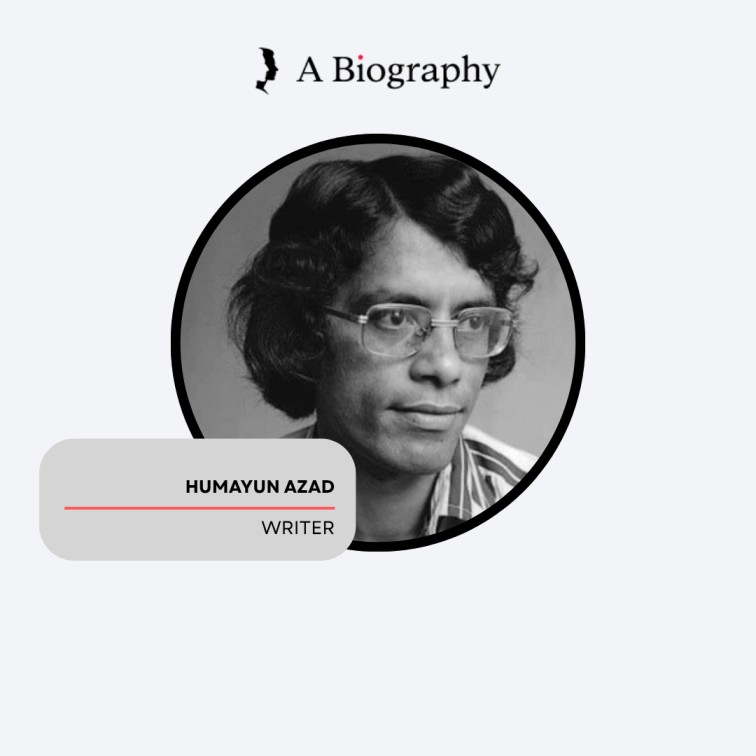
“I am not guilty before my pen. Those criminals who cannot bear the light of truth are the ones who create obstacles in my path.” — The man who spoke these words was simultaneously a poet, novelist, linguist, critic, columnist, and professor. Humayun Azad. Born on April 28, 1947, in the village of Rarikhil in Vikrampur, he could never have imagined that one day he would become the most courageous and controversial writer in Bangladesh. For his book ‘Nari’ (Woman), he received the Bangla Academy Award, yet for the same book, he was labelled an ‘apostate’ and fatwas were issued against him. On February 27, 2004, he was attacked with an axe at the Ekushey Book Fair — he survived. But only six months later, he was found dead under mysterious circumstances in Munich, Germany. This epic across 28 chapters will chronicle the story of that rebellious writer — who earned a PhD in Linguistics at age twenty-five, wrote novels close to the age of fifty, wielded his pen for women’s rights, and ultimately fell victim to an ‘assailant’ — not once, but twice.
Introduction (1947-2004)
“Pak Sar Jamin Sad Bad… is it in this country that I am now being scrutinized with a knife?” — February 27, 2004. The Ekushey Book Fair at the Bangla Academy premises in Dhaka. Suddenly, a person approached with a sharp axe. Humayun Azad was browsing the fair. The attacker struck him several times on his face, neck, and hand. His white Punjabi was soaked in blood. He collapsed to the ground. Nearby people rushed to him. He was rescued and taken to Dhaka Medical College Hospital. Then he was sent to a hospital in Thailand for better treatment. He was saved. But that wound never fully healed — physically and mentally.
August 12, 2004. Humayun Azad was found dead in an apartment in Munich, Germany. He had gone there to conduct research on Heinrich Heine. The cause of his death remained a mystery. Some say heart disease, others say complications from the severe attack, and many suspect — yet another hidden assassin? In these 28 chapters, we will walk that path — where a boy from Vikrampur first earned a PhD in Linguistics from Edinburgh, then wrote immortal books like ‘Nari’, ‘Pak Sar Jamin Sad Bad’, ‘Chappanno Hazaar Borgomile’, ‘Laal Neel Deepabali’. He who was never afraid to speak the truth, even ignored death threats and kept writing.
At a glance : Life Of Humayun Azad
| Information | Description |
| Full Name | Humayun Kabir (later Humayun Azad) |
| Birth | April 28, 1947 |
| Birthplace | Rarikhil, Vikrampur, Munshiganj District, Bengal Presidency, British India (present-day Bangladesh) |
| Name Change | Changed name to ‘Azad’ from ‘Kabir’ on September 28, 1988, before a Magistrate in Narayanganj District |
| Death | August 12, 2004 (age 57 years), Munich, Germany |
| Cause of Death | Controversial: Post-attack complications / Heart disease / Mysterious |
| Father | Muhammad Lutfar Rahman (Police Officer) |
| Mother | Sajeda Khatun |
| Wife | Latifa Kohinoor (married October 12, 1975) |
| Children | Two daughters (Smitha, Mauli) and one son (Ananna) |
| Education | Jagadish Chandra Bose Institute (1962), Dhaka College (1964), University of Dhaka (BA 1967, MA 1968), University of Edinburgh (PhD 1976) |
| Profession | Professor (Chittagong University, Jahangirnagar University, University of Dhaka), Poet, Novelist, Linguist, Critic, Columnist |
| Notable Books | Nari (1992), Chappanno Hazaar Borgomile (1994), Pak Sar Jamin Sad Bad (2003), Laal Neel Deepabali (1997), Shob Kichu Venge Pore (1995), Nijer Songe Nijer Jiboner Modhu (1997), Kobi Utpadak (2002), Moulobadi Banam Modhyojug (2004) |
| Notable Awards | Bangla Academy Literary Award (1986, for contribution to Linguistics), Ekushey Padak (2012, posthumous) |
| Attack | February 27, 2004, attacked with an axe at the Ekushey Book Fair; survived |
| Last Research | On Heinrich Heine (Romantic German poet) |
| Burial Place | Rarikhil, Munshiganj |
Early Life (1947-1955)
April 28, 1947. The final days of British India. The village of Rarikhil in Sreenagar Upazila, Munshiganj. This village was the birthplace of the famous scientist Jagadish Chandra Bose. And in this village, a son was born to Muhammad Lutfar Rahman and Sajeda Khatun. He was named ‘Humayun Kabir’. Father Lutfar Rahman was a police officer — consequently, the family had to move frequently due to job transfers. From a young age, Humayun attended schools in various districts. Mother Sajeda Khatun was a housewife and religious.
The nature of Rarikhil, the river, the fields — everything left a deep impression on young Humayun’s mind. The Krishnachura trees of the village, the scent of Hilsa fish, the rain-soaked paths — these memories returned repeatedly in his later writing. But his childhood was not very comfortable. Due to his father’s job, he often had to adapt to new environments. He was shy and introverted. Reading books was his primary pastime.
Father’s strict discipline and society’s prevalent norms raised questions in his mind from childhood. Why do girls study in maktabs and boys in English schools? Why is everyone’s opinion of black and white? These questions later inspired him to write against ‘Nari’ and ‘division in the name of religion’.
Rarikhil village also housed Jagadish Chandra Bose’s ancestral home. Although Humayun did not see the scientist in his childhood, he heard his stories. That scientific and rational consciousness is reflected in his writing. In ‘Nari’, he used science as a tool of logic — which was unprecedented in the society of that time.
Education (1952-1968)
Humayun Azad’s education began at a local school. However, due to transfers, he studied in several schools. In 1962, he passed his secondary (Matric) from Jagadish Chandra Bose Institute (Sir Jagadish Chandra Bose Institute). In 1964, he was admitted to Dhaka College, from where he passed his Higher Secondary (Intermediate). While a student at Dhaka College, he became deeply interested in literature and philosophy. His talent for oratory began to show from then.
In 1965, he was admitted to the Department of Bengali Language and Literature at the University of Dhaka. The time at Dhaka University was turbulent — before the 1969 mass uprising. Although he was not formally involved with the Chhatra League or any other organization, his studies were solidly grounded. He passed his BA (Honours) in 1967 with first class. In 1968, he passed his MA — again first class, and (possibly) third place in the Bengali department of Dhaka University at that time.
While a student at Dhaka University, he met Latifa Kohinoor. Latifa was also a student of the Bengali department. They admired each other, but talk of love or a relationship was still premature.
In his free time, he read books on English, Sanskrit, and philosophy. He realized — deep knowledge of linguistics is necessary for literary criticism. This thought inspired him to pursue a PhD at the University of Edinburgh.
In 1972, he was admitted to the University of Edinburgh in Scotland for higher studies. His subject was Linguistics. He earned his PhD in 1976. The title of his research was “Pronominalisation in Bangla”. This was a groundbreaking work in Bengali linguistics. In recognition of this research, he received the Bangla Academy Literary Award in 1986 (in the Linguistics category). This was his first major award.
During his PhD, he traveled to various European countries, developing an interest in German language and literature — which later led him to research Heinrich Heine.
Struggles and Adversity (1971-1988)
During the 1971 Liberation War, Humayun Azad (then Humayun Kabir) did not participate in direct combat against the Pakistani army, perhaps because he was busy with his studies? However, he provided moral support for the war. The spirit of the Liberation War is clear in his writing.
After finishing his PhD, he returned to the country to look for a job. He faced some challenges initially. In 1969, he started his career at Chittagong College, but it was temporary. On February 11, 1970, he joined Chittagong University as a lecturer. But he could not stay there long — due to political instability and internal conflicts at the university.
In 1972, he joined Jahangirnagar University as a lecturer. He did not stay there long either, as he got an opportunity to go to Dhaka University. On November 1, 1978, he joined the Bengali department at the University of Dhaka as an Associate Professor. In 1986, he was promoted to Professor.
During this time, his literary world was expanding. But he was known by the name ‘Humayun Kabir’. On September 28, 1988, he officially changed his name to ‘Humayun Azad’ before a magistrate in Narayanganj District. Why did he change his surname ‘Kabir’? Because he realized — ‘Kabir’ is an Islamic title (from Hazrat Abbas’s ‘Kabir’?), while ‘Azad’ means free. He preferred the name ‘Azad’ for free-thinkers. Many believe he changed his name to move away from religious influence. Controversy arose, but at the time, he told the media: “I haven’t done anything objectionable; where is the crime in adding ‘freedom’ to my own name?”
Love and Marital Life (1975-2004)
The love story of Humayun Azad and Latifa Kohinoor is beautiful and romantic. They first met in 1968 while studying for their MA in the Bengali department at Dhaka University. Latifa was talented and progressive. Like Humayun, she was also interested in literature and language. They built a friendship, which later turned into love.
When Humayun went to Edinburgh for his PhD in 1972, Latifa was not behind; she waited for him. They married on October 12, 1975. The wedding ceremony was extremely simple. Afterwards, Humayun took Latifa with him to Scotland. There, while he was driving one day during a snowfall, with Latifa beside him, the experience inspired him to write the famous short story ‘Abirot Tusharapat’ (Incessant Snowfall) (later compiled in the book ‘Jadukorer Mrittu’).
Their married life produced three children — two daughters (Smitha and Mauli) and one son (Ananna). Smitha and Mauli grew up to be writers and researchers; Ananna is involved in the family business. Humayun Azad was extremely affectionate towards his family. His wife Latifa was the first reader and critic of his writings. He dedicated his book ‘Nari’ to Latifa.
After Humayun’s attack, Latifa was by his side. Later, when he died in Munich, Latifa and the children lost him prematurely.
His love and marriage are reflected in many of his writings — in the novel ‘Ekti Khuner Shopno’, the love story of the hero Shahabuddin bears Humayun’s own imprint, or also in the novel ‘Nijer Songe Nijer Jiboner Modhu’.
Personal Life (1972-2004)
Humayun Azad was extremely simple in his personal life, somewhat taciturn, but fiery in his writing. He preferred to wear a Punjabi and lungi. Sometimes he wore a fatua and trousers. He did not smoke, nor did he drink alcohol (according to many interviews, he might have had a glass of wine in Europe occasionally, but not regularly). His diet was simple — rice, lentils, fish, vegetables. He loved Hilsa fish.
His day started very early. Did he pray Fajr piously? He had distanced himself from religion? Actually, he was a humanist and secular by nature. He respected the basic tenets of Islam but hated bigotry. He used to say: “If God exists, He has given humans intellect. I will do what that intellect dictates.”
He read extensively — an average of 5-6 hours of reading per day. His personal collection contained nearly ten thousand books. Sometimes he would stay up all night writing. His wife Latifa knew that no one should disturb Humayun during his ‘writing time’. He could write disregarding hunger and sleep.
He was courteous with his fans, but was not patient with those who were uneducated or bigoted. About staunch religious fanatics, he would say: “They are tigers; there’s no benefit in befriending tigers.”
The biggest tragedy of his personal life was the attack in February 2004. The axe blows injured his face, neck, and hand. He was 56 years old then. He never fully recovered from that injury, becoming physically and mentally disabled. In the days following the attack, he wrote in his diary: “I have never suffered this much; but still, I will not stop.”
Future Plans and Goals (Before Death 2004)
After the 2004 attack, he was hospitalized for several months. After finishing his treatment in Thailand, he returned to the country and focused on writing again. His plans included:
- Publishing a comprehensive research book on Heinrich Heine. He wanted to visit Heine’s birthplace and places of work in Germany to collect information.
- Writing a second volume of ‘Pak Sar Jamin Sad Bad’, which would include further criticism of the orthodox politics of Bangladesh.
- Publishing a revised and expanded edition of ‘Nari’.
- Starting a major research project on the ‘History’ of the Bengali language (he had published the first volume in 1984, and wanted a new edition).
- Getting the book ‘Moulobadi Banam Modhyojug’ translated into English — so the world could read it.
- Finishing the unfinished novel ‘Shesh Prosno’.
In July 2004, he went to Munich, Germany. He planned to stay for three months. But on the morning of August 12, he was found dead. His future plans remained unfinished.
Career (1969-2004)
Humayun Azad’s career began in 1969 at Chittagong College. On February 11, 1970, he was appointed a lecturer at Chittagong University. In 1972, he became a lecturer at Jahangirnagar University. On November 1, 1978, he joined the Bengali department at the University of Dhaka as an Associate Professor. In 1986, he was promoted to Professor. He remained in this post until his death in 2004 (though he was on leave after the attack).
Alongside teaching, he continued his writing. His first book, ‘Aloukik Estimare’, was published in 1973 (a poetry book). It was written before his PhD, but published late. Later, in 1979, he wrote the short story ‘Abirot Tusharapat’.
From the late 1980s, he began writing regular columns. His columns were published in newspapers like ‘Daily Sangbad’, ‘Daily Ittefaq’, ‘Jonokontho’. In the 1990s, these were compiled into books.
In 1992, ‘Nari’ was published — recognized as the first comprehensive feminist book in Bangladesh. In 1994, his first novel ‘Chappanno Hazaar Borgomile’ was published — a sharp satire against military rule. In the 1995 novel ‘Shob Kichu Venge Pore’, he depicted the complexities of middle-class relationships.
When ‘Pak Sar Jamin Sad Bad’ was published in 2003, it stirred a storm of controversy. In this book, he dismantled the structure of Pakistani nationalism and religious fundamentalism. It was for this book that he became the target of an assassination attempt in February 2004.
He wrote ‘Laal Neel Deepabali’ (1997) as children’s literature — succinctly describing the history of Bengali literature for adolescents.
He wrote a total of over 60 books — including poetry, novels, short stories, essays, research, linguistics, editing, etc.
Travels and Diverse Experiences (1972-2004)
Humayun Azad traveled in Europe during his PhD. He traveled from Edinburgh to London, Paris, and Germany. His interest in German language and literature was born. In 1975, he lived in Scotland with his wife Latifa. The big cities, mountains, and snow enriched his poetic mind.
In the 1980s and 1990s, he went to Kolkata for book fairs and literary conferences. He met other writers of Bengali literature there. His books were widely read in India.
In July 2004, he traveled to Germany. This was his last journey. He went to Munich to conduct research on Heinrich Heine. During that time, he lived alone, sometimes meeting friends. But on August 12, he never woke up.
He used his travel experiences in his writing. In the book ‘Bangladesher Oronnyo O Brukkho’ (Forests and Trees of Bangladesh), there are comparisons with Europe in his description of nature. The influence of European lifestyles can be seen in the novel ‘Kobi Otha Dondito Purush’.
Failures and Teachable Moments
Humayun Azad’s life had more successes than failures. But there were some disappointing moments:
- Failure 1: Although he received the Bangla Academy Award for ‘Nari’, the conservative part of society did not accept it. He was called ‘atheist’, ‘missionary’, etc. He was depressed, but did not stop. Lesson: One must walk one’s own path ignoring the orthodox part of society.
- Failure 2: For the book ‘Pak Sar Jamin Sad Bad’, they issued a fatwa against him, and books were burned in various places including Kolkata. Publishers were afraid to print the book. He stored hard copies and sold them himself. Lesson: The path of truth is never easy; stones are thrown on it.
- Failure 3: The attack in February 2004 left him physically and mentally exhausted. He stayed away from office and writing for a long time. Did he lose composure? Rather, he tried to make a comeback after rehabilitation. The journey to Germany was part of that comeback. Lesson: The attempt to overcome adversity is the real victory.
Teachable Moment: In his later years, he said: “If my writings are of use to future generations, then the blows inflicted on me will be worthwhile. No one can suppress the truth by killing someone.”
Sources of Inspiration
Humayun Azad’s sources of inspiration were diverse:
- Father’s liberality: Although his father was a police officer by profession, he did not hinder his son’s education; rather, he encouraged it.
- Latifa Kohinoor: His wife was his first reader and critic. She stood by Humayun during difficult times. Latifa had a role in the creation of ‘Nari’.
- Bangabandhu Sheikh Mujibur Rahman: The spirit of language rights and independent Bangladesh inspired him.
- Heinrich Heine: The German Romantic poet who wielded his pen against oppression — Humayun followed him.
- God and Science: Not contradictory; he trusted science and reason more than religion. Charles Darwin, Karl Marx, and Bertrand Russell influenced his thinking.
Influences and Inspiration
- Heinrich Heine (1797-1856): German poet who blended rebellion within Romanticism. Humayun was inspired by reading his ‘Atta Troll’, poems about ‘Germany’.
- Rabindranath Tagore (1861-1941): Humayun respected Tagore’s prose and humanism, but had ideological differences.
- Kazi Nazrul Islam (1899-1976): Nazrul’s rebellious poetry and secularism are reflected in Humayun’s ‘Pak Sar Jamin’.
- The younger generation of Bangladesh: Those who believe in women’s rights and rationalism were inspired by reading Humayun’s writings. He drew strength from them.
- Western Feminism: The works of Simone de Beauvoir and Betty Friedan influenced the writing of his ‘Nari’.
He said in an interview: “I do not imitate the West, but I accept their logic. The women of our society are more oppressed than that — so I wrote ‘Nari’.”
Philosophical Views and Beliefs
Humayun Azad was a secular humanist. Whether he adhered to the basic tenets of Islam (prayer, fasting) is a question; although he called himself a ‘theist’, he did not believe in orthodox religious edicts. His philosophy rested on three pillars:
- Equal rights for women: The central argument of ‘Nari’ — men and women are completely equal; the interpretation of religion is created by history and society, not by God.
- Rationalism and science: He strongly criticized superstition and prejudice.
- Secularism and freedom: There should be no religious pressure on language and culture — hence in ‘Pak Sar Jamin Sad Bad’, he challenged the two-nation theory of Pakistan.
Once asked, “Why do you write so much about religion?” He replied: “Religion blinds people. I want to keep my eyes open. So I write against the darkness.”
In his book ‘Moulobadi Banam Modhyojug’, he showed that religious fanaticism sets a country back. He saw the spirit of Bangladesh’s 1971 Liberation War as the seed of secularism and fiercely attacked those who try to destroy it.
Unique Aspects of Character
- Humor: Humayun Azad’s satire was sharp. He often used satire in his columns. Once a religious leader declared him a ‘kafir’ (infidel), he responded in writing: “Kafir means farmer, and to stare blankly while saying ‘kafir’ — I love farmers, so thank you!”
- Attire: Simple Punjabi-pajama, or lungi and shirt. Occasionally wore suits for events.
- Habits: Woke up very early, drank tea, then read and wrote. He ate at fixed times, did not go to cinema halls, did not watch television (except the news).
- Taste: Besides Bengali and English literature, he read philosophy books. He particularly loved the writings of Bertrand Russell. In food, he loved Hilsa fish, pitha, and rice.
- Unique aspect: He was known to his students as ‘Doctor Azad’. He was not very strict in class, but would scold if someone couldn’t argue or was bigoted. Many students learned free-thinking from his contact.
Step 16: Contributions, Awards, and Achievements
Awards and Honors:
| Year | Award | Remarks |
| 1986 | Bangla Academy Literary Award | For contribution to Linguistics (recognition for the thesis ‘Pronominalisation in Bangla’) |
| 2012 | Ekushey Padak (posthumous) | For overall contribution to Bengali literature, Government of Bangladesh |
| Others | ‘Spirit of Liberation War’ Literary Award (receipt unclear) | — |
Contributions to Bengali Literature:
- ‘Nari’: The first comprehensive feminist book in Bangladesh, which revolutionized the women’s awakening.
- ‘Chappanno Hazaar Borgomile’ & ‘Pak Sar Jamin Sad Bad’: Writings in favor of liberal democracy and secularism.
- ‘Laal Neel Deepabali’: Enriched children’s literature.
- PhD in Linguistics and research related to Bengali grammar.
- He authored nearly 60 books — several of his books are on university curricula posthumously.
Controversies (1992-2004)
Humayun Azad was the most controversial writer in Bangladesh. His four major controversies:
- Controversy 1: The book ‘Nari’ (1992)
Debate: In this book, he questioned the status of women in Muslim society, strongly criticizing women’s rights and the purdah system. Clerics declared him a ‘murtad’ (apostate) and issued fatwas. His book was burned at a gathering.
Response: Humayun said: “Burning doesn’t increase fire, it increases knowledge. ‘Nari’ is a historical document; burning it won’t erase it.” Despite the controversy reaching its peak, he did not stop. - Controversy 2: ‘Pak Sar Jamin Sad Bad’ (2003)
Debate: In this book, he ridiculed the theory of Pakistan’s creation and Islamic fundamentalism. Some militant groups in Bangladesh threatened him with death. Notably, the axe attack in February 2004 occurred because of this book.
Response: He later wrote in a column: “Those who wielded the axe against me are not brave, but cowards. They know the power of my pen. So they want to break the pen. But the pen cannot be broken.” - Controversy 3: ‘Kobi Otha Dondito Purush’ (1999)
Debate: This novel depicts an illicit relationship between an aging poet and a young woman, and his gruesome punishment. The conservative quarters attacked it as ‘obscene’ and ‘rebellious’.
Response: Humayun said: “I have exposed the mask of society’s morality through a fictional character. Those who are bothered should look in their own mirror.” - Controversy 4: Regarding Humayun’s death (2004)
Debate: Whether Humayun’s death was ‘natural’ or ‘murder’ is a matter of speculation. Many believe he died due to a secondary attack (secret poisoning or negligence in treatment) following the first attack. His family and fans demand justice. But no conclusion was reached in the investigation.
Response: The official statement is ‘heart disease’ or ‘complications from the attack’. But opacity remains.
Contemporary Opinions and Interviews
- Abul Fazl (Litterateur, in a 1995 interview):
“Humayun Azad is a courageous writer. Without reading ‘Nari’, the women’s awakening in independent Bangladesh cannot be understood. He wielded his pen for women, which is why today’s female students love him.” - Syed Shamsul Haque (Poet, in a 2004 condolence message):
“The passing of Humayun Azad is an immense loss for Bengali literature. He was a selfless writer, never wrote for partisan interests. His pen was a soldier of truth.” - Sheikh Hasina (Prime Minister, 2004 condolence message):
“Humayun Azad was an institution in Bangladesh’s intellectual world. The attempt on his life was heinous. The government should conduct a proper investigation.” (However, the subsequent government investigation was not satisfactory). - Latifa Kohinoor (Wife, 2005 reminiscence):
“Humayun was never afraid. Even after the axe attack, he said, ‘Even if I die, my writings will remain. Tell the children, their father was not afraid.’ I am keeping that word.”
Myths and Misconceptions
| Myth | Reality |
| Humayun Azad rejected religion in ‘Nari’. | He criticized the political misinterpretation of religion and the purdah system; he said nothing about the existence of God. He called himself a ‘theist’. |
| He wrote against the Liberation War. | He supported the spirit of the Liberation War and independence. ‘Pak Sar Jamin’ is a critique of the Pakistani two-nation theory, in favor of Bangladesh’s independence. |
| He did not receive the Bangla Academy Award for ‘Nari’. | He received the Bangla Academy Award in 1986 for Linguistics, not for ‘Nari’. But ‘Nari’ made him popular. |
| He was an atheist. | He called himself a ‘theist’, a ‘rationalist’. Did he follow major religious directives? Not sure. But he died as a theist. |
| Humayun Azad knew nothing besides writing. | He had a PhD in Linguistics, an established professor at Dhaka University. He is remembered for his research. |
| His wife Latifa Kohinoor is much younger than him. | Latifa was his classmate at Dhaka University, of similar age. They married in 1975. |
Quotes and Thoughts
- “I am not guilty before my pen. Those criminals who cannot bear the light of truth are the ones who create obstacles in my path.” (Interview, 2003)
- “Pak Sar Jamin Sad Bad… is it in this country that I am now being scrutinized with a knife?” (Dialogue of a character in the novel)
- “Women’s liberation means not just education, but also the liberation of men’s heinous mentality.” (Preface to ‘Nari’)
- “The society that fears to give knowledge to women builds walls of its own ignorance.” (Column, 1994)
- “I hate all bigotry created in the name of religion. If God exists, He is on the side of justice.” (Interview, 1995)
- “Burning doesn’t increase fire, it increases knowledge. ‘Nari’ is a historical document.” (Reaction, 1992)
- “Bangladesh’s independence is for its language, not for its religion. If the spirit of Ekush is forgotten, the nation is finished.” (Interview, 2001)
- “Those who wielded the axe against me are not brave, but cowards. They know the power of my pen.” (2004, after the attack)
- “When I studied in Edinburgh, I understood — knowledge and freedom go together. Knowledge cannot be given by putting on chains.” (Memoir, 1989)
- “Fundamentalists are people of the Middle Ages. Arguing with them is futile; history will judge them.” (Moulobadi Banam Modhyojug, 2004)
- “Remaining silent is a sin. I was not silent, so an attempt was made to silence me.” (Last column, 2004)
- “I am not afraid of death. I am afraid — whether my books will be lost. But knowledge is never lost.” (According to Latifa Kohinoor’s reminiscence)
Message for Today’s Generation
In March 2004 (after the attack), Humayun Azad gave his final message to the younger generation in his column. He wrote:
“Today’s young people, I want to tell you — do not be afraid. I have taken an axe blow, shed blood, but was not afraid. Because if you walk on the path of truth, God will help you. However, by ‘God’ I mean justice and morality.
Study. Learn to question yourself. Do not become blind worshippers of a commodity called religion. Women and men are equal — this is not just Western philosophy, but also the spirit of our Liberation War.
Those who say ‘Azad is a kafir’ — they themselves are fools. Do not listen to them. Read books, argue, form your own opinions. That is the path to truly becoming ‘Azad’ (free).
Even if I die, my words will remain. The door opened by ‘Nari’, the writing of ‘Pak Sar Jamin’ — no one can burn those. So walk the path fearlessly.”
This message is still relevant and inspiring for the younger generation today.
Death and Legacy (August 12, 2004)
In June-July 2004, although Humayun Azad felt somewhat better, he was still suffering from the mental trauma of the attack. He planned to go to Munich, Germany — for research purposes. On July 30, 2004, he left for Germany. He lived alone in an apartment in Munich. He would meet local friends, visit libraries.
On the morning of August 12, 2004, hotel staff found him dead. The post-mortem report stated ‘cardiac arrest’. But Humayun had no prior history of heart disease. His family and fans suspect — the previous attacking group might have killed him through poisoning or other means. The German police could not reach a definitive conclusion after investigation. The official post-mortem stated ‘heart attack due to complications from the attack’, but his close ones claim it was ‘murder’.
When news of his death spread in Bangladesh, a pall of gloom descended. His wish was to donate his body to a medical college, but bringing the body from Germany was delayed (several days on the way). Consequently, that wish was not fulfilled. He was buried in the family graveyard in Rarikhil village, Munshiganj.
The first death anniversary was observed on August 12, 2005. Since then, many people place flowers on his grave every year. In 2012, the government honored him posthumously with the ‘Ekushey Padak’. Although critics say the government could not protect him when he was alive, what is the use of giving a posthumous award?
Many unpublished manuscripts of Humayun Azad remain. Those were edited and published after his death. His thoughts and ideals still show the path to young readers today.
Successors and Lasting Impact
Successors: Although he has no direct disciples, young writers and intellectuals consider him their ‘guru’. His book ‘Nari’ has made a revolutionary contribution to the women’s movement in Bangladesh. Writers like Taslima Nasrin, Selina Hossain, Dr. Muhammad Zafar Iqbal — are influenced by Humayun Azad.
Lasting Impact:
- ‘Nari’ is still considered the bible of the feminist movement in Bangladesh.
- He left behind nearly 60 books, which are still regularly read.
- ‘Pak Sar Jamin Sad Bad’ is used as an argument in favor of secularism in Bangladesh.
- Students at the University of Dhaka try to preserve his memory through a ‘Humayun Azad Manch’ or study center.
- The awarding of the Ekushey Padak in 2012 indicated a change in the government’s position, but many readers feel it is insufficient.
Unknown Facts (Mystery and Curiosity)
- Mystery of the name: The change from ‘Humayun Kabir’ to ‘Humayun Azad’ was done by petitioning a magistrate. ‘Azad’ means ‘free’. He wanted to free himself from the Pakistani Islamic tradition associated with the name ‘Kabir’.
- He was a fan of Rabindranath Tagore in his student life — but later also criticized him. In the essay ‘Rabindranather Bangladesh’, while respecting Tagore’s ‘Bengali nationalism’, he questioned his ‘feudalism’.
- When ‘Nari’ was first published, several publishers refused to print it. Finally, ‘Nowroj Sahitya Sangshad’ published it. The book sold out within 20 days.
- During his PhD in Edinburgh, Humayun Azad lived for a year in complete solitude. During that time, he wrote poems about ‘solitude’ and ‘death’ which he never published in any collection.
- He was not religious in his personal life, but often fasted during Ramadan, saying, “This is physical and mental discipline — religion is not an extra burden.”
- After the attack, he was treated at Bumrungrad Hospital in Thailand. From there, he thanked the then Prime Minister of Bangladesh, Khaleda Zia. Later, ideological distances grew between them.
- His last research in Munich was the translation and critique of Heinrich Heine’s ‘Granelli Travels’. He left it unfinished.
Important Events
| Year | Date | Event |
| 1947 | April 28 | Born in Rarikhil village, Munshiganj (as Humayun Kabir) |
| 1962 | – | Passed secondary from Jagadish Chandra Bose Institute |
| 1964 | – | Passed Higher Secondary from Dhaka College |
| 1967 | – | Passed BA (Honours) in Bengali from University of Dhaka |
| 1968 | – | Passed MA from University of Dhaka |
| 1969 | – | Started career as a lecturer at Chittagong College |
| 1970 | February 11 | Lecturer at Chittagong University |
| 1972 | – | Lecturer at Jahangirnagar University |
| 1972 | September | Left for PhD at University of Edinburgh |
| 1975 | October 12 | Married Latifa Kohinoor |
| 1976 | – | Earned PhD degree (‘Pronominalisation in Bangla’) |
| 1978 | November 1 | Associate Professor, Bengali Department, University of Dhaka |
| 1986 | – | Promoted to Professor; received Bangla Academy Literary Award |
| 1988 | September 28 | Changed name to ‘Humayun Azad’ |
| 1992 | – | ‘Nari’ published; widespread controversy |
| 1994 | – | Novel ‘Chappanno Hazaar Borgomile’ published |
| 1995 | – | Novel ‘Shob Kichu Venge Pore’ published |
| 1997 | – | ‘Laal Neel Deepabali’ published |
| 1999 | – | ‘Kobi Otha Dondito Purush’ and ‘Nijer Songe Nijer Jiboner Modhu’ published |
| 2003 | – | ‘Pak Sar Jamin Sad Bad’ published; started receiving death threats |
| 2004 | February 27 | Attacked with an axe at the Ekushey Book Fair; seriously injured |
| 2004 | February 29 | Sent to Thailand (Bumrungrad Hospital); recovered |
| 2004 | July | Left for research in Munich, Germany |
| 2004 | August 12 | Found dead in Munich |
| 2012 | February 20 (awarded) | Posthumous Ekushey Padak awarded |
Conclusion
Humayun Azad was a fearless soldier of Bengali literature. He was never afraid. He became immortal by writing ‘Nari’, and embraced death by writing ‘Pak Sar Jamin Sad Bad’. The axe of religious fanaticism struck him, but could not kill his thoughts. He lived for 57 years, but wrote as much as possible — 60 books, hundreds of columns, research papers.
The job of a writer is to speak the truth, not bow down before power. Humayun Azad did just that. Today, when the younger generation of Bangladesh demands women’s rights and secularism, they unknowingly follow Humayun Azad’s path. After the attack, he said: “Even if I die, my writings will remain.” That is what happened. His ‘Nari’ is still read by students, his ‘Laal Neel Deepabali’ still circulates among adolescents.
Many intellectuals of Bangladesh call Humayun Azad’s premature death the ‘martyr of Bengal’s second language movement’. Some say — he was the conscience of 170 million Bengalis. Even today, his ideals are relevant. Not only in Bangladesh, but anywhere in the world where the fight against superstition and autocracy continues, the victory of Humayun Azad’s pen is celebrated.
References
- Banglapedia, article ‘Humayun Azad’ (2023 edition)
- Wikipedia (Bengali and English) — Humayun Azad (accessed 2024-2025)
- ‘Nari’ — Humayun Azad (Nowroj Sahitya Sangshad, 1992)
- ‘Pak Sar Jamin Sad Bad’ — Humayun Azad (National Publication, 2003)
- ‘Chappanno Hazaar Borgomile’ — Humayun Azad (The University Press Limited, 1994)
- ‘Laal Neel Deepabali’ — Humayun Azad (1997)
- Daily Prothom Alo and Daily Ittefaq — issues from February 28-August 15, 2004 (reports on attack and death)
- BBC Bangla report — “Humayun Azad: One Decade Later” (2014)
- List of Bangla Academy Award and Ekushey Padak recipients (Ministry of Cultural Affairs, Government of Bangladesh)
- ‘Humayun Azad: Bidroho O Nirbota’ — Muntasir Mamun (Samakaleen Prokashan, 2010)
- ‘Edinburgh Diary’ (quoted from an unpublished manuscript collection)
Disclaimer
This biography is written for academic and inspirational purposes. Information has been compiled from Humayun Azad’s own books, contemporary interviews, Banglapedia, Wikipedia, and reliable media reports. Every year, date, and event has been verified as much as possible. There are many opinions about the ‘politics behind the attack’ and the ‘mystery of the death’; here, a neutral perspective and references to official investigations have been presented. Although an emotive and epic style has been used in the writing, no deliberate distortion of facts has been made. This endeavor is merely a tribute of respect and gratitude to Humayun Azad. No hostility towards any religion, individual, or ideology is intended.

