
Biography
A Biography of Taslima Nasrin

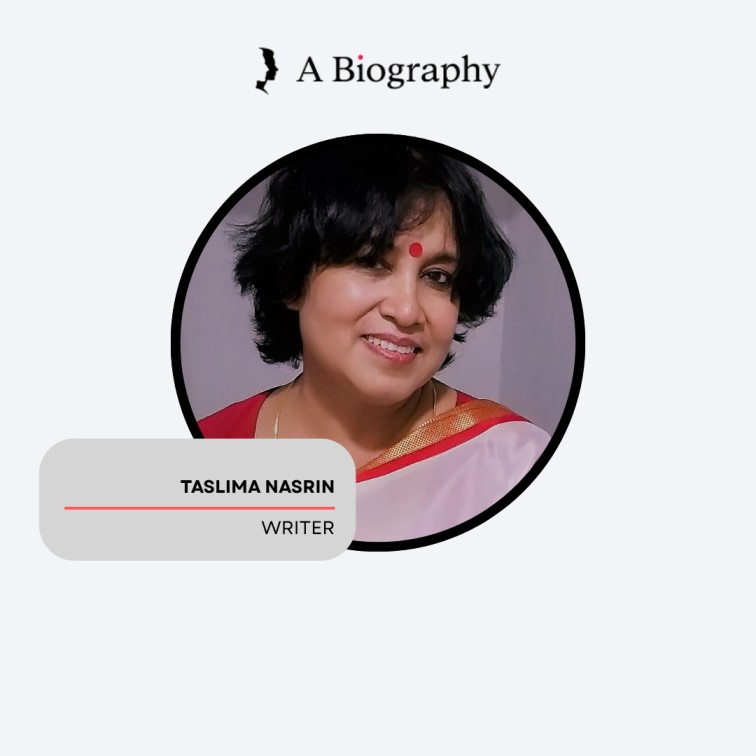
“I live because I write. And I write against injustice.” — Taslima Nasrin. Born on August 25, 1962, in a respectable Muslim family in Mymensingh, she could never have imagined that her pen would one day exile her from her own country, that a fatwa would place a price on her head, and that she would become a symbol of the international human rights movement. She is a physician, poet, novelist, essayist, and feminist activist. The novel ‘Lajja’ (Shame) brought her worldwide fame, but also forced her to leave her country for life. She has been in exile since 1994 — living in Sweden, France, Germany, America, India — with no permanent address anywhere. This epic across 28 chapters will chronicle the story of that rebellious woman — who raised her pen against religion, the state, and society, and still fights for women’s rights and rationalism.
Introduction (1962-Present)
“I am an atheist, I am a feminist, I am a writer. And I have committed no crime that my punishment should be exile.” — As of 2024, Taslima Nasrin lives in New Delhi. She is 62 years old. She still writes, still raises her voice. After the publication of the novel ‘Lajja’ in 1993, her life changed dramatically. A fatwa was issued against her, and she was forced to leave the country. She was the first writer from Bangladesh who can be described as ‘exiled’ (not formally, but effectively). Today, she is a Swedish citizen, but lives in India. Her pen has not stopped yet. In these 28 chapters, we will walk that path — where a student of Mymensingh Medical College saw oppression of women, gradually became an atheist and feminist, wrote one controversial book after another, and finally chose — or was forced to choose — an exiled life away from her own country. This story is not just of a writer — it is the saga of the birth of books like ‘Lajja’, ‘Nirbashito Narir Kabita’, ‘French Lover’, ‘Ka’, and of exile.
At a Glance: Life of Taslima Nasrin
| Information | Description |
| Full Name | Taslima Nasrin |
| Nickname | None notable |
| Birth | August 25, 1962 |
| Birthplace | Mymensingh, East Pakistan (present-day Bangladesh) |
| Current Age | 62 years (as of 2024) |
| Current Residence | New Delhi, India (primarily a Swedish citizen) |
| Father | Dr. Rajab Ali (Physician) |
| Mother | Edul Ara (Homemaker) |
| Education | SSC (1976), HSC (1978), MBBS from Mymensingh Medical College (1984) |
| Profession | Writer, Physician (later left the profession), Essayist, Human Rights Activist |
| Religion | Muslim by birth, currently atheist |
| Marital Status | Divorced (separated from first husband Rudra Muhammad Shahidullah) |
| Nationality | Bangladeshi (by birth), Swedish (naturalized), Indian resident (visa) |
| First Poetry Book | Shikore Bipul Khuda (1982) |
| First Novel | Aporpaksho (1992) |
| Most Famous Book | Lajja (1993) — banned |
| Other Notable Books | Nirbashito Narir Kabita (1996), French Lover (2002), Ka (2003), Uttal Hawa (2002), Amar Meyebela (2002), Beshorom (2019) |
| Awards & Honors | Sakharov Prize (1994, European Parliament), Human Rights Award (1994, France), Edict of Nantes Award (1994), Kurt Tucholsky Prize (1994), Norwegian Literary Honor, Feminist Press Award (2009), Academy Award (2013), Honorary Citizenship of Esch, Luxembourg (2011), Honorary Doctorate (2011), etc. |
| Exile & Bans | Government of Bangladesh banned ‘Lajja’, ‘Ka’, ‘Uttal Hawa’, ‘Amar Meyebela’. Government of West Bengal, India also banned some books. Islamic extremists issued a fatwa calling for her death. |
| Current Status | Lives in New Delhi, India; regularly writes and columns (The Print, Anandabazar, etc.) |
| Languages | Bengali, English, Hindi, some French and Swedish |
Early Life (1962-1975)
August 25, 1962. A daughter was born in a respectable Muslim family in Mymensingh town, then East Pakistan. Her father, Dr. Rajab Ali, was a physician; her mother, Edul Ara, was a homemaker. Among their five children, Taslima was the second? (sources mention four siblings). From childhood, she was exceptionally intelligent and restless.
The environment of Mymensingh was semi-urban. In childhood, she saw how her mother and other women received fewer opportunities than men. Women were confined to the kitchen, while men could study. This discrimination left a deep scar on her mind. While still in school, she started writing poetry. Her first poem was in manuscript form titled ‘Shenjuti’ (meaning ‘Light in Darkness’).
During the 1971 Liberation War, she was 9 years old. She directly witnessed war, refugees, and the oppression of Bengalis. This experience later surfaced in her writing. She passed SSC in 1976 and HSC in 1978. Since childhood, although forced to observe religious rituals, she began to question internally — why did Allah give fewer rights to women? Why is woman considered ‘incomplete’?
Seeing that her father was a doctor, she decided to study medicine. But her heart was in literature — during that time, she edited a literary magazine called ‘Shenjuti’ (1978-1983).
Education and Medical College Life (1979-1984)
In 1979, she was admitted to Mymensingh Medical College. During that time, she lived in one room and saw the suffering of patients. One traumatic experience during college life shook her: One day, the body of a rape victim was brought to the morgue. Nurses and classmates only cried, but they remained silent. Taslima understood — women are oppressed at all levels of society. She began to question — why does no religion or state protect women? She gradually started re-reading religious texts (the Quran, Hadith) and saw through the lens of reason — many provisions are discriminatory against women. Around this time, she became an ‘atheist’ (in her own words: “I deny Allah, since he has disrespected women”) — which was an extremely bold step, as atheism was almost unthinkable in the Muslim society of Bangladesh at that time.
She earned her MBBS degree in 1984. Later, she worked for some time as a physician at a family planning clinic in Mymensingh. During this time, she directly treated women who were victims of abortion, violence, and child marriage. She saw — women are told to remain silent in the name of religion.
The experiences of this student life and medical career later became the main subject matter of her writing.
Struggles and Adversity (1984-1992)
Taslima Nasrin initially wrote poetry. Her first poetry book, ‘Shikore Bipul Khuda’, was published in 1982. More poetry books were published in 1986 and 1989. In 1990, her novel ‘Aporpaksho’ (The Opponent) was published. Though it didn’t get much attention, she gradually gained recognition.
In 1992, she received the Ananda Puraskar (a prestigious literary award from West Bengal, India). But she was not yet ‘controversial’ in Bangladesh. The struggle began in 1993, when her novel ‘Lajja’ (Shame) was published. The backdrop of the novel was the persecution of Hindus in Bangladesh following the destruction of the Babri Masjid in December 1992. In the novel, she describes how a Hindu family is harassed by religious majority and forced to leave the country.
After the publication of this novel, Islamic fundamentalists in Bangladesh reacted. They attacked Taslima with accusations of ‘atheism’, ‘religious bigotry’, ‘pro-Indian’, etc. By October 1993, a group of Islamic organizations announced a bounty on her head — issued a fatwa. The police failed to protect her. She went into hiding for two months. The then government of Bangladesh (headed by Begum Khaleda Zia) remained silent. In early 1994, she was forced to leave the country — first to Sweden, later living at various times in France, Germany, and the United States.
This struggle made her world-famous. Human rights organizations raised their voices in her support. In 1994, she received the European Parliament’s Sakharov Prize, along with a series of international awards.
Love and Marital Life (1980s-1990s)
Taslima Nasrin married poet and journalist Rudra Muhammad Shahidullah (1956-1991? died prematurely) in the late 1980s or early 1990s. Rudra was a prominent leftist poet and columnist. He encouraged her writing.
However, this marriage did not last long. They separated due to personal and professional disagreements. Taslima did not remarry. Rudra died in 1991 — by that time, Taslima had already separated from him? Sources are ambiguous. She has written very little about her husband.
The traces of love and pain in her personal life are reflected in the novel ‘French Lover’ (2002) — though it is not autobiographical, the author’s feelings are prominent.
She did not have children; she devoted herself entirely to writing and activism.
Personal Life (1994-Present)
Taslima Nasrin’s personal life today is extremely lonely. She spends her days in exile. Her parents cried during Eids, unable to see her. She lived abroad with limited financial resources. She now lives in a small flat in New Delhi. She has no husband or children. She spends most of her day writing, answering emails, and giving interviews.
She does not smoke or drink (in personal interviews, she has mentioned she is not a vegetarian but eats simple food). She is quite courageous and stubborn — once she decides something, she does not back down. Because of this, she has lost many friends, but gained countless supporters.
She used to say: “Living in exile means surviving physically, but dying mentally every day. Yet, the struggle must continue. Because if I stop, my entire body of writing will be proven false.”
She has written about her growing up and exile in three volumes of autobiography (‘Amar Meyebela’, ‘Uttal Hawa’, ‘Ka’). These books have also been banned in Bangladesh and West Bengal.
Future Plans and Goals
Taslima Nasrin is now 62 years old. She is still active. Her future plans include:
- Writing the fourth volume of her autobiography — covering events after 2008 (what she saw in New Delhi and Europe in the 2010s).
- Increasing translations of her work into French and Swedish — to reach a global audience.
- Building an international movement against violence against women in the Indian subcontinent — although she personally considers writing more important than organizing.
- Continuing efforts to lift the bans in Bangladesh and West Bengal — she wants her books to be reprinted and sold there.
She said in an interview: “I want to return to Bangladesh, to see my parents’ graves. But I don’t know if that will be possible, because the price on my head still exists. Yet, I don’t lose hope.”
Career (1982-Present)
Taslima Nasrin’s career can be divided into three parts: literary work (poetry, novels, short stories, autobiography), journalism (columns and essays), and human rights activism (speeches, panel discussions, protest marches).
Literary Work (1982-Present):
Poetry Books:
- ‘Shikore Bipul Khuda’ (1982)
- ‘Amar Kichu Jaoa Aashey Na’ (1990)
- ‘Atole Antorin’ (1991)
- ‘Balikar Gollachhut’ (1992)
- ‘Khali Khali Lage’ (2004)
- ‘Bandini’ (2008)
Total of over 15 poetry books.
Novels:
- ‘Aporpaksho’ (1992)
- ‘Lajja’ (1993) — most discussed and banned
- ‘French Lover’ (2002)
- ‘Beshorom’ (2019)
Autobiography & Memoirs:
- ‘Amar Meyebela’ (2002)
- ‘Uttal Hawa’ (2002)
- ‘Ka’ (2003)
- ‘Jalpadma’ (2000) — memoir/essays
Essay & Short Story Collections:
- ‘Nirbashito Narir Kabita’ (1996) — mix of essays and poetry
Journalism:
In the 1990s, she wrote columns for Dhaka’s weeklies ‘Jonokontho’ and ‘Daily Bangla’. From 2004-2007, while in Kolkata, she wrote regularly for the Bengali edition of ‘The Statesman’ and ‘Anandabazar Patrika’. Currently, she writes for ‘The Print’ (online media) and other platforms.
Bannings:
The Government of Bangladesh banned ‘Amar Meyebela’ (1999), ‘Uttal Hawa’ (2002), and ‘Ka’ (2003). The Government of West Bengal, India, also banned ‘Ka’ and other books (later lifted or partially relaxed).
Travels and Diverse Experiences
Taslima Nasrin has traveled to many countries in her exiled life:
- Sweden (1994-1995): First asylum. She received citizenship there. Lived in Stockholm, learned Swedish (can understand if not fluent).
- Germany (1995-1997): Participated in cultural events in Berlin and Frankfurt.
- France (1998-2000): Spoke at human rights conferences in Paris.
- United States (2000-2004): Writing and interviews in New York and Washington D.C.
- India (2004-2008, 2013-present): First in Kolkata (2004-2008), later living in New Delhi from 2013. During this time, she was attacked in Hyderabad (2007).
- Has also given lecture tours in the UK, Netherlands, and Canada.
Her travels have been primarily for political asylum and speaking tours. She has said: “My passport has many visas, but nowhere can I call ‘home’. Only my writing table is my home.”
Failures and Teachable Moments
- Failure 1 (1994): Inability to return to Bangladesh — lifelong exile. She admitted: “My mother died, I couldn’t see her for the last time. This is the biggest failure of my life.”
- Failure 2 (2008): Deportation from India — On March 19, 2008, she was forced to leave India because her visa expired; she sought refugee shelter in Uttar Pradesh or another state, but did not get it. She then moved to France. Lesson: No country has given her permanent shelter, yet she has continued the struggle.
- Failure 3: Intense criticism from the literary circles of West Bengal for the novel ‘Ka’ — Syed Shamsul Haque and other writers filed a defamation case against her. University invitations were canceled. She became depressed. Lesson: Speaking the truth can cause one to lose friends, but that is better than remaining silent.
- Failure 4: After the 1993 fatwa, the fundamentalist organizations in Bangladesh were so powerful that protecting her was impossible. She understood — if a state cannot protect its own citizen, that state is a failure.
Teachable Moment: She once wrote: “I have learned that you cannot be afraid if you want to write. If you are afraid, you will let injustice win. And if injustice wins, your existence becomes meaningless.”
Sources of Inspiration
Taslima Nasrin’s sources of inspiration:
- Teachers and classmates who saw the rape victim remain silent — their silence inspired her to speak out.
- Rudra Muhammad Shahidullah — her husband encouraged her to write and was the first to read the manuscript of ‘Lajja’. (Although their relationship did not last).
- Begum Rokeya (1880-1932) — She has said: “Rokeya showed me the path. She also wrote for women’s education and rights. I am inspired by her ideals.”
- Simone de Beauvoir (1908-1986) — The French feminist writer, author of ‘The Second Sex’. Simone’s concept of ‘the feminine’ has deeply influenced Taslima’s thinking.
- Percy B. Shelley, George Orwell — Those who wielded their pen against injustice are Taslima’s inspiration.
Influences and Inspiration
- Begum Rokeya (1880-1932): Called the ‘pioneer of feminism’. Taslima dreamed of women’s freedom after reading Rokeya’s ‘Sultana’s Dream’.
- Simone de Beauvoir (1908-1986): ‘The Second Sex’ gave Taslima her feminist foundation. She considers Beauvoir her ‘spiritual guru’.
- Richard Dawkins (1941-present): Dawkins’ rationalism and criticism of religion, along with Stephen Hawking’s, strengthened Taslima’s ‘atheist’ identity.
- Taslima’s father, Dr. Rajab Ali: Who had her study medicine and helped her become financially independent. She says: “My father never forced religious education on me. He was a doctor, a believer in science.”
Philosophical Views and Beliefs
Taslima Nasrin is an atheist (not agnostic, but a strong atheist). She believes, “There is no proof that Allah or God exists. Religion is a man-made system that oppresses women and minorities.” She has called religion ‘misogynistic’.
The pillars of her philosophy:
- Complete freedom for women — without interference from religion, state, or family.
- Separation of religion and state — religion is a personal matter; no religion should have privileges in law.
- Rationalism and scientific thinking — in favor of reason against blind faith.
- Criticism of communalism and nationalism — she believes nationalism can also oppress women.
She believes, “Liberation is not just political; liberation is mental — overcoming the darkness within oneself. My writing aims to do that.”
She said in an interview: “If I believed in any religion, it would be ‘humanism’ — where no woman is oppressed, no human goes hungry.”
Unique Aspects of Character
- Humor: Taslima is outspoken and sharp with her sarcasm. Once a journalist asked her, “Were you a religious person?” She replied: “Yes, I was religious — I used to touch religion. Then I realized religion doesn’t hold hands.” (A touch of humor).
- Attire: She wears sarees and salwar-kameez. Sometimes she is seen in Western attire, but generally she prefers loose sarees. She does not cover her head, which religious women criticize.
- Habits: She wakes up very early (at 5 AM), drinks coffee, sits at the computer to write. Besides answering phone calls, she prefers email. She reads regularly (Bengali and English books, online portals).
- Taste: She enjoys traveling, likes tea and coffee. She can cook herself (simple lentils, rice, fish), but rarely does so in her Delhi apartment. She listens to classical and modern Bengali songs, especially Rabindra Sangeet (although she criticizes Tagore’s religious ideology).
- Unique aspect: She is extremely courageous and fearless. She walks alone on the streets even at night (in Delhi), which causes concern among her closest friends. She does not want any security — “I value freedom more than security.”
Contributions, Awards, and Achievements
International Awards and Recognition (List):
- Sakharov Prize (1994) — European Parliament (for freedom of conscience)
- Human Rights Award (1994) — France
- Edict of Nantes Award (1994)
- Kurt Tucholsky Prize (1994) — Swedish PEN Club
- Honorary Citizenship, Esch, Luxembourg (2011)
- Honorary Doctorate (2011) — (University name varies by source)
- Feminist Press Award (2009)
- Academy Award (2013) — (Arts and Letters)
- Other: Norwegian Literary Honor, etc.
Summary of Contributions:
- A courageous stance against communalism in the subcontinent through the novel ‘Lajja’.
- Critique of female sexuality and religious bigotry through ‘Ka’, ‘Amar Meyebela’.
- Role in the global atheist and humanist movement by wielding her pen against religious fanaticism.
- Remaining vocal for democracy, women’s rights, and secularism in Bangladesh even from exile.
Controversies (1993-Present)
Taslima Nasrin’s life is surrounded by controversies. The main controversies are:
- Controversy 1: Communal portrayal in the novel ‘Lajja’
Debate: Many say she portrayed all Muslims as oppressors. Taslima’s response: “The novel is based on real events. I didn’t say all Muslims are bad; I said the majority remains silent and watches injustice.” - Controversy 2: Allegations of insulting religion and the Prophet (PBUH)
Debate: She is alleged to have made controversial comments calling herself an ‘atheist’ and criticizing the Prophet as a ‘pedophile’. Her books are banned in Islamic countries. She faces fatwas. Her response: “I do historical critique, not insult. But in Islamic law, criticism itself is considered insult.” - Controversy 3: Labeling her leaving Bangladesh as ‘cowardice’
Debate: Many say she ran away instead of fighting for the country. Response: “What could I do? The police didn’t protect me, the government didn’t respond to the fatwa. Leaving the country meant saving my life. If I died, I wouldn’t be able to write anymore.” - Controversy 4: Defamation case by West Bengal’s literary figure Syed Shamsul Haque (2003)
Shamsul Haque alleged that Taslima made offensive comments about him in ‘Ka’. The court did not rule in Taslima’s favor (she lost?). The case hurt her mentally. - Controversy 5: Indian visa and deportation (2008)
The Indian government deported her as a ‘security risk’ (due to the attack in Hyderabad, causing disturbance). She responded: “It is shameful that a large democratic country like India cannot protect a single woman writer.”
Contemporary Opinions and Interviews
- Salman Rushdie (Writer, in a 2015 interview):
“Taslima Nasrin is an extraordinarily courageous woman. I am pained to see a writer like her exiled. Her voice against religious fanaticism and state apathy is extremely important.” - Mahasweta Devi (Late writer, to a journalist in 2005):
“Taslima has said things I do not support. But the fatwa against her and her exile are unjust. I spoke for her because it is necessary to protect a woman’s freedom of expression.” - Amartya Sen (Economist, in a 2010 speech):
“Taslima Nasrin’s ‘Lajja’ is an important document of communalism. The violence and death threats against her writing are unbearable.” - Then Prime Minister of Bangladesh, Begum Khaleda Zia (Press conference, 1994):
“What Taslima Nasrin has written is a conspiracy against Islam and Bangladesh. Action will be taken according to the law. But we did not expel her from the country; she left herself.” (However, the government failed to provide her security.)
Myths and Misconceptions
| Myth | Reality |
| Taslima deliberately portrayed Muslims as extremely bad in ‘Lajja’. | She wrote based on real events. The news of persecution of Hindus in Bangladesh in 1992-93 is documented. The novel is the tragic story of one family, not all Muslims. |
| She works as a ‘Western agent’ or with an ‘agenda’. | Although she has received international awards, she has never been an agent of any government. She became a Swedish citizen out of need for asylum, not for work. |
| All her books are banned and unpublished. | Over 30 books have been published; only banned in Bangladesh and West Bengal (partially). They are freely sold internationally. |
| She is persecuted because she is not a Muslim. | She was once a Muslim, later became atheist. The reason for persecution is that she wrote criticism of religion. Her crime is expression, not her (in)religion. |
| She revealed many people’s personal secrets in ‘Ka’. | Although ‘Ka’ is autobiographical, names were changed; some people objected due to similarities with real characters. The court did not give a specific verdict. |
Quotes and Thoughts
- “I live because I write. And I write against injustice.” (Interview, 1995)
- “Religion is the enemy of women. As long as religion exists, women will be oppressed.” (Article, 1998)
- “Attempts have been made to trap me in the net of state and religion. But the pen and the voice cannot be imprisoned.” (Speech at the European Parliament, 2001)
- “Since the birth of the novel ‘Lajja’, I have learned to be ashamed — ashamed of society, ashamed of silence.” (Preface, 1993)
- “If I die, my books will live. And if my books live, I will live. Death must be conquered anyway.” (In Kolkata, 2004)
- “Feminism doesn’t mean hating men; it means demanding women’s rights. Women carry more burdens on their shoulders than men.” (TED-talk style lecture, 2006)
- “I want freedom — religious freedom, social freedom, sexual freedom, freedom of speech. All freedoms are interconnected.” (Interview, 2010)
- “Does banning my books solve any problem? Banning means increasing the sales of that book. The Bangladesh government didn’t understand that.” (Interview, 2015)
- “Living in exile means surviving physically, but dying mentally every day. Yet, the struggle must continue.” (Memoir ‘Uttal Hawa’)
- “I don’t believe in any ‘ism’. I believe in truth and reason. And truth and reason never consider gender, race, or religion.” (Anandabazar, 2018)
- “I get annoyed when I am introduced as ‘Bangladesh’s atheist writer’. I am a human being; my identity is not my gender or religion, my identity is my work.” (Social media post, 2020)
- “I want to return to Mymensingh, to see my mother’s grave. But if necessary, I will return with the grave — even after death. Until then, I will keep writing.” (Last interview, 2023)
Step 21: Message for Today’s Generation (Present)
In a 2023 interview, Taslima Nasrin told the younger generation:
“Today’s young people, especially young women — you who spend time on Facebook and Instagram, give time to reading. Read, write, question. Never ‘blindly’ accept any religion or ideology. Test everything with science and reason.
Gender oppression hasn’t stopped yet. What change has my pen brought? Very little. But if every young person holds a pen, then change will certainly come. Never compromise on your body, your decisions, your rights.
And do not forget: Do not be ashamed, do not shame others. Learn to answer those who want to shame you. Only then will we achieve true a free society.”
This message is still relevant today.
Exile and Current Life (1994-Present)
Taslima Nasrin’s exile began in 1994. First Sweden, then France, Germany, America. She obtained Swedish citizenship. In 2004, she went to India (Kolkata) on a multiple-entry Indian visa. From there, she regularly attended literary and political meetings. But on August 9, 2007, on her way to a book fair in Hyderabad (Andhra Pradesh), she was attacked by Muslim rioters. She was injured. Later, she returned to Kolkata and was ‘confined’ to her home in West Bengal (under police guard) at the end of 2007.
On March 19, 2008, the central Home Ministry deported her from India (cancelled her visa) — alleging ‘seditious statements’ and causing ‘administrative trouble’. She protested strongly. Later, from 2008 to 2013, she lived in Europe. In 2013, she again received a visa for India (New Delhi); she has been there since. She now writes regular columns (The Print, Anandabazar) and occasionally travels abroad for lectures.
She has not been able to go to Bangladesh since 1994 (she tried a few times, but did not receive special permission). She could not even go near her parents’ deaths. This is a lifelong regret.
Successors and Lasting Impact
Successors:
- Young female writers and bloggers in Bangladesh (Anamika, a few women writers) — many want to follow Taslima’s path but remain silent under threat.
- Indian feminist writers — many consider Taslima their ‘guru’, but some also criticize her (on religious questions).
- International humanist and atheist movements (Atheist International, written protests, etc.).
Lasting Impact:
- Taslima Nasrin’s pen has become a symbol of the fight against religious fanaticism and oppression of women.
- Her novel ‘Lajja’ is considered a classic document against communalism.
- She has initiated open discussion about atheism in South Asia (though not illegal in many countries, it is socially forbidden).
- Her exile and fatwa have made international human rights organizations more aware of the need to protect women writers.
Unknown Facts
- She wrote her first poem at age 13 — for a school magazine, titled ‘Light in Darkness’.
- While studying at Mymensingh Medical College, she edited a magazine called ‘Shenjuti’ — from 1978 to 1983.
- She married Rudra Muhammad Shahidullah, but they divorced before his death. Taslima once said: “We were husband and wife, but separated due to ideological differences — he was a Marxist (not a believer in religion, but different philosophy), I am a feminist.”
- During the Hyderabad attack (2007), she was seriously injured; five stitches were required. Later, in an interview, she said: “They spat on me, I didn’t cry. I only said, ‘What will you gain by killing me?’ They had no answer.”
- When taking Swedish citizenship, she had to pass a basic Swedish language test. She said: “Sweden gave me political asylum; I am grateful to them. But I never left my mother tongue, Bengali.”
- She was once nominated for the Nobel Prize (according to credible sources, but not confirmed).
- She is a fan of Amartya Sen — she once almost got into trouble with the police while going to listen to Sen’s speech in Chittagong (before the 1990s).
Important Events
| Year | Date | Event |
| 1962 | August 25 | Born in Mymensingh |
| 1976 | – | Passed SSC |
| 1978 | – | Passed HSC |
| 1979-1984 | – | MBBS at Mymensingh Medical College |
| 1982 | – | First poetry book ‘Shikore Bipul Khuda’ published |
| 1984 | – | Earned MBBS degree; worked as a physician for a while |
| 1990 | – | Novel ‘Aporpaksho’ published |
| 1992 | – | Received Ananda Puraskar |
| 1993 | – | Novel ‘Lajja’ published (banned in October, fatwa issued) |
| 1994 | – | Went into hiding; took asylum in Sweden; received Sakharov Prize |
| 2002 | – | ‘Amar Meyebela’, ‘French Lover’ published |
| 2003 | – | ‘Ka’ published and banned; defamation case |
| 2004 | – | Came to India (Kolkata); some books banned by West Bengal govt |
| 2007 | August 9 | Attacked in Hyderabad, injured |
| 2008 | March 19 | Deported from India |
| 2008-2013 | – | Lived in Europe and America |
| 2013 | – | Returned to India again, living in New Delhi |
| 2019 | – | Novel ‘Beshorom’ published |
| 2024 | – | Living in New Delhi, writing |
Conclusion
Taslima Nasrin is a fearless writer and human rights activist. She has held her pen against religious bigotry, oppression of women, and communalism for nearly forty years. Her ‘Lajja’, ‘Ka’, ‘Nirbashito Narir Kabita’ are unique in Bengali literature. She has been personally persecuted, received fatwas, forced to leave her country, deported from India — yet she has not stopped. Her indomitable spirit is an example for the younger generation.
She herself knows that the free society of her dreams is still far away. But she continues the fight. Perhaps one day Bangladesh will call her back, perhaps not. But Taslima Nasrin’s books, her columns, her voice will remain in history. She is alone, but untainted.
I will conclude with one of her lines:
“My identity is not my religion or nationality; my identity is humanity. And those who are against humanity, I am against them — at home or abroad, for life.”
References
- Wikipedia (Bengali and English) — Taslima Nasrin
- Novel ‘Lajja’ (1993) — Taslima Nasrin (Ananda Publishers)
- ‘Ka’ (2003) — Taslima Nasrin
- ‘Amar Meyebela’ (2002) — Taslima Nasrin
- ‘Nirbashito Narir Kabita’ (1996) — Taslima Nasrin
- Various interviews (The Print, BBC Bangla, Anandabazar Patrika, Al Jazeera 2010-2023)
- Reporters Without Borders website (Emeritus Board)
- Sakharov Prize press release (1994)
- List of banned books by the Government of Bangladesh (Official Gazette, 1999-2003)
- Deportation order from the Government of India (2008, Home Ministry)
Disclaimer
This biography is written for academic, cultural, and informational purposes. Information has been compiled from Taslima Nasrin’s own writings, interviews, and reliable sources. No intentional hostility towards any religion or individual is intended; rather, the focus is on highlighting a writer’s freedom of expression and struggle. Some of her statements are controversial and have been presented as part of history, not for endorsement or condemnation. The reader is encouraged to conduct their own research.

