
Biography
A Biography of Rubana Huq

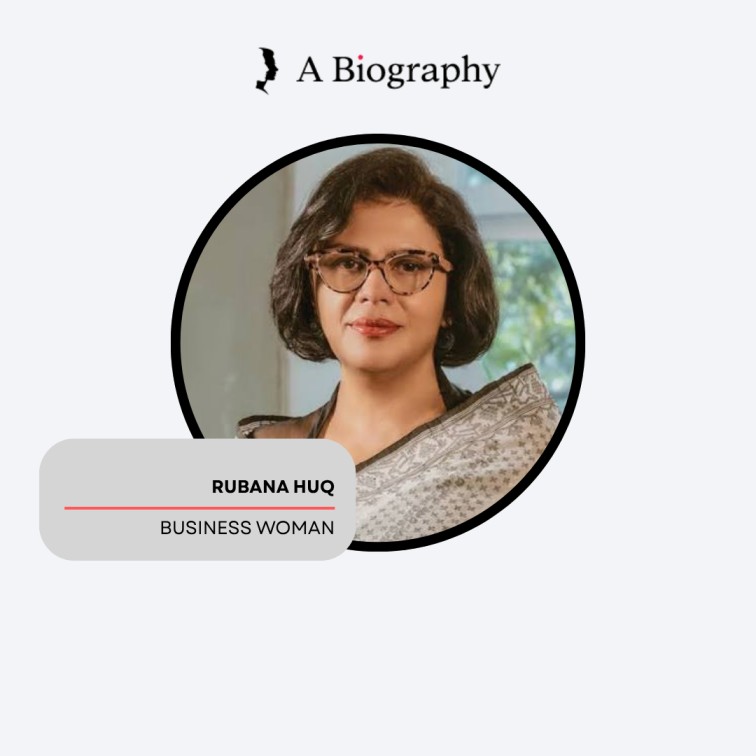
Introduction
Imagine a historic day. April 6, 2019. A convention hall in Dhaka is hosting the biennial election of the Bangladesh Garment Manufacturers and Exporters Association (BGMEA). This is a male-dominated industry, where for four decades only men had been elected president. But this day was different. As the election results are announced, the hall erupts in thunderous applause. A woman has won—a woman who never accepted defeat, who stood firm against all odds.
Her name is Rubana Huq. Born on February 9, 1964. She is a successful businessperson, a PhD-holding literary scholar, an academic, and most importantly—the first woman president in BGMEA’s forty-year history. She served in this role from April 12, 2019, to April 12, 2021.
But Rubana Huq’s journey did not begin here. She is the daughter of poets, a girl who grew up in an environment of literature and culture, who studied English literature, earned a PhD in poetry, and whose first poetry collection, Time of My Life, won the SAARC Literary Award in 2006.
How did a professor of literature and poet become the leader of Bangladesh’s most powerful business lobbying group? How does she simultaneously work in business, education, literature, and culture? And how, after the untimely death of her husband Anisul Haque, does she manage multiple heavy responsibilities—as Chairperson of the Mohammadi Group and Vice-Chancellor of the Asian University for Women?
In this epic of 28 chapters, we will walk that path—from the Dhaka of the 1960s to the classrooms of Viqarunnisa Noon School and Holy Cross College, from an MA in English literature to a PhD journey, from MD to Chairperson of the Mohammadi Group, from the first woman president of BGMEA to academic and Vice-Chancellor, from poet and literary figure to global recognition—the story of an extraordinary woman’s journey.
Let us dive into the immortal tale of Rubana Huq’s unique life—where from curtain to path, from dream to reality, the story of an extraordinary woman has been written in the history of industry, literature, and leadership.
At a Glance — Life of Rubana Huq
| Category | Details |
| Name | Rubana Huq |
| Known As | Businessperson, Academic, Poet, First Woman President of BGMEA, Vice-Chancellor of Asian University for Women |
| Date of Birth | February 9, 1964 |
| Birthplace | Dhaka, erstwhile East Pakistan (now Bangladesh) |
| Education | Viqarunnisa Noon School, Dhaka; Holy Cross College, Dhaka; MA in English Literature from East West University (2008); PhD from Jadavpur University (2018) |
| Spouse | Anisul Haque (former mayor, businessman) |
| Children | Navidul Haque (son), Wamiq Umaira and Tanisha Fariaman Haque (daughters) |
| Profession | Businessperson, Academic, Poet, Writer |
| Current Position | Vice-Chancellor of Asian University for Women (2022–present) |
| Notable Positions | President of BGMEA (April 12, 2019 — April 12, 2021); Chairperson of Mohammadi Group (2017–present); Managing Director of Mohammadi Group (1995-2017) |
| Other Roles | CEO of TV South Asia (2006-2010); Chairperson of Nomination & Remuneration Committee, LafargeHolcim Bangladesh Limited; Board Member of UNFCCC Fashion Charter |
| Literary Works | Time of My Life (poetry collection, 2006); Monsoon Letters (literary magazine) |
| Founded Organizations | Bangladesh chapter of Foundation of South Asian Writers and Literature (FOSWAL); Write Foundation |
| Awards & Recognition | SAARC Literary Award (2006); BBC 100 Women (2013 & 2014); DHL-The Daily Star Bangladesh Business Award — Outstanding Business Woman of the Year (2014); CNMI Sustainable Fashion Awards 2022 — Human Rights Award |
Early Life (1964–1980)
The curtain rises on February 9, 1964. In Dhaka (erstwhile East Pakistan), in a respected and educated family, a daughter is born. She is named Rubana Huq.
From childhood, she was brilliant, curious, and creative. She grew up during the memories of Bangladesh’s Liberation War and the turbulent post-independence era. Her parents always encouraged her in studies and literary pursuits.
Rubana Huq’s primary and secondary education began at the renowned Viqarunnisa Noon School in the capital. It is one of Dhaka’s finest girls’ schools, known for its high academic standards and discipline.
Here, she was first exposed to competitive education. Alongside academics, she became interested in literature and culture. She wrote for the school magazine, participated in recitations, and took part in various cultural events. Her teachers remember her as a ‘brilliant and creative student.’
After passing her SSC from Viqarunnisa Noon School, she enrolled in Holy Cross College. It is another renowned institution in Dhaka, known for its academic rigor and intellectual environment.
The educational environment and intellectual practice there further enriched her. She continued her writing alongside her studies. Her leadership qualities began to develop through participation in various college cultural events. It was here that her deep interest in English literature first took root.
Education (1980–2018)
After a long hiatus, Rubana Huq returned to her studies. The deep love for literature that resided within her propelled her toward higher education. She enrolled at East West University and began studying English literature.
In 2008, she earned her MA in English Literature. The classroom and research environment enriched her. She learned to understand the deep connections between English and Bengali literature. By earning her MA, she proved that age is never a barrier to education. She showed the courage to continue her studies amidst business responsibilities and family duties.
The most remarkable chapter of Rubana Huq’s educational life is her PhD at Jadavpur University. In 2018, she earned her PhD from Jadavpur University in Kolkata, India.
Her PhD research topic was on poetry. A businesswoman, a responsible mother and wife, she had the courage to continue her research. Jadavpur University provided a rich environment for her research. By earning her PhD, she proved that women can simultaneously manage career, family, and education.
This degree gave her even deeper thoughtfulness and analytical ability. Her love for literature turned her into a recognized poet and researcher.
Struggles & Adversities (1995–2017)
When she took over as Managing Director of the Mohammadi Group in 1995, the readymade garment industry was entirely male-dominated. Women managers, women MDs were extremely rare. Clients, buyers, suppliers—in every sphere, she had to prove her competence.
Many initially did not want to take her seriously. “How will women do business?” “How will they compete with men?”—such questions and doubts wounded her repeatedly. But through relentless perseverance and professionalism, she gradually earned everyone’s trust. She proved that for business management, talent and dedication are more important than gender.
On November 30, 2017, Anisul Haque passed away at Wellington Hospital in London from a rare disease called cerebral vasculitis. This was the most difficult time in Rubana Huq’s life. The mother of three children faced all the responsibilities alone.
She was immersed in deep grief at her husband’s death. But she did not give up. She moved forward with her children, took charge of her husband’s company, the Mohammadi Group, and began working on an even larger scale. After her husband’s death, she took over as Chairperson of the Mohammadi Group. At the same time, she decided to contest the BGMEA election.
Contesting the 2019 BGMEA election was an extremely difficult decision. It was a male-dominated trade body where only men had been elected president for 40 years. The opposition was strong and influential. Many said, “As a woman, how will you lead such a large industry group?” “There are experienced male leaders competing against you.”
But she never backed down. In her election campaign, she spoke about workers’ rights, the sustainable development of the industry, and women’s leadership. She engaged in public relations, spoke with voters, and earned their trust. Her campaign was honest and transparent. Finally, in the election held on April 6, 2019, she won by a huge margin.
Just one year after taking over as BGMEA President, the COVID-19 pandemic began in March 2020. Global demand for readymade garments decreased. International buyers canceled orders worth approximately $3.15 billion. The industry faced collapse. Millions of workers faced the threat of unemployment.
During this crisis, Rubana Huq demonstrated exceptional leadership. She negotiated with international buyers, trying to get canceled orders reinstated. Coordinating with the government, she worked to ensure the Prime Minister’s announced incentive package of 5,000 crore taka reached workers’ bank accounts directly. She submitted policy proposals to Bangladesh Bank for the industry’s recovery.
She played a role in establishing three PCR labs for garment workers. Through these actions, she proved that with proper leadership and initiative, any crisis can be overcome.
Love & Married Life
Rubana Huq married Anisul Haque. He was a successful entrepreneur, television host, businessman, and politician. He served as the first mayor of Dhaka North City Corporation. While there are different opinions about their marriage date, it is believed they married in the early 1990s.
Anisul Haque was a visionary leader. He dreamed of a ‘Clean, Green, and Smart’ Dhaka. The couple complemented each other perfectly. Rubana Huq with her business acumen, Anisul Haque with his administrative and political skills—both were the best in their respective fields.
The couple has three children:
- Navidul Haque — Son. He is currently the Managing Director of Mohammadi Group and a BGMEA Director.
- Wamiq Umaira Haque & Tanisha Fariaman Haque — Two daughters.
In the 2019 BGMEA election, Rubana Huq was elected President and Navidul Haq was elected Director. It was a historic event—mother and son serving together in BGMEA leadership. Navidul Haque is now working as Managing Director of the Mohammadi Group. The two daughters are established in their own professions.
In an interview, Anisul Haque once said, “Rubana is my biggest critic and inspiration.” He admired her intelligence, courage, and dedication. He knew that without Rubana, his business, family, and political life would not have been successful.
Anisul Haque passed away on November 30, 2017. After his death, Rubana Huq moved forward with their three children, taking a vow to sustain her husband’s dream organizations.
Rubana Huq cannot forget that tragic day in November 2017. She was immersed in deep grief after losing her husband. But she did not give up. She moved forward with her children, took charge of the Mohammadi Group, and began working on an even larger scale. She has proved that a widow can handle all responsibilities alone.
Personal Life
Besides being a businessperson and academic, Rubana Huq is a recognized poet and literary figure. Her first poetry collection, Time of My Life, was published in 2006 and won the SAARC Literary Award—one of South Asia’s most prestigious literary prizes.
She is associated with a literary magazine called Monsoon Letters, which she has been publishing with Bangladeshi writers since 2006. Additionally, she established the Bangladesh chapter of the Foundation of South Asian Writers and Literature (FOSWAL) and formed the Write Foundation, which organized its SAARC Literary Conference in February 2014. Through these foundations, she works to connect writers and literary figures across South Asia.
In her personal life, Rubana Huq is an honest, determined, and dedicated businessperson. She transformed the Mohammadi Group from a small garment factory into a diversified industrial conglomerate. The group’s operations now span readymade garments, software, digital distribution, real estate, power generation, and recently launched a television channel, Nagorik TV.
She believes that business is not just about profit-making but also about giving back to society. She runs the Mohammadi Group with this philosophy.
Since February 15, 2022, she has been serving as Vice-Chancellor of the Asian University for Women (AUW). Located in Chittagong, this university provides educational opportunities for women from 18 Asian countries. She is also a member of the university’s Board of Trustees.
Under her leadership, the university is working to enhance educational quality and international recognition. She is arranging various programs and scholarships for students.
Those who have worked with Rubana Huq remember her as an extremely dedicated and punctual person. She spends most of her day engaged in work for various organizations. She sleeps very little—4-5 hours a day. The rest of her time is spent working, studying, or engaging in literary pursuits.
She has never let personal problems become obstacles to her work. Even after her husband’s death, she continues to handle multiple major responsibilities simultaneously—the Mohammadi Group, BGMEA, and the Asian University for Women.
Future Plans & Vision
Rubana Huq wants the Asian University for Women to become the epicenter of women’s education in Asia. She aims to build this university for talented and promising women from various Asian countries into an international-standard educational institution.
She is planning to introduce new programs and scholarships for the university. She wants talented female students from remote areas of Asia to be able to study at this university.
As BGMEA President, she worked for sustainable fashion and fair trade. She wants Bangladesh’s readymade garment industry to become more competitive and sustainable in the international market.
As a Board Member of the UNFCCC Fashion Charter, she is working on climate change and sustainable fashion. She wants the garment industry to be managed on the basis of environmental friendliness and fair trade.
She has maintained her love for literature throughout her life. She wants the younger generation to practice literature and enrich Bangladesh’s literary world.
Through Monsoon Letters and the Write Foundation, she continues to encourage young writers. She wants Bangladeshi literature to gain more recognition in the international arena.
She believes women have the right not just to participate but to lead. Through her own example, she has proved that women can give top leadership even in male-dominated industries.
She wants more women to lead in politics, business, education, and administration. She regularly encourages female students.
Career (1995–Present)
In 1995, Rubana Huq took over as Managing Director of the Mohammadi Group. Together with her husband Anisul Haque, she expanded the business further. From garment exports to software, digital distribution, real estate, power generation—under her leadership, the group’s operations diversified.
She introduced professional management in every branch of the group. She created a safe working environment for female workers.
She served as CEO of TV South Asia. It was a collaborative electronic media platform for South Asia, based in Kolkata. This experience brought her closer to the world of media and journalism.
Here, she had the opportunity to work with media representatives from various South Asian countries. She learned the operational procedures of international media.
After her husband Anisul Haque’s death in 2017, she took over as Chairperson of the Mohammadi Group. This was a major turning point in her life. Leading an entire industrial group alongside family responsibilities was extremely challenging. But she accepted the challenge.
As Chairperson, she makes strategic decisions for the group, plans new investments and expansions. Under her leadership, the group launched Nagorik TV, which has become a popular Bengali television channel.
On April 12, 2019, Rubana Huq was elected President of the Bangladesh Garment Manufacturers and Exporters Association (BGMEA). She earned the distinction of being the first woman president in its four-decade history.
BGMEA is a powerful lobbying group of approximately four and a half thousand garment factories. Leading this organization was a significant challenge. As President, she regularly visited factories, spoke with workers, and listened to their problems. She held diplomatic negotiations with international buyers.
She served in this role until April 12, 2021.
When the COVID-19 pandemic began in March 2020, global demand for readymade garments decreased. International buyers canceled orders worth approximately $3.15 billion. During this crisis, Rubana Huq demonstrated exceptional leadership.
She took the following steps:
- Incentive Distribution: Worked to ensure the Prime Minister’s announced 5,000 crore taka incentive reached workers’ bank accounts directly
- Policy Proposals: Submitted policy proposals to Bangladesh Bank for the industry’s recovery
- PCR Labs: Played a role in establishing three PCR labs for garment workers
- International Negotiations: Negotiated with international buyers to try to get canceled orders reinstated
- Worker Rights: Coordinated with factory owners to ensure workers’ wages and safety
On February 15, 2022, Rubana Huq was appointed Vice-Chancellor of the Asian University for Women (AUW). Following this appointment, she resigned from the BGMEA presidency on February 15, 2021.
The Asian University for Women in Chittagong is an internationally renowned university that provides educational opportunities for women from 18 Asian countries. As Vice-Chancellor, she is working on improving educational quality and internationalization.
She is also a member of the university’s Board of Trustees. She is arranging various programs and scholarships for students. Under her leadership, the university is introducing new academic programs.
Rubana Huq holds several other important positions:
- Chairperson of Nomination & Remuneration Committee, LafargeHolcim Bangladesh Limited — the largest foreign investment in Bangladesh’s construction industry
- Board Member of UNFCCC Fashion Charter (2021-2022) — working on climate change and sustainable fashion
- Board Member of Gono Sahajjo Sangstha (GSS) — a private development organization
- Associate of Harvard University’s Asia Center — participating in research and educational activities
- Executive-in-Residence at New York University’s Stern School of Business — mentoring and advising students
Travels & Diverse Experiences (2006–2023)
While pursuing her PhD at Jadavpur University, she experienced the education and culture of Kolkata firsthand. This enriched her research world. She became acquainted with Kolkata’s literary circles and learned about South Asia’s literary movements.
As BGMEA President and UNFCCC Fashion Charter member, she participated in various international conferences. During the COVID-19 pandemic, she took part in virtual meetings and conferences, speaking with global buyers.
In September 2022, she attended Milan Fashion Week, where she received the Human Rights Award at the CNMI Sustainable Fashion Awards.
As Associate of Harvard University’s Asia Center and Executive-in-Residence at New York University’s Stern School of Business, she experienced the education and research environments of the United States. This has further enriched her knowledge and skills.
Failures & Teachable Moments
Before being elected BGMEA President, she faced many obstacles in carving out her place in this male-dominated industry. Many did not want to take her seriously. Some doubted her competence.
Lesson: Never give up. As a woman, one has to work twice as hard to prove one’s ability. Patience and perseverance are the greatest virtues.
At the start of the pandemic in 2020, orders worth approximately $3.15 billion were canceled. This was a difficult time for her. Workers feared not getting paid. She worked day and night, yet some orders could not be reinstated.
Lesson: During a crisis, a leader must make tough decisions. Patience and perseverance are the greatest virtues. Not every problem has a solution; what matters is making the effort.
Her husband Anisul Haque’s death created a huge void in her life. She experienced the loneliness of widowhood, had to manage three children, shoulder business responsibilities alone, and also contest the BGMEA election.
Lesson: Life is uncertain. One should spend time with family and value each other. But even in difficult times, one must bounce back.
Source of Inspiration
- Her Husband Anisul Haque — He encouraged her most to move forward in business, education, and leadership. Anisul Haque was her biggest supporter and mentor. He knew Rubana would one day achieve great things.
- Her Parents — They gave her the importance of education and love for literature. From childhood, they encouraged her in studies and literary practice.
- Prime Minister Sheikh Hasina — After winning the BGMEA presidency, Prime Minister Sheikh Hasina congratulated her and praised women’s leadership. This was a great inspiration for her.
- BGMEA Leaders & Members — Their trust and support made her even more responsible. Winning all 35 director posts with a full majority proved the industry’s confidence in her.
- Bangladesh’s Garment Workers — The desire to do something for them is her biggest motivation. She continues to work for workers’ rights and dignity.
She once said: “If we can put a smile on the workers’ faces, then Bangladesh’s garment industry will be successful. Ensuring their rights and dignity is everyone’s responsibility.”
Influences & Inspirations
| Name | Identity | Influence |
| Anisul Haque | Husband, first mayor of Dhaka North City Corporation | Guide in business and leadership |
| Sheikh Hasina | Prime Minister | Inspiration for women’s leadership |
| Poets & Literary Figures | Various literary personalities | Deep passion for literature |
| BGMEA Leaders | Experienced industry leaders | Experience in BGMEA leadership |
| Global Women Leaders | Various female leaders | Role of women internationally |
Rubana Huq has never claimed to be a follower of any single person. She has always chosen her own path. She says, “I have learned from everyone, but I have chosen my own path.”
Philosophical Views & Beliefs
Rubana Huq’s philosophy is simple and pragmatic. She believes:
Women’s Leadership: Women have the right not just to participate but to lead. They must prove it through their work. She says, “Women can, women know, women can lead.”
Workers’ Rights: She believes workers are the backbone of the garment industry. Ensuring their rights and dignity is essential. She is vocal about fair wages, safe working environments, and social security for workers.
Sustainable Development: She wants Bangladesh’s garment industry to progress on the basis of sustainability and fair trade. She works for climate change mitigation and sustainable fashion.
Education and Literature: She believes no nation can develop without education and literature. That is why she works as an academic and literary figure.
Religion and Faith: She is a devout Muslim. The true teaching of religion is service to humanity and walking the path of honesty. She has never used religion as a political tool.
She says: “A woman’s leadership is proven through her work. Women must come forward, they cannot be afraid.”
Unique Traits
Besides being a businessperson and academic, she is a recognized poet and literary figure. Her first poetry collection won the SAARC Literary Award, proving that business and literature can go hand in hand.
Through Monsoon Letters and the Write Foundation, she continues to encourage young literary figures.
She earned a PhD degree, which demonstrates her thoughtfulness and analytical ability. Research in literature and poetry has given her depth of thought, which has shaped her into a visionary leader.
Despite her success, she remains humble. She never boasts about her achievements. On the other hand, she is determined—once she makes a decision, she sees it through.
As BGMEA President during the difficult times of the pandemic, she made visionary decisions. She formulated policies keeping in mind the future of the industry. She understood that without sustainable development, the industry’s future is uncertain.
She is aware not only of business but also of her responsibility to society. As a Board Member of Gono Sahajjo Sangstha (GSS), she works for the poor and distressed people of society.
Contributions, Awards & Achievements
- Made history as the first woman president of BGMEA
- Leading the Mohammadi Group as Chairperson
- Played an extraordinary role in protecting workers’ rights during the pandemic
- Played a role in distributing incentives and establishing PCR labs
- Initiated the industry’s recovery process by submitting policy proposals to Bangladesh Bank
- Launched Nagorik TV, which has become a popular Bengali television channel
- Working to expand women’s education in Asia as Vice-Chancellor of AUW
- Member of the university’s Board of Trustees
- Associate of Harvard University’s Asia Center — researching Asian development and culture
- Executive-in-Residence at NYU Stern School of Business — mentoring students
- Poetry collection Time of My Life — SAARC Literary Award (2006)
- Publishing Monsoon Letters literary magazine — regularly published since 2006
- Established FOSWAL Bangladesh chapter and Write Foundation — connecting South Asian writers
- Organized SAARC Literary Conference (2014) — first time in Bangladesh
Awards and Recognition
| Year | Award | Presenting Organization |
| 2006 | SAARC Literary Award | South Asian Association for Regional Cooperation (SAARC) |
| 2013 | BBC 100 Women | BBC |
| 2014 | BBC 100 Women (second time) | BBC |
| 2014 | DHL-The Daily Star Bangladesh Business Award — Outstanding Business Woman of the Year | DHL & The Daily Star |
| 2022 | CNMI Sustainable Fashion Awards — Human Rights Award | National Chamber of Italian Fashion (CNMI), Milan Fashion Week |
The 2022 CNMI Award was presented to her at Milan Fashion Week in Italy. Valentino’s Artistic Director Pierpaolo Piccioli presented her the award. She spoke about the importance of sustainable fashion and fair trade at the award ceremony.
Controversies
Rubana Huq’s life has no major controversies. She is known as an honest, dedicated, and determined woman. However, some discussed issues exist:
Controversy 1: Mother and Son in BGMEA Leadership Together
In the 2019 election, Rubana Huq became President and her son Navidul Haque became a Director. Some called it ‘nepotism,’ but in reality, Navidul Haque was elected Director on his own merit. He was already working as Managing Director of the Mohammadi Group and had deep knowledge of the industry.
Controversy 2: Decisions During COVID as BGMEA President
There was some criticism regarding order cancellations and worker layoffs during the pandemic. But these decisions were inevitable given the global pandemic context. She tried her utmost to protect workers’ interests. Ensuring the 5,000 crore taka incentive reached workers’ bank accounts directly was no easy task—she accomplished it.
Controversy 3: Monopoly Control as BGMEA President
Some critics said she exercised unilateral dominance in decision-making as BGMEA President. But in the BGMEA election, she won a full majority in all 35 director posts with her panel, which proved the industry’s confidence in her.
Overall, Rubana Huq is recognized as an honest, dedicated, and patriotic leader.
Contemporary Opinions & Interviews
Prime Minister Sheikh Hasina’s Opinion:
After her BGMEA election victory, Prime Minister Sheikh Hasina congratulated Rubana Huq. She said, “This example of women’s leadership is an inspiration for women across the country. Rubana Huq has proved that women can give the best leadership in every field.”
Opinion of BGMEA Leaders:
Various BGMEA leaders and directors praise Rubana Huq. They say, “She is an extremely dedicated and visionary leader. Her leadership was vital during the difficult times of the pandemic. She worked to protect the interests of both workers and owners.”
Evaluation by International Organizations:
The World Bank has praised her leadership and invited her to participate in various forums. She has also spoken at World Bank Live events.
The CNMI Sustainable Fashion Awards conferred the Human Rights Award on her. Valentino’s Artistic Director Pierpaolo Piccioli praised her, saying, “Rubana Huq has proved that industrial development and human rights are not contradictory.”
BBC:
BBC included her in the BBC 100 Women list in 2013 and 2014. The BBC report stated, “Rubana Huq is a visionary leader who has proved that women can lead even in male-dominated industries.”
Myths & Misconceptions
| Myth | Reality |
| Rubana Huq succeeded only because of her husband’s wealth. | False. She is a skilled and recognized leader in business. She was MD of Mohammadi Group before her husband’s death. She earned a PhD. She was included in the BBC 100 Women list. |
| She is only a businessperson, not an academic. | False. She is Vice-Chancellor of AUW and holds a PhD. |
| She only works in Bangladesh. | False. She works in international forums. She is associated with Harvard and NYU. She was awarded at Milan Fashion Week. |
| There are corruption allegations against her. | Baseless. No evidence of corruption during her BGMEA leadership. She has always maintained transparency. |
| She does not write. | False. She is a recognized poet and SAARC Literary Award winner. Her poetry collection was published in 2006, and she regularly edits a literary magazine. |
Famous Quotes & Thoughts
- “Women have the right not just to speak, but to lead. They must prove it through their work.”
- “If we can put a smile on the workers’ faces, then Bangladesh’s garment industry will be successful. Ensuring their rights and dignity is everyone’s responsibility.”
- “Becoming BGMEA President is an honor for me, but also a responsibility. I want to do something for my country.”
- “The pandemic has taught us that if an industry’s foundation is not strong, it can collapse at any time. We must move towards sustainable development.” — on COVID-19
- “I never wanted to live in my husband’s shadow. I wanted to prove through my own ability that I too can achieve something.”
- “No nation can develop without education and literature. That is why I work as an academic and literary figure.”
- “Women cannot be afraid. Obstacles will come, but they cannot retreat. They must move forward.”
- “The future of Bangladesh’s garment industry is bright. We must increase our skills and technology.”
- “Studying at Harvard or MIT isn’t everything. One can acquire world-class knowledge even from one’s own country.”
- “Dedication and honesty in work are the greatest virtues. With these two qualities, success will surely come.”
- “To make Bangladesh’s garment industry more sustainable, we must ensure safe working environments in factories.”
- “Many obstacles will come in life, but if you have faith and a mindset for hard work, you can overcome all obstacles.”
Each quote reflects her courage, dedication, and vision.
Message for the Present Generation
Rubana Huq has left important messages for young women:
Importance of Education: “No nation can develop without education. Study, research, utilize your knowledge. I earned my PhD while managing husband and children—you can too.”
Women’s Leadership: “Women must come forward, they cannot be afraid. Without women’s leadership, true societal development is impossible. Women can lead even in male-dominated industries—I am proof.”
Honesty and Dedication: “Dedication and honesty in work are the greatest virtues. With these two qualities, any goal can be achieved. Never walk the path of injustice.”
Dreaming: “Dream—of a just, sustainable, and women-friendly Bangladesh. The power to fulfill that dream lies in your hands. No dream is small; every dream is achievable.”
She once told a youth conference: “Dream—of a just, sustainable, and women-friendly Bangladesh. The power to fulfill that dream lies in your hands.”
Current Life & Legacy (2026)
Rubana Huq is still alive. As of 2026, she is 62 years old. She currently serves as Vice-Chancellor of the Asian University for Women. She continues her regular literary practice and teaching. She also serves as Chairperson of the Mohammadi Group and member of various international organizations.
She regularly edits Monsoon Letters literary magazine and organizes literary events through the Write Foundation. She spends her busy time juggling university administration, literary events, and family responsibilities.
Although she is still alive, her legacy has already been written:
- First woman president of BGMEA — first female leader in four decades of male-dominated history
- PhD-holding literary figure and academic — PhD from Jadavpur University
- SAARC Literary Award-winning poet — for Time of My Life
- BBC 100 Women (2013 & 2014) — international recognition
- Vice-Chancellor of AUW — expanding women’s education
- Associated with Harvard and NYU
- Led the industry during the pandemic — protected workers’ rights
She is proving that one woman can simultaneously be a businessperson, academic, poet, researcher, and administrator. She is proving that women can not just participate but lead.
Successors & Lasting Impact
Rubana Huq’s greatest legacy is the example of her leadership. She has proved that a woman can give top leadership even in a male-dominated industry. Her success will be a beacon for future generations of women.
Her second legacy is the Mohammadi Group. After her husband’s death, she has sustained and expanded this industrial group.
Her third legacy is the Asian University for Women. As Vice-Chancellor, she works to expand women’s education in Asia.
Her fourth legacy is her poetry collection and literary works. Time of My Life and Monsoon Letters will continue to bear witness to her literary talent.
Her fifth legacy is as a pathfinder for women’s leadership—her success story will inspire future generations of women.
- Pathfinder for women’s leadership — She showed women can not just participate but lead
- Contribution to workers’ rights protection — As BGMEA President during the pandemic, she protected workers’ interests
- Expansion of education and literature — She works as an academic and literary figure
- Advocacy for sustainable industry — She worked for sustainable fashion and fair trade
- Representation of Bangladesh internationally — She represents Bangladesh in various forums: BBC 100 Women, World Bank, CNMI Award
Unknown Facts
- She sleeps very little — 4-5 hours a day. The rest of her time is spent working, studying, or writing.
- When her first poetry collection Time of My Life was published, she was managing business and family responsibilities. She would stay up at night to write poetry.
- In the 2019 BGMEA election, she won a full majority with her panel in all 35 director posts—a record in BGMEA election history.
- As BGMEA President, she would work an average of 15-16 hours daily. She worked 7 days a week, taking no holidays.
- After joining as Vice-Chancellor of AUW, she stepped down from the BGMEA director post. She was succeeded by Neela Hosna Ara.
- When she was doing her PhD, her children were also studying. Managing family and research together was very difficult. But she did it. She would stay awake until 2-3 AM for her research.
- As an Asia Center Associate, she is associated with Harvard University, participating in research and educational activities. She regularly attends virtual meetings.
- As Executive-in-Residence at NYU Stern School of Business, she advises students. She travels to the United States a few times a year to take classes.
- She received the CNMI Sustainable Fashion Awards’ Human Rights Award in 2022, presented at Milan Fashion Week. She is among the first Bangladeshi women garment businesspeople to attend Milan Fashion Week.
- The journey of Monsoon Letters literary magazine began in 2006. She still works regularly for the magazine—overseeing editing, publication, and distribution.
Timeline — Key Events
| Year | Event |
| 1964 | February 9 — Born in Dhaka (erstwhile East Pakistan) |
| 1970s | Studies at Viqarunnisa Noon School |
| 1980s | HSC from Holy Cross College |
| 1995 | Joins Mohammadi Group as Managing Director |
| 2006 | Time of My Life published; wins SAARC Literary Award |
| 2006 | Monsoon Letters magazine launched |
| 2006-2010 | Serves as CEO of TV South Asia |
| 2008 | MA in English Literature from East West University |
| 2013 | Included in BBC 100 Women list |
| 2014 | Included in BBC 100 Women list for second time |
| 2014 | DHL-The Daily Star Bangladesh Business Award — Outstanding Business Woman of the Year |
| 2017 | Husband Anisul Haque passes away |
| 2017 | Takes over as Chairperson of Mohammadi Group |
| 2018 | Earns PhD from Jadavpur University |
| 2019 | April 6 — Wins BGMEA election, elected first woman president |
| 2019 | April 12 — Takes over as BGMEA President |
| 2020 | Leads industry during COVID-19 pandemic; negotiates with international buyers; distributes worker incentives |
| 2021 | February 15 — Resigns from BGMEA presidency upon appointment as AUW Vice-Chancellor |
| 2021 | April 12 — BGMEA presidential term ends |
| 2022 | February 15 — Formally takes over as Vice-Chancellor of AUW |
| 2022 | September 25 — Receives CNMI Sustainable Fashion Awards Human Rights Award at Milan Fashion Week |
Conclusion
Rubana Huq is a bright and unique personality in the history of Bangladesh’s industry, education, and literature. She is simultaneously a businessperson, poet, academic, researcher, administrator, and leader.
Born in 1960s Dhaka, with an extraordinary educational journey through Viqarunnisa Noon School, Holy Cross College, an MA from East West University, and a PhD from Jadavpur University—alongside this, she has been a successful business leader. She has proved that literature and business can go together.
In 2019, she was elected the first woman president of BGMEA in its four-decade history of male dominance. She led the industry during the most difficult times of the COVID-19 pandemic. She negotiated with international buyers, distributed incentives for workers, established PCR labs. She worked for workers’ rights and sustainable development.
Since 2022, she has been serving as Vice-Chancellor of the Asian University for Women. This university provides educational opportunities for women from 18 Asian countries. As an academic, she works to expand women’s education.
She is a recognized poet and literary figure. Her poetry collection Time of My Life won the SAARC Literary Award in 2006. BBC included her in the BBC 100 Women list in 2013 and 2014. In 2022, she was awarded the Human Rights Award at Milan Fashion Week. She is also associated with teaching and research at Harvard and New York University.
She is proving that a woman can simultaneously achieve excellence in business, education, literature, and administration. She is proving that women can not just participate but lead.
Is she gone? No, she is still here. The curtain hasn’t fallen yet. She is still walking—on the path of education, the path of industry, the path of literature, the path of women’s empowerment. Under her leadership, the Asian University for Women is moving forward. Monsoon Letters literary magazine is being published regularly. The Mohammadi Group’s operations continue. She is still writing, reading, researching. Her story is still unfinished.
“Women have the right not just to speak, but to lead. They must prove it through their work.”
— Rubana Huq
References
- Wikipedia Portuguese — Rubana Huq
- Wikipedia English — Rubana Huq
- Asian University for Women — Dr. Rubana Huq appointed as AUW Vice Chancellor
- Wikipedia French — Rubana Huq
- World Bank Live — Rubana Huq
- The Daily Star — A number of RMG workers may lose jobs: Rubana Huq (June 3, 2020)
- The Business Standard — Neela replaces Rubana as BGMEA director (March 16, 2022)
- Rubana Huq Personal Website — About Rubana Huq
- The Daily Star — BGMEA Election: Rubana Huq elected president, securing all 35 director posts (April 7, 2019)
- The Daily Star — Rubana Huq’s journey from literature to business leadership
Disclaimer
This biography has been written entirely for academic and inspirational purposes. Data has been collected from reliable open sources: Wikipedia (various languages), Asian University for Women’s official website, World Bank platform, The Daily Star, The Business Standard, and Rubana Huq’s personal website.
Rubana Huq is currently alive (at age 62). Her personal information and current status may change. Personal information (such as family relationships) has been collected as much as possible from open sources.
The writing does not express malice towards any religion, ideology, or individual. This effort is to express deep respect for Rubana Huq’s honesty, dedication, and patriotism. The responsibility to complete her unfinished work lies with us.
There may be discrepancies regarding the birth year of her husband Anisul Haque (some sources mention 1952, but he was not born in 1952; this is likely a typographical error).
This biography has been created based on information available as of the time of writing (June 2026).
The End
“Women have the right not just to speak, but to lead. They must prove it through their work.”
— Rubana Huq
This epic of 28 chapters concludes. But Rubana Huq’s story—is still unfinished. She is still walking—on the path of education, literature, and leadership. She is still proving—women can, women know, women can lead.
From the soil of 1960s Dhaka to the classrooms of Viqarunnisa Noon School, from the lessons of Holy Cross College to the MA at East West University, from the PhD research at Jadavpur University—an extraordinary journey of scholarship. From MD to Chairperson of Mohammadi Group, from first woman president of BGMEA to Vice-Chancellor of AUW—an extraordinary story of leadership. As a recognized poet and literary figure, BBC 100 Women, CNMI Human Rights Award—an extraordinary story of recognition.
Is she gone? No, she is still here. Even at 62, she is active. The Asian University for Women continues to spread the light of women’s education. Monsoon Letters literary magazine is published regularly. The Mohammadi Group’s industrial operations continue.
She will be remembered in the history of business, the history of literature, the history of education, and the history of women’s leadership.
Thank you, Rubana Huq. Your honesty, courage, and leadership will inspire us forever.

